Choosing a compensation structure is one of the most consequential decisions an MLM business owner will make. It shapes how distributors earn, how the network grows, and how the software behind the business needs to be built. Among the many models available, the comparison of Level MLM Software vs Unilevel comes up constantly for companies trying to decide which structure fits their long-term goals.
There isn’t a single correct answer here. The right structure depends on your network design, recruitment strategy, commission rules, how deep you want earnings to flow, the experience level of your distributors, your broader business objectives, and how flexible your software needs to be to support all of it. This article breaks down both models so you can make an informed decision rather than guessing based on what a competitor uses.
What Is Level MLM Software?
Level MLM Software is built around a structure where distributors and their downlines are organized into clearly defined levels, and commissions are calculated based on which level a member sits at relative to the distributor who sponsored them.
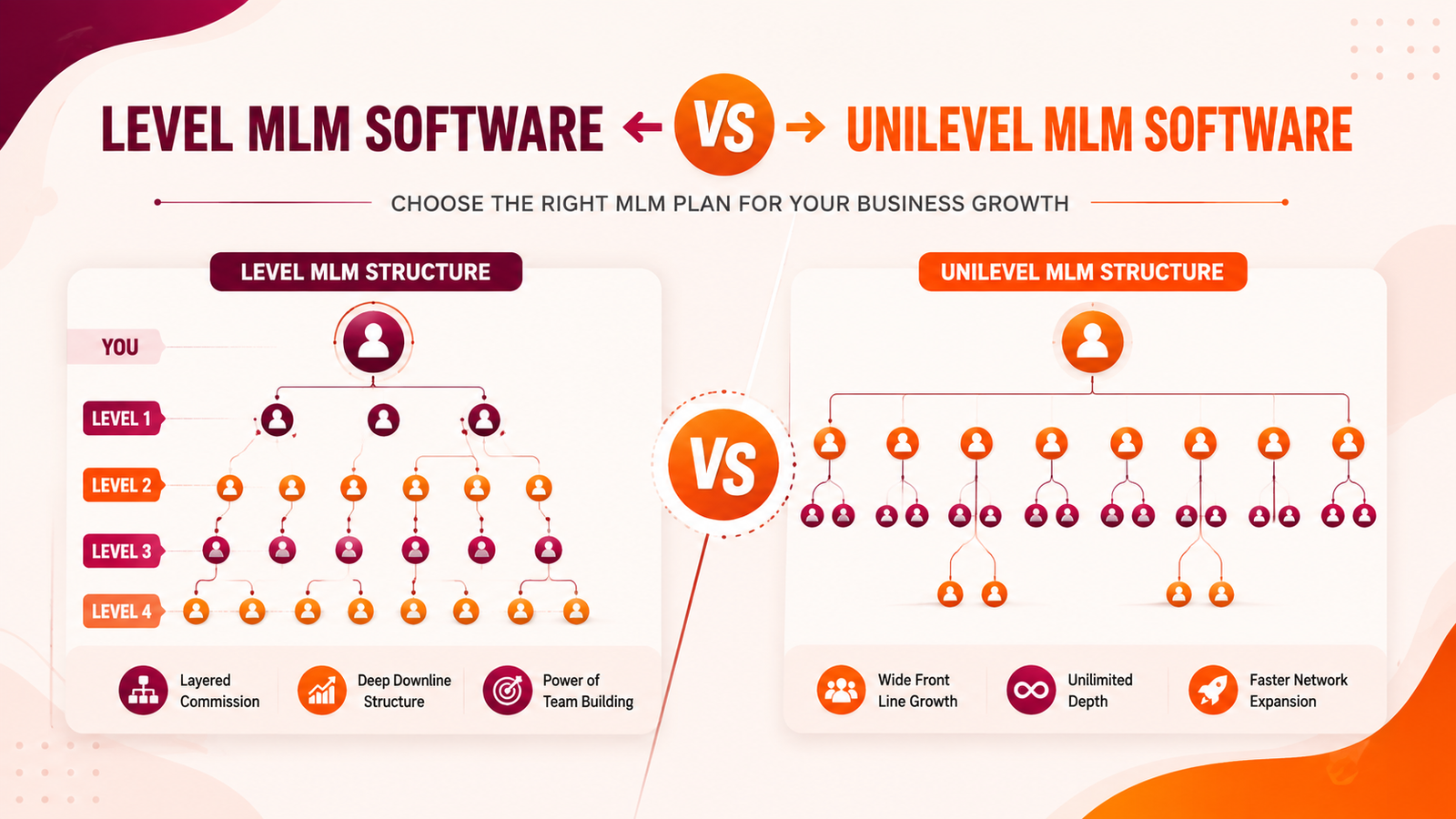
In a level-based network, every member who joins directly under a distributor sits at Level 1. Members recruited by those Level 1 members become Level 2, and so on, going deeper into the network. Businesses using this model typically configure level-wise commission percentages, meaning a distributor might earn one percentage from Level 1 activity, a different percentage from Level 2, and progressively adjusted rates as the levels go deeper.
Because payouts depend on precise level tracking, automation becomes essential. Manually calculating who sits where, and how much they’re owed, becomes unmanageable once a network grows beyond a handful of members. This is where genealogy tracking and downline visualization tools built into Level MLM Software matter they let both admins and distributors see exactly how the network is structured and how earnings flow through it.
Here’s a simple way to picture it: imagine a distributor named Distributor A. Three people join directly under A that’s Level 1. Each of those three brings in two more people each that’s Level 2, six members. If those six each bring in one person, that’s Level 3, six more members. The software calculates commission separately for each of these layers based on rules the company defines, rather than treating the whole downline as one flat group.
What Is Unilevel MLM Software?
Unilevel MLM Software takes a different approach to the network’s shape, even though it also organizes distributors across multiple levels.
The defining feature of Unilevel is unlimited first-level recruitment. A distributor isn’t restricted in how many people they can personally sponsor everyone they bring in sits directly on their frontline, no matter how many that turns out to be. Beneath that first level, the structure still extends downward through multiple levels, and commissions can be configured across each of those levels, similar in principle to level-based calculation but starting from a much wider base.
This model gives distributors and admins a straightforward way to visualize growth: a wide frontline with layers building underneath it. Downline visibility tends to be intuitive, since new distributors immediately understand that everyone they personally recruit is on their team, without needing to grasp positional placement rules. Commission configuration remains flexible on the backend companies can still define how many levels pay out and at what percentage but the recruitment mechanic itself stays open-ended.
For businesses and distributor dashboards, this often translates into simpler onboarding conversations. New distributors don’t need to be walked through complex placement logic; they just need to understand that direct recruits build their team.
Level MLM Software vs Unilevel Key Differences
Rather than a table, here’s how the two structures compare across the factors that matter most:
- Network structure: Level MLM organizes members strictly by depth from the sponsor, while Unilevel organizes members with an emphasis on frontline width plus depth beneath each recruit.
- First-level recruitment: Level MLM structures sometimes apply placement or width restrictions depending on company rules, whereas Unilevel allows unlimited direct recruits.
- Width: Unilevel is generally wider at the top level by design; Level MLM’s width depends entirely on how the company configures level rules.
- Depth: Both models can extend to multiple levels, but Level MLM is often used specifically because a business wants very precise control over how deep commissions are paid.
- Commission method: Both use level-based payout logic, but Level MLM tends to apply more granular, level-specific percentage rules, while Unilevel often uses a more standardized percentage curve across levels.
- Recruitment flexibility: Unilevel offers more open recruitment flexibility; Level MLM can involve more structured rules depending on the business’s compensation plan.
- Downline management: Level MLM downline views emphasize level segmentation; Unilevel downline views emphasize frontline size alongside depth.
- Commission configuration: Both require configurable, automated calculation engines the difference lies in how rules are structured rather than whether they’re customizable.
- Software requirements: Both need strong genealogy tracking and real-time commission engines, though Level MLM setups sometimes require more detailed level-rule configuration screens.
- Best business fit: Level MLM often suits companies wanting tightly controlled, level-specific compensation logic. Unilevel often suits companies prioritizing wide-scale recruitment and simpler distributor onboarding.
How Commission Calculation Differs
To understand the practical difference, consider this hypothetical scenario. These percentages are purely illustrative actual compensation depends entirely on a company’s own plan.
Say a distributor, we’ll call her Distributor R, has a downline generating business volume. In a Level MLM setup, the company might configure Level 1 commissions at 10%, Level 2 at 6%, Level 3 at 4%, and Level 4 at 2%. If Level 1 generates ₹50,000 in business volume, Level 2 generates ₹80,000, Level 3 generates ₹1,20,000, and Level 4 generates ₹1,50,000, Distributor R’s commission would be calculated separately at each level according to those percentages, then summed into a total payout.
In a Unilevel setup, the same layered percentage logic could apply, but because the frontline itself is unrestricted, Level 1 business volume is often significantly larger since more people can be sponsored directly. The calculation logic is similar level-by-level percentage application but the volume distribution across levels tends to look different because of how recruitment happens.
The key takeaway isn’t the specific numbers it’s that both models rely on automated, rule-based commission calculation, and the software has to handle that logic accurately and transparently for both admins and distributors.
Level MLM vs Unilevel Which Structure Offers More Flexibility?
Flexibility isn’t really about which model is inherently more adaptable it’s about whether the software can be configured to match the company’s actual compensation rules.
Both structures can support rank-based rules, additional bonuses, and customized level percentages if the software is built to allow it. Where differences show up is in how the base recruitment logic behaves: Unilevel’s unrestricted frontline naturally supports businesses that want broad network expansion without placement constraints, while Level MLM’s structured depth logic naturally supports businesses that want more granular control over how earnings are distributed level by level.
The software itself should never force a business into a rigid mold. Instead, it should be built to accommodate the company’s specific compensation strategy, whether that leans toward wide recruitment, deep structured payouts, or a hybrid of both.
Advantages of Level MLM Software
- Structured commission management that ties payouts directly to defined levels
- Clear level-based organization, making it easier to audit how earnings are distributed
- Configurable payout rules that can be adjusted per level as business needs change
- Automated calculations, removing manual errors from complex level-based payouts
- Transparent genealogy tracking, so distributors can see exactly where they and their downline stand
- Scalable network management as the business grows across more levels
- Performance monitoring tools that help identify which levels are driving the most volume
Advantages of Unilevel MLM Software
- Unlimited frontline recruitment, removing artificial caps on direct sponsorship
- Simple network visualization that’s easy for new distributors to understand
- Straightforward commission logic built around level-based percentages
- Flexible team expansion without placement restrictions
- Easy distributor understanding, which can shorten onboarding time
- Multi-level commission management that still rewards depth, not just width
- Automated reporting that gives admins clear visibility into performance across the network
Which MLM Business Should Choose Level MLM?
A Level structure tends to make sense for businesses that want clearly defined earning levels tied to specific qualification criteria. If your company wants granular control over how much is paid at each depth rewarding early levels differently from deeper ones based on strategic priorities Level MLM software provides that level of configurability.
It’s also a reasonable fit for organizations with specific rank or qualification rules tied to level performance, where detailed control over commission depth is a business requirement rather than a nice-to-have. This doesn’t mean every business with layered goals needs a Level structure it depends on how central that granularity is to the compensation strategy.
Which MLM Business Should Choose Unilevel?
Unilevel tends to suit businesses focused on wide frontline recruitment, particularly product-oriented MLM models where personal sales and broad distributor networks matter more than tightly controlled depth rules. Companies that want a comparatively simple structure one that’s easy to explain during recruitment conversations often gravitate toward Unilevel.
It also works well for organizations that still want configurable multi-level commissions but prioritize straightforward onboarding and network visualization over granular level-specific rule-setting.
What Should You Look for in MLM Software?
Regardless of which structure you choose, certain features matter for any MLM software investment:
- Custom compensation plan configuration because your plan should shape the software, not the other way around
- Genealogy tree visualization essential for both admins and distributors to understand network positioning
- Real-time commission calculation delays in payout visibility create distributor frustration
- E-wallet management for handling distributor balances and withdrawals securely
- Payout management structured, auditable processes for releasing commissions
- Rank and achievement management to support qualification-based incentives
- Member dashboard giving distributors self-service visibility into their performance
- Admin dashboard centralized oversight of network activity and commission flow
- Sales and order tracking connecting compensation directly to actual business volume
- Reports and analytics for spotting trends and making informed business decisions
- Payment gateway integration for smooth, secure financial transactions
- Mobile responsiveness since distributors increasingly manage their business from phones
- Security and access controls protecting sensitive financial and personal data
- Scalability so the software grows with the network instead of becoming a bottleneck
- API/integration support for connecting with other business tools as needs evolve
How MLM Engine Can Support Your Compensation Plan
MLM Engine is built to support businesses navigating exactly this kind of decision. Rather than pushing companies toward one fixed structure, MLM Engine focuses on compensation plan management that can be configured around the business’s actual rules, whether that means Level, Unilevel, or a hybrid approach.
Through MLM Engine, businesses can manage distributor networks, track genealogy in real time, automate commission calculations across levels, handle e-wallet balances, manage rank progression, and generate reports that give clear visibility into how the business is performing. Admin controls allow oversight of the entire network, while payment integrations keep financial operations secure and streamlined.
MLM Engine doesn’t promise guaranteed profits or claim to be the only solution on the market it’s positioned as a technology platform that helps businesses automate and manage the compensation structure they’ve already decided fits their goals.
Level MLM Software vs Unilevel How to Make the Right Choice
Before selecting software, it helps to work through a few practical questions:
- How many direct members should one distributor realistically be able to sponsor?
- How many commission levels does the compensation plan require?
- Is the business primarily focused on width, depth, or a balance of both?
- How complex are the commission rules the company wants to implement?
- Are rank-based commissions part of the plan?
- Does the company need additional bonus structures beyond level-based payouts?
- How much customization will the software realistically need to support?
- What reporting capabilities does the admin team require?
- How will the compensation plan need to scale as the distributor network grows?
The most important step here is finalizing your compensation rules before choosing software not the other way around. Software should be selected to fit the plan, not force the plan to fit the software’s limitations.
Conclusion
The comparison between Level MLM Software vs Unilevel ultimately comes down to how a business wants its network to grow and how it wants to reward that growth. Level MLM offers structured, depth-focused control over commissions, while Unilevel offers wide-open frontline recruitment paired with multi-level payout logic. Neither model is universally better the right fit depends on your compensation strategy, network structure, commission rules, growth objectives, and how much customization your business needs.
MLM Engine is built to accommodate either approach, giving businesses the flexibility to configure their software around the compensation model they’ve actually chosen rather than adapting their plan to fit rigid software limitations.
Contact MLM Engine
Email: mlmenginesoftware@gmail.com
Phone: +91 90220 51223
Website: https://mlmengine.com/
WhatsApp Channel: https://whatsapp.com/channel/0029Vaj8FP577qVKIi7ooC1d
Looking for flexible MLM software for your compensation plan? Connect with MLM Engine to discuss your requirements and explore a suitable solution.