MLM Software Kharadi: Building a Stronger Digital Foundation for Direct Selling
In-House vs Ready-Made MLM: Which Delivers Better ROI? Generation vs Repurchase MLM: Which Model Fits Your Business? Choosing a compensation plan is one of those

Introduction
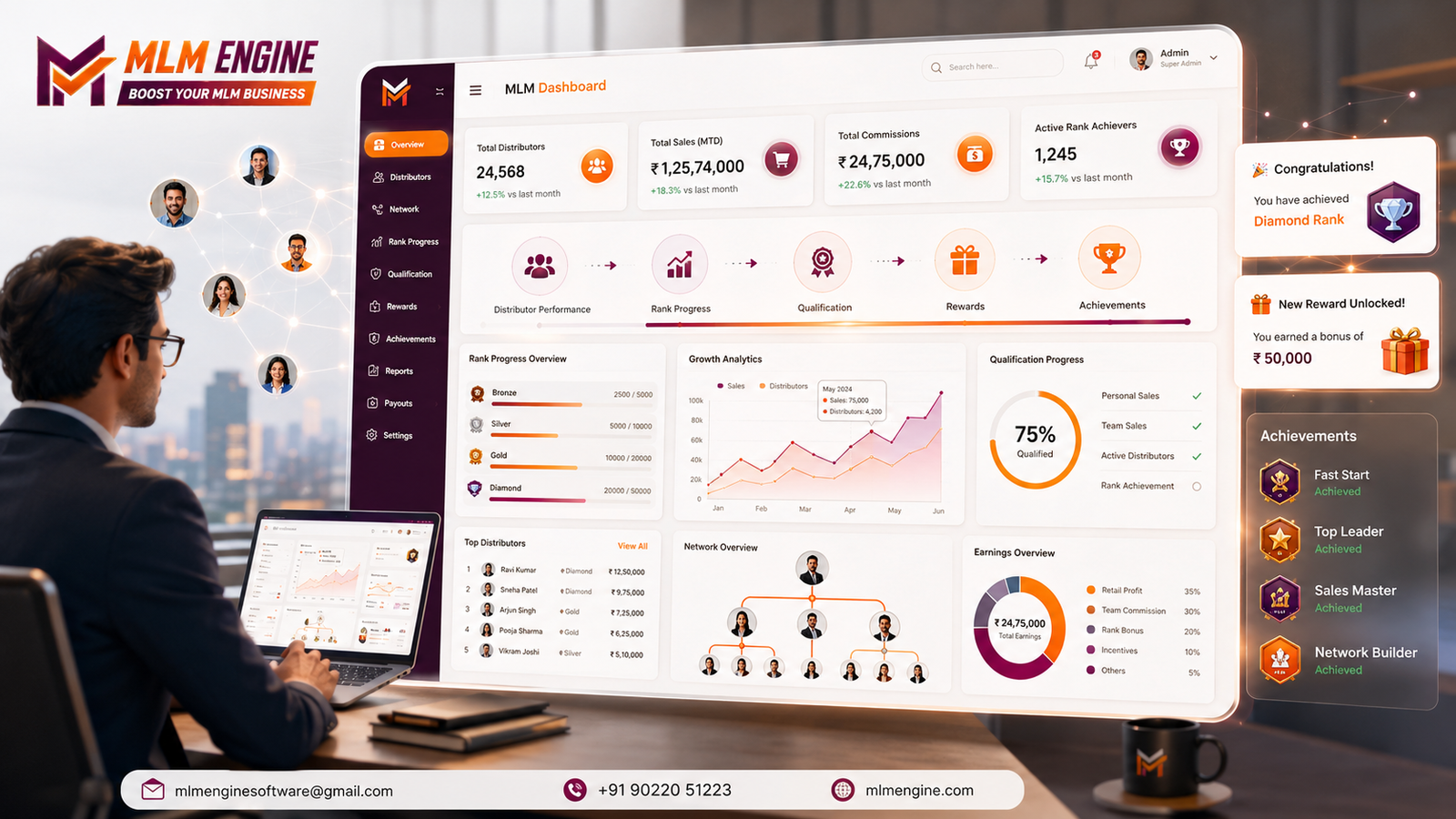
Every growing MLM company eventually runs into the same problem commission payouts alone stop being enough to keep a network motivated. Distributors want to see where they stand, what they’re working toward and what happens once they get there. This is exactly where Rank & Reward Management in MLM Software becomes essential. It gives a business a structured way to track distributor progress, recognize achievement and distribute rewards in a way that feels fair, transparent, and consistent.
A basic commission structure tells a distributor how much they earned. It doesn’t tell them how close they are to their next milestone, or what recognition awaits them once they reach it. Rank and reward systems fill that gap. They turn a distributor’s daily effort into a visible journey, with checkpoints, incentives, and recognition built along the way. For network marketing companies trying to keep their teams engaged over the long term, this structure often makes the difference between a distributor who stays active for a few months and one who builds a career within the business.
At its core, rank and reward management is the system a company uses to define distributor levels, decide what qualifies someone to move up, and determine what they receive when they do. Rather than manually reviewing performance data every cycle, the software handles this automatically based on rules the company sets in advance.
A distributor rank is simply a title or level that reflects a person’s standing in the network something like “Team Leader” or “Director.” Rank qualification criteria are the specific conditions a distributor must meet to hold that rank, which could include personal sales volume, team size, or group performance over a set period.
Achievement milestones mark smaller wins along the way, even before someone qualifies for a full rank change. Reward eligibility determines who actually receives a bonus, gift, or recognition once conditions are met, while performance-based recognition ensures the system rewards real, measurable activity rather than tenure alone.
Automated rank upgrades mean the software checks distributor performance against the rules and updates their rank without manual intervention, and reward tracking keeps a running record of what was earned, when and why useful for both the distributor and the company’s own audit trail.
For example, a distributor who consistently hits their personal volume target for three consecutive months might automatically qualify for the next rank, triggering a notification and reward allocation without an administrator needing to check spreadsheets or approve it manually every time.
A well-structured rank system does more than assign titles. It gives distributors something concrete to work toward, which changes how they approach their daily activity.
It motivates distributors by turning long-term goals into a series of achievable steps rather than one distant target. It creates measurable goals, since qualification criteria are usually based on clear numbers like sales volume or team growth. It recognizes high performers in a visible way, which tends to encourage others to work toward the same recognition. It improves distributor engagement, because people are more likely to stay active when they can track their own progress. It encourages consistent sales activity, since many rank structures reward steady performance over time rather than one-off spikes. And it helps build a performance-driven network where advancement is tied to effort and results rather than informal favoritism.
It’s worth being clear that rank management is a tool for organizing performance and recognition it doesn’t guarantee income or business growth on its own. What it does is make performance visible and consistent, which many MLM businesses find valuable regardless of their specific compensation plan.
Reward management typically follows a defined sequence, even though the exact rules vary by company: Performance Tracking → Rank Qualification → Eligibility Verification → Reward Approval → Reward Allocation → Distributor Notification.
Performance tracking is the ongoing process of recording a distributor’s sales, referrals and team activity as it happens. Rank qualification is the point where the software checks that recorded performance against the criteria set for each rank. Eligibility verification confirms that the distributor genuinely meets all conditions not just one metric in isolation before anything is finalized.
Reward approval is often where administrators retain oversight, especially for higher-value rewards, even in an otherwise automated system. Reward allocation is the actual step of crediting a bonus, badge or incentive to the distributor’s account. Finally, distributor notification closes the loop by informing the distributor of their new rank or reward, which matters more than it might seem recognition that isn’t communicated clearly tends to lose its motivational value.
Most MLM businesses structure their ranks in a progression, though the specific names and requirements vary by company. A common pattern might look like: Starter Rank, the entry point for new distributors Associate Rank, awarded after some initial activity or sales Team Leader, often tied to early team-building milestones; Senior Leader, typically requiring sustained personal and team performance. Manager, usually involving oversight of a larger or more established team. Executive, often reserved for consistently high performers; Director, a senior leadership rank tied to significant team growth and Elite Rank, frequently the top tier reserved for top-performing leaders.
These names and their exact qualification requirements are entirely customizable and should be built around the company’s own compensation plan rather than adopted as a fixed standard.
Performance Rewards are tied directly to measurable sales or activity targets over a given period. Rank Achievement Rewards are given specifically when a distributor moves up to a new rank, marking that transition. Leadership Rewards recognize distributors who build and support successful teams, rather than individual sales alone. Milestone Rewards mark smaller but meaningful achievements along the way, keeping motivation steady between major rank changes. Recognition Rewards may not always carry monetary value things like badges or public acknowledgment can still matter to distributors. Target-Based Incentives are set around specific short-term goals, often used during campaigns or promotional periods. Team Achievement Rewards recognize the collective performance of a group rather than any single distributor. Special Campaign Rewards are configured for limited-time promotions or company initiatives outside the standard reward structure.
The right mix of rewards depends heavily on the company’s business model, target audience, and the regulatory environment it operates in what works for one MLM business may not suit another.
Companies that still track ranks and rewards manually tend to run into the same recurring issues. Rank tracking done by hand relies on someone regularly reviewing sales data and cross-checking it against qualification rules, which becomes harder to sustain as the network grows. Checking qualification manually is genuinely time-consuming, and it’s easy for small errors to slip through when the process depends on spreadsheets rather than defined rules.
Reward calculation done manually is more prone to mistakes, particularly when a company runs multiple reward types at once. Reporting tends to be limited, often summarized only periodically rather than available in real time. Distributors themselves usually have poor visibility into their own progress under a manual system, which can quietly reduce motivation even when the underlying compensation plan is generous.
MLM software changes each of these points. Rank tracking becomes automated and consistent. Qualification checking follows rule-based logic rather than manual judgment calls, and reward calculation is handled by the system itself, reducing the chance of error. Reporting becomes available through real-time dashboards, giving administrators an up-to-date view without waiting for a periodic review. Distributors gain better visibility into their own standing, and the entire structure becomes considerably easier to scale as the network expands.
Software-based rank qualification generally works by evaluating several performance factors together rather than relying on a single number. A simplified way to think about it: Sales Activity plus Personal Performance plus Team Performance plus Required Volume equals Rank Eligibility.
The system checks each of these components against the rules configured for a given rank, and only when all required conditions are satisfied does a distributor become eligible for advancement. The exact formula, weighting, and thresholds depend entirely on the company’s own compensation plan there’s no universal standard here and that flexibility is part of what makes configurable software useful.
For administrators, the practical value of organized rank and reward management often comes down to time saved and errors avoided. MLM Engine can help businesses bring this structure together through centralized software management, giving administrators a single place to configure, monitor, and adjust rank and reward rules as the business evolves.
Some of the benefits administrators typically see include reduced administrative work, since less time is spent manually reviewing performance data or calculating rewards; better performance visibility through a clearer, real-time view into how individuals and teams are performing; centralized rank configuration, with all rank rules and criteria managed from one place instead of scattered spreadsheets; automated qualification tracking, where the system checks eligibility continuously rather than during periodic manual reviews improved reward management, with rewards allocated consistently based on configured rules transparent reporting, offering clear records that help with audits, disputes, or performance reviews and scalable network management, a structure that continues to function smoothly as the distributor base grows.
These capabilities are generally available as configurable modules depending on the specific plan a business selects, rather than a fixed one-size-fits-all package.
Consider a fictional distributor, referred to here simply as a new team member, who joins at the Starter Rank. Over the following months, they consistently meet their personal sales volume target and begin recruiting a small team of their own.
Once their personal performance and early team activity meet the qualification rules configured for the Associate Rank, the software automatically verifies this and updates their status. As their team grows and begins contributing measurable group volume, they move closer to qualifying for Team Leader status a transition that, in this scenario, also unlocks a leadership-tier reward configured by the company.
This kind of progression illustrates how automated qualification tracking removes the guesswork from advancement. It doesn’t promise a specific income outcome actual results depend entirely on individual effort, market conditions, and the company’s own compensation structure but it does show how a distributor’s progress can be tracked and recognized in a consistent, rule-based way.
Not all MLM software handles rank and reward management the same way, so it’s worth being deliberate about what a business actually needs.
Flexible Rank Configuration matters because every compensation plan structures its ranks differently, and rigid systems tend to force awkward workarounds. Custom Qualification Rules should allow a business to define exactly what determines advancement, rather than accepting a generic template. Reliable Calculations are non-negotiable reward and rank errors quickly damage distributor trust.
Detailed Reporting helps administrators actually understand what’s happening across the network, not just track totals. Admin Controls should allow for manual oversight where needed, particularly for higher-value rewards. Distributor Dashboards give distributors visibility into their own progress, which supports engagement on its own.
Scalability ensures the system continues to work as the network grows from dozens to thousands of distributors. Security protects sensitive performance and financial data. Integration Capabilities matter if the rank and reward system needs to connect with other business tools. Mobile-Friendly Access lets distributors check their status on the go, and Easy Configuration means administrators aren’t dependent on developers every time a rule needs adjusting.
Even well-intentioned MLM businesses run into avoidable problems when setting up their rank and reward systems.
Creating unclear rank criteria leaves distributors confused about what’s actually required to advance, which tends to reduce motivation rather than build it. Making qualification rules unnecessarily complicated has a similar effect if distributors can’t easily understand how they’re being measured, the system stops functioning as a motivator.
Failing to communicate reward conditions clearly is another common issue; a reward that distributors don’t fully understand rarely has the intended impact. Depending entirely on spreadsheets becomes increasingly risky as a network grows, since manual tracking is where most calculation errors originate.
Not maintaining reward history creates problems down the line, particularly when disputes arise about what was earned and when. Using inconsistent qualification rules across different periods or teams undermines trust in the system as a whole. And ignoring reporting and audit requirements can create compliance headaches that are far easier to avoid than to fix after the fact.
The practical fix for most of these issues is the same: define rules clearly, communicate them consistently, and rely on a system that applies them the same way every time.
As an MLM network grows from a few dozen distributors to several hundred or more, spreadsheet-based tracking becomes noticeably harder to sustain. What worked for a small team quickly turns into a bottleneck once performance data, qualification checks, and reward calculations all need to happen simultaneously across a larger base.
Centralized software helps by keeping performance data, rank rules, and reward configurations in one connected system rather than spread across disconnected files. This doesn’t just save administrative time it also reduces the kind of small inconsistencies that erode distributor trust over time. For growing MLM businesses, automation isn’t about replacing human oversight; it’s about making sure that oversight is supported by accurate, real-time data rather than periodic manual checks.
Organized Rank & Reward Management in MLM Software gives businesses a structured, transparent way to track distributor performance and recognize achievement without relying on manual reviews or scattered spreadsheets. From custom rank configuration to automated qualification tracking and detailed reporting, the right system makes distributor progress easier to monitor and rewards easier to manage fairly and consistently.
MLM Engine offers this kind of centralized rank and reward management as part of its broader MLM software platform, built to adapt to different compensation plans and business needs. If your MLM business is looking to bring more structure and transparency to how distributors are recognized and rewarded, it’s worth exploring what MLM Engine can offer.
Email: mlmenginesoftware@gmail.com
Phone: +91 90220 51223
Website: https://mlmengine.com/
WhatsApp Channel: https://whatsapp.com/channel/0029Vaj8FP577qVKIi7ooC1d
In-House vs Ready-Made MLM: Which Delivers Better ROI? Generation vs Repurchase MLM: Which Model Fits Your Business? Choosing a compensation plan is one of those
In-House vs Ready-Made MLM: Which Delivers Better ROI? Generation vs Repurchase MLM: Which Model Fits Your Business? Choosing a compensation plan is one of those
In-House vs Ready-Made MLM: Which Delivers Better ROI? Generation vs Repurchase MLM: Which Model Fits Your Business? Choosing a compensation plan is one of those
Generation vs Repurchase MLM: Which Model Fits Your Business? Choosing a compensation plan is one of those decisions that quietly shapes the entire future of
Generation vs Repurchase MLM: Which Model Fits Your Business? Choosing a compensation plan is one of those decisions that quietly shapes the entire future of
Generation vs Repurchase MLM: Which Model Fits Your Business? Choosing a compensation plan is one of those decisions that quietly shapes the entire future of
MLM Software for Pimpri-Chinchwad Businesses: Features That Matter Pimpri-Chinchwad has grown into one of Maharashtra’s most active business and industrial hubs, and that growth is