MLM Software in Guwahati: A Complete Guide for Network Marketing Businesses
How Matrix MLM Software in Surat Helps Businesses Manage Distributor Networks Efficiently A distributor business rarely struggles on day one. The trouble starts when a

Running a growing network marketing business involves more than enrolling distributors and processing orders. Business owners must maintain accurate distributor records, monitor team structures, track sales volume, calculate commissions, and ensure that business activities remain organized. For direct selling companies operating in Guwahati, these responsibilities can become increasingly difficult as distributor networks expand.
Initially, maintaining records through spreadsheets or manual reporting may seem manageable. However, when hundreds or thousands of distributors join the network, tracking their positions, understanding team performance, and verifying commission calculations can consume considerable administrative time.
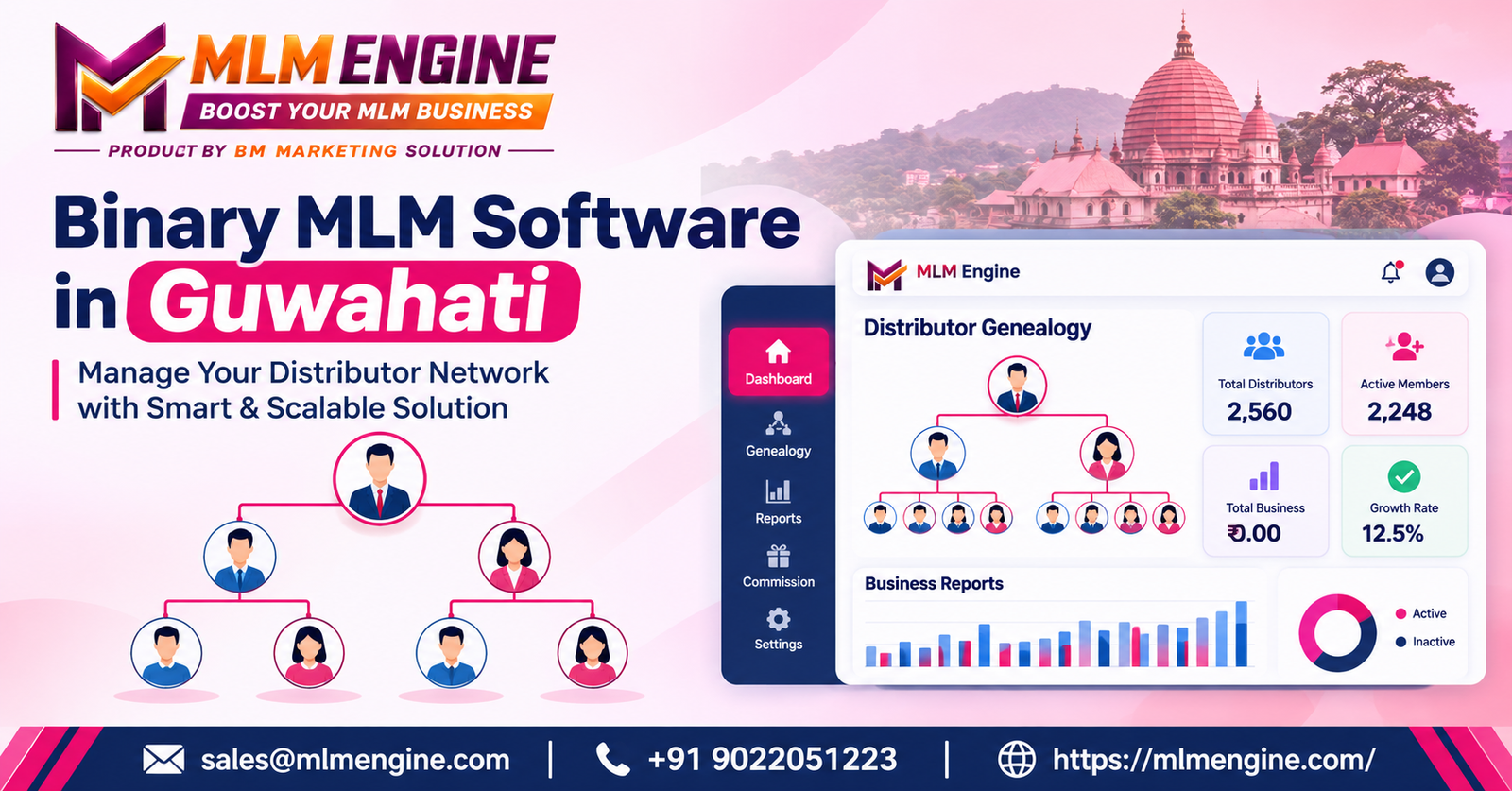
Binary MLM software in Guwahati provides a technology-based approach to organizing these activities. It helps businesses manage distributor registrations, visualize binary genealogy structures, monitor business volume, and automate calculations according to predefined compensation rules.
For companies looking to establish a more structured operational environment, the right software can simplify everyday administration while making business information easier to access and review.
A binary MLM plan is a network marketing compensation structure in which each distributor typically has two primary placement positions, commonly known as the left leg and right leg.
Each distributor can build two primary teams beneath their position. Additional distributors may be placed within either team according to the company’s placement rules.
For example, a distributor may have a left team containing 120 members and a right team containing 95 members. Sales activity generated by distributors across both teams may contribute to the business volume tracked under the compensation plan.
Depending on the compensation structure, commissions may be calculated using eligible business volume from both legs, matching volume, specified payout percentages, caps, carry-forward rules, or other configured conditions.
The exact calculation depends on the company’s compensation structure.
A Binary compensation plan therefore requires accurate placement records, transaction information, and clearly defined calculation rules. Without reliable records, administrators may struggle to verify team activity or explain commission statements.
As a distributor network expands, operational responsibilities increase. Businesses that rely heavily on manual processes may experience several challenges.
Distributor information may include registration details, sponsor relationships, placement positions, contact information, and account status. Maintaining these records across multiple spreadsheets can create inconsistencies.
A centralized Distributor management system helps administrators maintain structured records and retrieve relevant information more easily.
Understanding the structure of a binary network becomes difficult when distributors are spread across multiple levels.
Without a clear genealogy view, administrators may spend additional time identifying reporting relationships, checking placements, or reviewing team structures.
Business volume can originate from different distributors, orders, and transactions. Maintaining an accurate view of eligible volume is important for evaluating compensation eligibility and operational activity.
Manual commission calculations can become complicated when a plan includes multiple conditions, payout limits, matching requirements, or carry-forward rules.
A properly configured MLM commission calculation system can apply these rules consistently, subject to correct configuration and transaction data.
Distributors and administrators often need different information. Business owners may require consolidated reports, while distributors may want to review personal orders, team activity, and commission statements.
A structured reporting system makes relevant information easier to access without depending entirely on manual requests.
A suitable Binary network management software solution can centralize important business activities within a single platform.
Administrators can manage distributor registration information, sponsor details, placement information, and account records.
Depending on the platform, distributors may also receive individual login credentials to access their business dashboards.
A Distributor genealogy tree displays the structure of the network, including the primary left and right teams and their downstream members.
This visual representation helps administrators understand placement relationships without manually reviewing multiple records.
The system may display team membership, eligible business volume, and relevant activity for each leg.
This makes it easier to understand how business activity is distributed across the network.
A configured system can calculate commissions using approved compensation rules.
Depending on the plan, these rules may include eligible business volume from both legs, matching volume requirements, commission percentages, payout limits, carry-forward conditions, and applicable eligibility requirements.
The system should be tested against sample transactions before production use to verify that calculations match the company’s approved plan.
A distributor dashboard may provide access to personal account information, team structure, business activity, orders, and commission statements.
The availability of individual reports depends on the software configuration and user permissions.
Administrators may require reports covering registrations, orders, team activity, business volume, commissions, and account status.
These reports support routine monitoring and help identify records requiring further review.
Some platforms include order management and repeat-purchase tracking.
When integrated with the compensation plan, eligible transactions can contribute to business volume according to configured rules.
Role-based permissions help restrict access to sensitive business information.
For example, administrators may manage network-wide records, while distributors can access only the information permitted for their accounts.
Selecting software involves more than checking a feature list. Businesses should evaluate how well the system supports their actual operational requirements.
Flexible Compensation Plan Configuration: Supports business-specific binary compensation rules.
Commission Calculation Engine: Applies defined payout conditions consistently.
Genealogy Visualization: Makes network relationships easier to understand.
Distributor Dashboard: Provides convenient access to relevant account information.
Administrative Reporting: Supports operational monitoring and record verification.
Mobile-Friendly Interface: Helps users access information on different devices.
Data Security: Protects distributor and transaction information.
Integration Capabilities: Supports connections with relevant payment, order, or business systems.
Scalability: Helps accommodate additional distributors and transactions.
Businesses should also check whether the software supports plan modifications, historical reports, testing environments, and implementation assistance.
A system that is easy to operate and properly configured can be more useful than a platform offering numerous features that the business does not actually need.
A well-organized software system can make information easier to manage for both business administrators and individual distributors.
For administrators, a centralized platform can improve visibility into business operations.
Practical benefits include maintaining distributor records in one place, reviewing binary placement structures, monitoring team business volume, accessing transaction and commission reports, reducing repetitive administrative work, identifying inconsistencies requiring verification, and managing distributor access and account information.
These capabilities support MLM business automation by reducing dependence on disconnected records and repetitive manual processes.
Distributors also benefit when business information is accessible through an individual dashboard.
Depending on the software configuration, distributors may be able to view their binary genealogy tree, understand their left and right team structures, review eligible business activity, access personal order records, check commission statements, monitor account information, and access available business reports.
This visibility can help distributors understand their business activity and communicate more effectively with their teams.
Before selecting a platform, business owners should evaluate their requirements carefully.
The following checklist can help:
Understand your compensation plan: Document placement rules, commission conditions, payout limits, and carry-forward requirements.
Identify essential features: Decide which distributor, order, reporting, and commission management capabilities are necessary.
Check customization requirements: Confirm whether the software supports your specific binary plan.
Evaluate usability: Review the administrator panel and distributor dashboard.
Review security: Understand user permissions, data protection, backups, and account security.
Understand implementation: Ask about configuration, data migration, testing, and training.
Confirm reporting needs: Check whether the system provides the reports required by administrators and distributors.
Review integrations: Evaluate payment gateways, websites, ordering systems, and other relevant integrations.
Consider scalability: Ensure the platform can accommodate your expected network size and transaction volume.
Verify support: Understand the technical support process, maintenance arrangements, and upgrade requirements.
Businesses searching for Network marketing software in Guwahati should compare providers based on these practical requirements rather than choosing solely on price or the number of advertised features.
A demonstration using real business scenarios can help determine whether the platform is suitable for the company’s operations.
MLM Engine provides software solutions designed to support network marketing business management.
Businesses evaluating Binary MLM software in Guwahati can explore relevant software capabilities and discuss their distributor management, compensation plan, reporting, and operational requirements.
The evaluation process can include understanding the existing binary structure, identifying required features, reviewing dashboard functionality, and discussing customization or integration needs.
Rather than selecting software based only on a general feature list, businesses should consider how the proposed system aligns with their actual working processes.
A properly configured solution should help maintain structured records, organize distributor networks and support consistent business administration.
Managing a binary network requires accurate distributor records, organized team structures, reliable transaction information, and clearly defined commission calculations. As a direct selling business expands, maintaining these activities manually can become increasingly difficult.
Binary MLM software in Guwahati offers a structured approach to managing distributor networks, monitoring left and right teams, organizing business records, and supporting compensation calculations.
For businesses evaluating their technology requirements, MLM Engine can help explore relevant software capabilities and discuss requirements for binary network management.
If your business is planning to implement or improve a binary network management system, connect with MLM Engine to discuss your business structure and software requirements.
Contact MLM Engine
Email: sales@mlmengine.com
Phone: +91 9022051223
Website: https://mlmengine.com/
WhatsApp Channel: https://whatsapp.com/channel/0029Vaj8FP577qVKIi7ooC1d
How Matrix MLM Software in Surat Helps Businesses Manage Distributor Networks Efficiently A distributor business rarely struggles on day one. The trouble starts when a
How Matrix MLM Software in Surat Helps Businesses Manage Distributor Networks Efficiently A distributor business rarely struggles on day one. The trouble starts when a
Improve Business Operations with Binary MLM Software in Surat: A Complete Guide for Growing Businesses Surat has always been a city where business moves fast.
How MLM Software in Kochi Helps Businesses Manage Distributor Networks More Effectively Introduction Managing a growing distributor network requires more than maintaining a spreadsheet or
How MLM Software in Kochi Helps Businesses Manage Distributor Networks More Effectively Introduction Managing a growing distributor network requires more than maintaining a spreadsheet or
How Mobile Order Tracking Improves the Buying Experience A customer orders a storage organizer on a Thursday evening. A confirmation email arrives within seconds, complete
How Mobile Order Tracking Improves the Buying Experience A customer orders a storage organizer on a Thursday evening. A confirmation email arrives within seconds, complete
Binary MLM software in Guwahati is a business management system used by network marketing companies operating in or serving Guwahati. It helps manage distributor registrations, binary genealogy structures, team business volume, orders, and commission calculations according to the company’s configured compensation plan.
The software maintains distributor placement relationships within a binary genealogy structure. Administrators and authorized distributors can view left and right teams, examine network positions, and review relevant business activity. Available information depends on user permissions and software configuration.
Yes. A properly configured system can calculate commissions according to defined compensation rules. These may include eligible business volume, matching conditions, payout percentages, and commission limits. Businesses should validate calculations against sample transactions and approved plan documentation before processing actual payouts.
Important features include distributor registration, binary genealogy visualization, team volume tracking, commission calculation, dashboards, administrative reports, order management, security controls, and integration capabilities. Businesses should prioritize features that directly support their compensation plan and daily operational requirements.
It can be suitable for businesses that need structured distributor records, network visibility, and automated operational processes. The software should be evaluated according to the company’s network size, transaction volume, compensation rules, and future requirements. Proper implementation and ongoing maintenance remain important.
Many platforms provide distributor dashboards with genealogy trees, team information, business activity, and commission statements. Access depends on the software’s available features and permission settings. Businesses should verify which reports distributors can view before selecting a solution.
Businesses should review the provider’s experience, compensation plan configuration capabilities, software demonstration, security practices, reporting options, customization possibilities, implementation process, and support arrangements. Testing important business scenarios before implementation helps confirm whether the solution meets operational requirements.