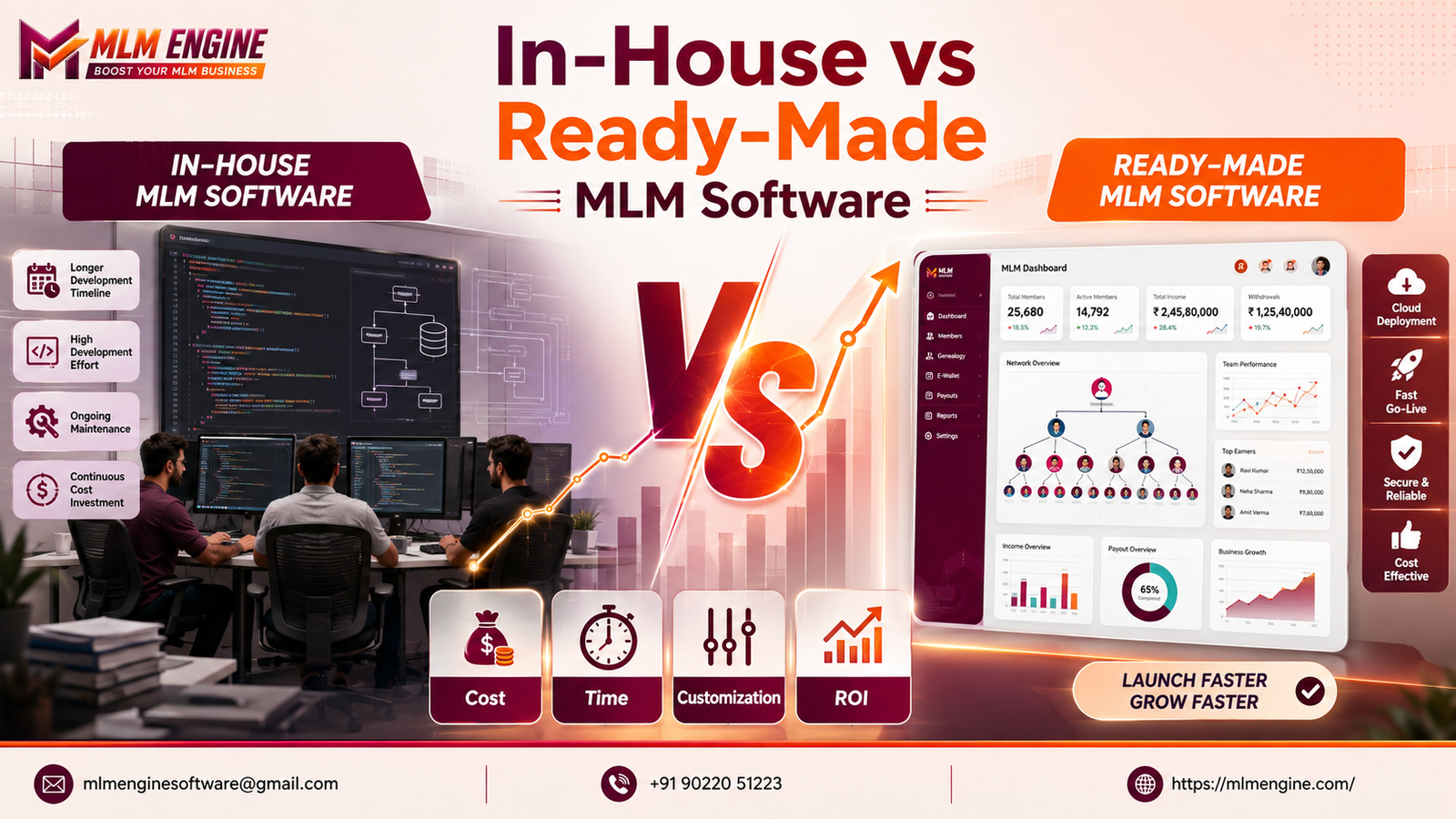
In-House vs Ready-Made MLM: Which Delivers Better ROI?
Introduction
Picture this an MLM business has just closed its funding round and is ready to build its digital backbone. The founders sit down with their tech lead, and the very first question that comes up isn’t about design or branding it’s about In-House vs Ready-Made MLM. Should they hire developers and build everything from scratch, or should they buy a solution that’s already been built, tested, and refined by others
This single decision quietly shapes almost everything that follows development cost, deployment time, scalability, maintenance workload, customization depth, security responsibility, and ultimately, long-term ROI. Get it right, and the business launches faster and scales smoothly. Get it wrong, and it can mean months of delay, budget overruns or a platform that can’t keep up with growth.
In this article, we’ll break down both paths in detail what they actually involve, what they cost over time, and how to figure out which one makes sense for your specific situation.
What Is In-House MLM Software?
In-house MLM software means building your platform from the ground up, using your own development team or a hired team working exclusively on your project.
This route typically involves:
- Custom development every feature, from compensation logic to dashboards, is coded specifically for your business.
- A dedicated development team developers, QA testers, database architects and often a project manager.
- Complete control over features nothing is locked behind someone else’s product roadmap.
- Custom business workflows the software can mirror your exact operational process instead of forcing you to adapt to a template.
- Technology and infrastructure decisions you choose the tech stack, hosting environment, and architecture.
- Full maintenance responsibility your team owns every bug fix, security patch and future upgrade.
- Longer development cycles planning, design, coding and testing all take time before anything goes live.
- Rigorous testing and security requirements since nothing is pre-built, every module needs to be tested from scratch.
The advantage is obvious: total ownership and flexibility. The limitation is just as real it demands significant time, technical expertise and sustained investment before the platform even generates revenue.
What Is Ready-Made MLM Software?
Ready-made MLM software refers to a pre-built platform that already includes the core features an MLM business needs, with configuration and customization layered on top rather than development from zero.
This typically includes:
- Pre-developed MLM features covering major compensation structures (Binary, Matrix, Unilevel, Board and others).
- Faster implementation, since the foundational architecture already exists.
- Ready-to-use dashboards for both admin and members.
- MLM plan management tools built specifically for network-based compensation.
- Member management systems covering onboarding, KYC, and hierarchy tracking.
- Commission management with automated calculation logic.
- Payment integration for common gateways and payout methods.
- Reports and analytics for tracking performance, growth, and payouts.
- Admin management tools for controlling the entire network from a central panel.
- User/member dashboards giving distributors visibility into their own network and earnings.
- Customization options to adapt branding, workflows, and specific business rules.
- Ongoing technical support and maintenance, usually handled by the provider.
A common misconception is that ready-made software is rigid. In practice, platforms like MLM Engine are built to be configurable allowing businesses to adjust compensation rules, branding, and workflows without starting development from scratch.
In-House vs Ready-Made MLM Cost Comparison
When comparing In-House vs Ready-Made MLM software, cost is usually the first factor businesses look at but it’s also the one most often misunderstood.
- Initial development cost: In-house software demands significant upfront investment in design, coding, and testing. Ready-made software involves a comparatively lower initial cost since the core platform is already built.
- Developer team: Building in-house means hiring or contracting a full development team this is an ongoing cost, not a one-time expense. Ready-made software typically doesn’t require you to maintain your own developers for core functionality.
- Infrastructure: In-house projects require you to plan and manage servers, hosting and environments from day one. Ready-made solutions often come with infrastructure guidance already built into the deployment process.
- Testing: In-house testing has to cover every feature from scratch, which takes time and resources. Ready-made platforms have generally already been tested across multiple deployments, reducing the testing burden on your side.
- Maintenance: In-house maintenance is entirely your responsibility bug fixes, patches and updates all fall on your team. Ready-made software usually includes maintenance support as part of the service.
- Security updates: With in-house software, your team must monitor and patch vulnerabilities continuously. Ready-made providers typically handle security updates as part of ongoing support.
- Feature development: Adding new features in-house means additional development cycles each time. With ready-made platforms, many features may already exist or be available as configurable add-ons.
- Deployment time: In-house development can take months before launch. Ready-made software can often be configured and deployed in a fraction of that time.
- Long-term cost: This is where the real comparison happens. In-house software may look expensive at first but could offer more control over long-term costs if managed efficiently. Ready-made software often has lower long-term costs when ongoing maintenance and feature development are factored in though this depends heavily on the provider and the customization required.
The key takeaway don’t just compare the initial price tag. The total cost of ownership development, infrastructure, maintenance, updates, and support combined is what actually determines which option is more cost-effective over time.
Development Time and Time-to-Market
Speed matters in the MLM industry. The longer it takes to launch, the longer revenue generation is delayed and the more market opportunity can slip away.
In-house development generally moves through these stages:
- Planning and requirement gathering
- UI/UX design
- Core development
- Testing and QA
- Security review
- Deployment
- Post-launch bug fixing
Each of these stages takes real time, and delays in one phase tend to cascade into the next.
Ready-made software, by comparison, usually follows a shorter path:
- Configuration of existing features
- Branding and UI customization
- Business-specific customization
- Third-party integrations
- Testing
- Deployment
Because the foundational platform already exists, ready-made solutions can significantly shorten time-to-market. For businesses that need to launch quickly and start generating revenue sooner, this speed advantage can be a decisive factor.
Customization and Flexibility
Customization is often assumed to favor in-house development automatically but that’s not always accurate.
Areas where customization typically matters most:
- MLM plan structure and compensation rules
- Commission calculation logic
- User roles and permissions
- Dashboard design and layout
- Payment gateway selection
- Reporting formats
- Notification systems
- Third-party integrations
- Business-specific workflows
In-house development offers unlimited customization in theory, since you control the entire codebase. But that flexibility comes at the cost of time and development resources for every change.
Ready-made does not automatically mean non-customizable. Many modern platforms are designed with configuration layers that allow businesses to adjust compensation plans, branding, dashboards, and workflows without touching the core code. MLM Engine, for example, is positioned around configurable MLM software allowing businesses to tailor plan structures and features to their specific requirements without building from zero.
Scalability and Performance
As an MLM network grows, the software needs to keep up more members, more transactions, more data, more complexity.
Scalability depends on:
- Growing member counts
- Increasing transaction volumes
- Database performance under load
- Server capacity and hosting setup
- API integrations with external systems
- Handling multi-level network structures efficiently
- Reporting performance as data grows
- Room for future feature expansion
Here’s an important clarification: scalability isn’t determined simply by whether software is in-house or ready-made. It depends on software architecture, hosting infrastructure, database design, coding quality and optimization. A poorly architected in-house system can struggle just as much as an unoptimized ready-made one and a well-built ready-made platform can scale just as effectively as custom code, provided the underlying infrastructure supports it.
Maintenance, Security, and Updates
Ongoing maintenance is one of the most overlooked costs in the In-House vs Ready-Made MLM decision.
Responsibilities to consider include:
- Security patches and vulnerability fixes
- Bug fixes as issues surface
- Server maintenance and uptime monitoring
- Database maintenance and optimization
- Adapting to payment gateway changes
- Handling API changes from third-party services
- Performance optimization as usage grows
- Backup systems and disaster recovery
- Data protection compliance
- Feature upgrades over time
With in-house software, all of this sits with your internal team indefinitely. With ready-made software, much of this is typically handled by the provider as part of ongoing support though the exact scope varies depending on the vendor and service agreement.
Whichever route you choose, maintenance should be factored into the actual cost of the software from day one not treated as an afterthought once the platform is live.
When Should You Choose In-House MLM Software?
In-house development tends to make more sense when:
- Your business has highly specialized requirements that off-the-shelf platforms can’t easily accommodate
- You already have a large, capable internal technical team
- You need complete technical control over the source code and architecture
- Your workflows are genuinely unique to your business model
- You have the long-term development resources to sustain the project
- You’re prepared to manage ongoing maintenance internally, indefinitely
This path suits businesses with the resources and patience for a longer build cycle in exchange for full ownership.
When Should You Choose Ready-Made MLM Software?
Ready-made software tends to be the more practical choice when:
- You need to launch quickly and can’t afford months of development time
- Your development resources are limited
- You need established, proven MLM functionality without reinventing it
- You want lower initial development complexity
- You need customization without a full development cycle
- You want to reduce the ongoing development workload on your team
- You need reliable technical support rather than managing everything internally
- You’d rather focus on running the business than building software
For businesses in this position, a configurable platform like MLM Engine offers a practical middle ground established MLM functionality with room to adapt it to specific business needs.
In-House vs Ready-Made MLM ROI Comparison
ROI isn’t just about what you spend upfront it’s about what you get back relative to the total investment over time.
Factors that shape the real ROI picture:
- Initial investment how much capital is committed before launch
- Time-to-market how soon the business can start generating revenue
- Development resources the ongoing cost of people and expertise
- Maintenance expenses the recurring cost of keeping the platform running
- Revenue launch time delays in launch directly delay revenue
- Scalability the cost of growing the platform as the business expands
- Customization the cost of adapting the software to changing needs
- Operational efficiency how much manual work the software eliminates
- Long-term ownership cost the cumulative cost across the software’s lifespan
A solution with a lower sticker price isn’t automatically the better ROI. A ready-made platform that launches three months faster could start generating revenue long before an in-house build reaches deployment and that head start often matters more than the raw price difference. Similarly, an in-house build with lower long-term maintenance costs (because it’s optimized for your exact use case) could outperform a ready-made solution over a five-year horizon. The right answer depends entirely on your specific business trajectory.
Quick Decision Guide
Here’s a simplified way to think about which option tends to fit which scenario:
- Faster launch → Ready-made
- Complete source-level control → In-house
- Lower development workload → Ready-made
- Highly specialized requirements → In-house
- Existing technical team → In-house
- Faster market entry → Ready-made
- Configurable MLM features without a full build → Ready-made/customized
- Long-term internal technology ownership → In-house
These are general tendencies, not fixed rules the right choice always depends on your specific business context.
Why Businesses Consider MLM Engine
For businesses leaning toward the ready-made or customizable route, MLM Engine is built around the core needs of MLM operations:
- MLM plan management across common compensation structures
- Member management covering onboarding and network hierarchy
- Commission management with automated calculation
- Admin dashboard for centralized network control
- Member dashboard giving distributors visibility into their earnings and network
- Reports and analytics for tracking business performance
- Payment integrations for handling transactions and payouts
- Customization to adapt the platform to specific business rules
- Scalable architecture designed to support network growth
Rather than positioning itself as a one-size-fits-all product, MLM Engine is built around the idea that ready-made doesn’t have to mean rigid businesses can get a functional platform quickly while still shaping it around their own compensation logic and branding.
Conclusion
There’s no universal winner in the In-House vs Ready-Made MLM debate the right choice depends on your budget, timeline, customization requirements, technical resources, scalability needs, maintenance capacity and long-term ROI goals.
Businesses with strong internal technical teams and highly specific requirements may find in-house development worth the investment. Businesses that need to launch quickly, manage costs carefully, and avoid the burden of ongoing in-house maintenance often find ready-made or customizable platforms deliver better overall value.
If you’re weighing this decision for your own MLM business, it’s worth exploring what a configurable, ready-made platform like MLM Engine can offer before committing to a full custom build.
Email: mlmenginesoftware@gmail.com
Phone: +91 90220 51223
Website: https://mlmengine.com/
WhatsApp Channel: https://whatsapp.com/channel/0029Vaj8FP577qVKIi7ooC1d
More Posts
MLM Software Wakad: A Practical Guide to Choosing the Right Solution for Your Business
In-House vs Ready-Made MLM: Which Delivers Better ROI? Generation vs Repurchase MLM: Which Model Fits Your Business? Choosing a compensation plan is one of those
Single Leg vs Binary MLM Software: Which Model Fits Your Business Better?
Generation vs Repurchase MLM: Which Model Fits Your Business? Choosing a compensation plan is one of those decisions that quietly shapes the entire future of
MLM Software Hinjewadi: Powering the Next Wave of Network Marketing Growth
Generation vs Repurchase MLM: Which Model Fits Your Business? Choosing a compensation plan is one of those decisions that quietly shapes the entire future of
Generation vs Repurchase MLM: Which Model Fits Your Business?
Generation vs Repurchase MLM: Which Model Fits Your Business? Choosing a compensation plan is one of those decisions that quietly shapes the entire future of
MLM Software for Pimpri-Chinchwad Businesses: Features That Matter
MLM Software for Pimpri-Chinchwad Businesses: Features That Matter Pimpri-Chinchwad has grown into one of Maharashtra’s most active business and industrial hubs, and that growth is
MLM Software Success Story: How the Right Platform Turned Operational Chaos Into Business Growth
Online Dating Portal Development & MLM Software Solution Guide Online dating has moved a long way from static profile listings and slow-loading chat rooms. Today’s
How the Right MLM Software Can Transform MLM Business Growth
Online Dating Portal Development & MLM Software Solution Guide Online dating has moved a long way from static profile listings and slow-loading chat rooms. Today’s