Investment MLM Software Baner: Features Every Business Should Know
Generation MLM Software Kharadi: A Smarter Way to Manage Multi-Level Growth Every generation-based MLM business hits the same wall eventually. What starts as a manageable

Most investment-based network businesses start small. A founder, a handful of early members, a few packages and a simple way of tracking who joined under whom. Then the network grows, and the simple way of tracking things stops working. Payments arrive at odd hours, members ask why a payout looks different from last month, and the person who built the original records is the only one who understands them.
That is usually the moment owners begin searching for Investment MLM Software Kothrud. If you are in that position, this guide is meant to slow the process down a little. Buying software for a network business is a decision you will live with for years, so it helps to know what a good platform looks like before you sit through your first sales demo.
A note before we begin: software organizes and automates your operations. It does not create income, and it cannot promise returns to anyone. Treat it as infrastructure, not as a growth guarantee.
Think of it as the operating system for your network. Members, packages, payments, commissions, wallets and reports all live in one place and follow rules you define, instead of being scattered across files and chat messages.
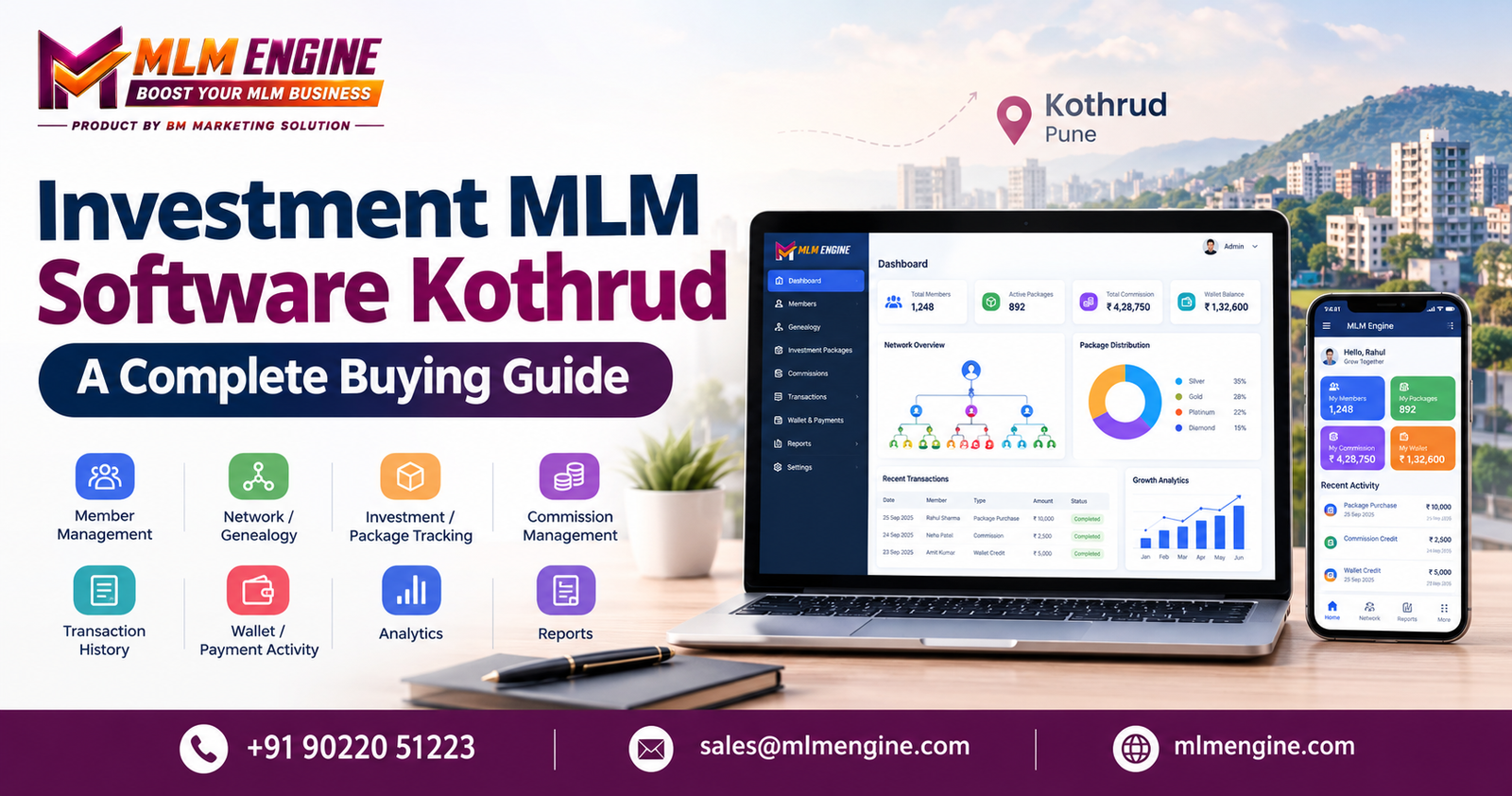
In practical terms, a solid platform handles member onboarding, tracks who sits where in the network, records what each member has purchased or invested in, calculates commissions according to your plan, keeps wallet balances, processes withdrawal requests, and produces reports for the admin team.
What it should not do is force your business into someone else’s template. Every network has its own plan logic, and the software should bend toward your model, not the reverse.
Kothrud has a mix of established professionals, small enterprises and growing local networks, and many MLM businesses here run lean teams. A lean team feels the pain of manual work faster, because the same few people handle onboarding, support, accounts and reporting.
The usual signs that it is time to move to software include commission calculations taking days instead of minutes, members raising repeated queries about balances, disagreements about who referred whom, difficulty producing a clean report when someone asks for one, and growing worry about who has access to sensitive records.
None of these problems is dramatic by itself. Together they eat time and erode trust, and trust is the one asset a network business cannot afford to lose.
Instead of a long feature list, here is how to think about the core modules and what separates a good one from a weak one.
Member and network management: The registration flow should be simple, and the network view should make relationships clear at a glance. Ask to see how it behaves with a few thousand members, not just a demo tree with ten.
Package and plan setup: Your business may offer several packages with different terms. The platform should let you configure these without rewriting code every time you tweak something.
Commission engine: This is the heart of the system. It should apply your rules consistently, keep a clear record of how each payout was calculated, and allow you to adjust the plan later without breaking history.
Wallet and transaction ledger: Every credit and debit should leave a trace. A clean ledger saves hours when a member questions a balance.
Withdrawal workflow: Requests should move through a defined review process, with status updates visible to both admin and member.
Payment gateway support: Confirm that the gateways you actually use are supported, and find out what happens if one of them has downtime.
Dashboards and reports: Admins need depth, while members need clarity. A member dashboard crowded with admin-level data usually confuses people.
Notifications: Email and SMS alerts for registrations, payments and withdrawals reduce support requests significantly.
Mobile usability: A large share of your members will open the platform on a phone. Test it on one during the demo.
Investment-linked networks handle sensitive personal and financial information, so security cannot be an afterthought. Before signing, get clear answers on how logins are protected, how admin permissions are separated, how data is backed up and how quickly it can be restored, and what the audit trail looks like when someone changes a record.
A vendor who answers these confidently and in plain language is a good sign. A vendor who deflects or only talks about features is a warning.
It is also worth remembering that investment-style models can attract regulatory attention. Software cannot make a business compliant on its own. Take proper legal and financial advice on how your model should be structured and what disclosures you owe to members.
The following statements describe what you should be able to confirm before you commit. Treat them as a checklist and do not move forward until each one is clear.
Ready-made platforms are quicker to launch and often cheaper at the start. They suit businesses whose plan matches a common structure closely. The trade-off is that unusual rules, special reports or branded member experiences can be hard to accommodate.
Custom or heavily customized platforms take longer and cost more upfront, but they fit the business precisely. They make sense when your plan has distinctive logic, when you expect to evolve it, or when integrations with other systems are important.
A middle path is also common: start with a flexible core product and customize the modules that genuinely differ from the standard. Whichever route you take, ask for the total cost across licensing, hosting, customization, support and future updates, rather than comparing headline prices only.
Choosing on price alone is the most common one. A cheap platform that cannot handle your plan, or that lacks support when something breaks, gets expensive quickly.
Another is skipping the demo or accepting a scripted one. Ask the vendor to walk through a real scenario from your business, including an awkward edge case.
Some owners also buy far more modules than they need, which makes the system harder to learn and harder to maintain. Start with what you will use in the first year and keep room to expand.
Finally, many underestimate training. The best software still fails if your admin team and members do not understand it. Ask what onboarding and documentation come with the platform.
MLM Engine builds customizable MLM software for different plan types, including investment-oriented models. The approach starts with understanding how your business really works, then configuring member management, network structure, commission logic, wallets, reports and dashboards around that. You can learn more about the platform at https://mlmengine.com/.
For anyone evaluating Investment MLM Software Kothrud, the sensible next step is a requirements conversation followed by a live demonstration. That lets you see the software handling your own rules before you commit to anything.
Picking the right platform is less about finding the longest feature list and more about finding a system that fits how your network operates, protects your members’ data and can grow with you. Take your time, insist on seeing your own scenarios in a demo, compare the full cost of ownership, and be careful about vendors who promise too much.
If you want to explore a customizable setup for your business in Kothrud or elsewhere in Pune, MLM Engine is ready to discuss your requirements.
Phone: +91 90220 51223
Email: sales@mlmengine.com
Website: mlmengine.com
Generation MLM Software Kharadi: A Smarter Way to Manage Multi-Level Growth Every generation-based MLM business hits the same wall eventually. What starts as a manageable
Generation MLM Software Kharadi: A Smarter Way to Manage Multi-Level Growth Every generation-based MLM business hits the same wall eventually. What starts as a manageable
Generation MLM Software Kharadi: A Smarter Way to Manage Multi-Level Growth Every generation-based MLM business hits the same wall eventually. What starts as a manageable
Generation MLM Software Kharadi: A Smarter Way to Manage Multi-Level Growth Every generation-based MLM business hits the same wall eventually. What starts as a manageable
Generation MLM Software Kothrud: A Practical Buying Guide A network with thirty distributors can run on a notebook and a good memory. However, a network
Simplifying Multi-Level Payout Management with Generation-Based MLM Technology in Hinjewadi As a distributor network grows past a handful of levels, tracking who earns what becomes
Simplifying Multi-Level Payout Management with Generation-Based MLM Technology in Hinjewadi As a distributor network grows past a handful of levels, tracking who earns what becomes