Direct-selling companies are increasingly relying on technology to manage distributor networks, organize business operations, and maintain accurate commission records. As businesses expand, managing registrations, sales activities, distributor relationships, and compensation calculations manually can become challenging.
For growing organizations, MLM Software in Chicago offers a technology solution to consider when looking for better ways to manage direct-selling operations. Businesses operating in Chicago, Illinois, and across the United States need organized systems that can support distributor management, sales tracking, commission calculations, and business reporting.
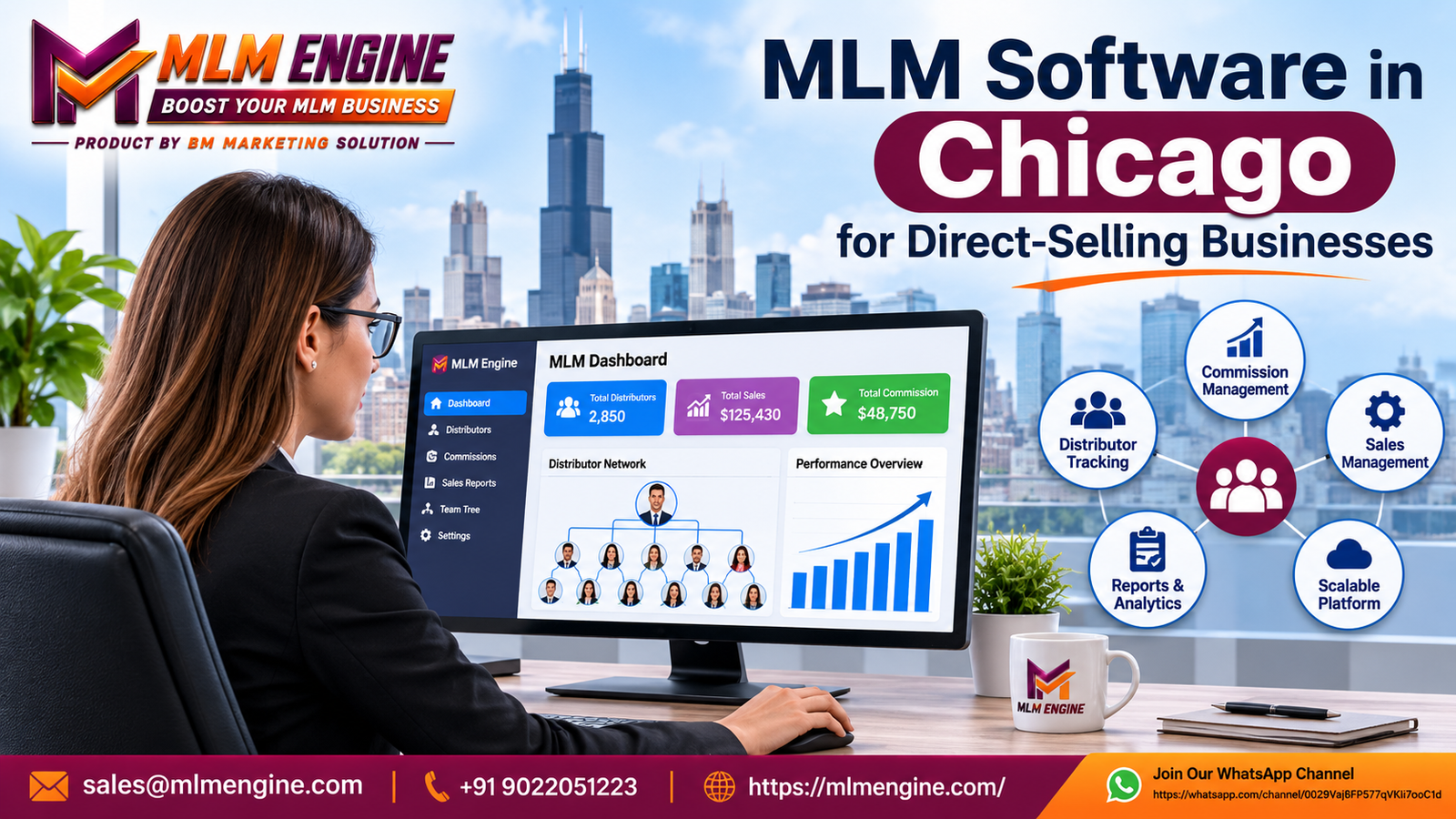
Modern MLM software solutions for businesses bring essential operations together through a centralized platform. Depending on the software configuration, companies can manage distributor registrations, genealogy structures, orders, commissions, transaction records, and administrative activities from one system.
However, choosing the right software requires more than comparing features. Businesses should consider their compensation plans, customization requirements, security expectations, scalability, and long-term operational goals.
In this article, we explore how MLM software works, its essential features, how it supports distributor and commission management, and what Chicago businesses should consider before choosing a software provider.
Understanding MLM Software for Modern Direct-Selling Businesses
Multi-level marketing (MLM) software is a business management platform designed to help direct-selling organizations manage distributors, sales activities, compensation structures, and administrative operations.
In a traditional direct-selling business, distributors promote products or services while building and managing their own distributor networks. As the organization expands, maintaining accurate records and managing compensation rules becomes increasingly important.
Network marketing software provides a centralized environment for organizing these activities.
For example, a direct-selling company operating in Chicago may have distributors throughout Illinois and other US states. Its administrators need to manage registrations, review sales activity, maintain distributor relationships, and calculate commissions according to the company’s compensation plan.
A centralized MLM platform can support these activities through features such as:
Distributor management: Maintain distributor profiles, registration details, and account information.
Genealogy management: View distributor relationships and organizational structures.
Commission management: Apply configured compensation rules to eligible business activities.
Order management: Organize product orders and transaction records.
Reporting and analytics: Review sales activity, distributor performance, and commission information.
Administrative controls: Manage user permissions and operational settings.
The available functionality depends on the software provider and the selected configuration.
Why Chicago Businesses Need Better Network Marketing Technology
Chicago has a diverse business environment, with organizations serving customers across different industries and geographical locations. Direct-selling companies operating in this market may need technology that supports distributed teams and organized business administration.
As distributor networks grow, operational responsibilities also increase.
Managing Expanding Distributor Networks
A growing distributor network creates additional administrative responsibilities. Companies need to maintain registration records, monitor distributor accounts, and understand how different teams are connected.
Without an organized system, administrators may spend considerable time checking multiple records and updating information manually.
A centralized platform helps businesses organize distributor information and review network structures more efficiently.
Organizing Business Operations
Direct-selling companies manage several activities simultaneously, including distributor registrations, orders, customer information, transactions, and commission records.
Using disconnected systems can make it difficult to maintain consistent information.
Direct selling business software can bring relevant operational activities together, reducing dependence on separate spreadsheets and manual processes.
Tracking Sales and Commissions
Commission calculations require accurate information about eligible sales, business volume, compensation rules, and qualification requirements.
When calculations are performed manually, errors and inconsistencies can become difficult to identify.
A properly configured commission system can apply approved rules consistently and maintain records for administrative review.
Supporting Teams Across Different Locations
A Chicago-based company may work with distributors throughout Illinois and other US states.
Mobile-friendly dashboards and centralized records allow authorized users to access relevant business information without depending on a physical office location.
Improving Administrative Visibility
Business owners and administrators need reliable information to understand operational performance.
Reports covering registrations, orders, sales activities, and commission records provide a structured view of business operations.
Essential Features to Look for in MLM Software
Selecting the right platform requires understanding which features support your business model and daily operations.
Here are ten important capabilities to consider when evaluating software providers.
1. Distributor Registration and Management
Distributor management features help companies maintain organized profiles for network members.
Depending on the platform, these features may include:
Online distributor registration.
Profile and contact information.
Account status management.
Sponsor information.
Registration history.
Distributor activity records.
For a company managing distributors across multiple US locations, centralized records can simplify routine administration.
2. Genealogy Tree and Network Visualization
A genealogy tree displays relationships between distributors within an organization.
It helps administrators understand sponsor connections, team structures, placement arrangements, and network levels.
A clear visual structure makes it easier to review distributor relationships without navigating multiple disconnected records.
3. Commission Calculation and Payout Management
Commission management is an important part of an MLM platform.
The system should support the company’s approved compensation rules and provide clear records of how commission amounts are calculated.
Depending on the configuration, relevant features may include:
Businesses should confirm whether the platform supports their exact compensation requirements before implementation.
4. Compensation Plan Support
Different direct-selling organizations use different compensation structures.
Common examples include:
Binary Plan: Organizes distributors into two primary legs or positions.
Matrix Plan: Uses predefined width and depth limits to structure distributor placement.
Unilevel Plan: Allows distributors to sponsor multiple people directly, with compensation rules based on defined levels.
Generation Plan: Uses defined generations or organizational levels to determine eligible commissions.
Not every platform supports every plan. Companies should confirm the availability of their required compensation model and understand how its rules can be configured.
5. Sales and Order Management
Order management helps businesses maintain records of product purchases, order statuses, and related transactions.
A suitable system should make it easier to review sales activity and connect relevant transactions with distributor accounts.
6. E-Wallet and Transaction Records
Some MLM platforms include an internal e-wallet feature for displaying commission balances and transaction history.
When evaluating this capability, ask how balances are recorded, adjusted, reconciled, and connected to actual payout processes.
An internal wallet record should not automatically be treated as a completed bank transfer.
7. Reports and Analytics
Reporting tools help administrators examine business activity.
Useful reporting categories may include:
Distributor registration reports.
Sales and order reports.
Commission summaries.
Network performance reports.
Transaction history.
Business activity reports.
The ability to export and review reports can also support accounting and administrative workflows.
8. Admin and Distributor Dashboards
An administrative dashboard should provide access to the information required to manage the organization.
Distributor dashboards should focus on relevant account information, network details, order records, and commission statements.
Role-based dashboards make the platform easier to use by presenting relevant information to different users.
9. Mobile-Friendly Access
Distributors and administrators may need to access their accounts using smartphones, tablets, or desktop computers.
A responsive interface makes essential business information easier to access across devices.
10. Data Security and Access Controls
Business platforms handle distributor profiles, transaction records, and other operational information.
Before selecting a provider, review:
User authentication.
Role-based permissions.
Data backup practices.
Secure data transmission.
Administrative access controls.
Data retention and recovery procedures.
Businesses should ask providers to explain their actual security practices rather than relying only on general security claims.
How MLM Software Helps Manage Distributor Networks
Distributor networks require continuous coordination, particularly when companies operate across multiple locations.
Distributor management software provides tools for organizing distributor information and maintaining visibility into network relationships.
Simplifying Distributor Onboarding
An organized registration process helps administrators collect required distributor information and maintain consistent account records.
For example, a new distributor joining a company in Chicago may complete an online registration process. The system can then store relevant profile information and sponsor details according to the company’s registration rules.
Maintaining Network Visibility
Distributor tracking software helps administrators review team structures and understand relationships between network members.
Genealogy visualization is particularly useful when a company has multiple distributor levels.
Reviewing Distributor Activity
Depending on available features, administrators may be able to review registration activity, order records, sales information, and other relevant performance indicators.
This information helps businesses identify operational issues and make informed administrative decisions.
Supporting Team Communication
A centralized platform may provide dashboards, notifications, or other communication-related features.
Businesses should evaluate whether these functions meet their actual requirements or whether additional communication tools are needed.
Understanding MLM Commission Management
An MLM commission management system calculates compensation based on predefined business rules and eligible activities.
Its purpose is to make commission processing more organized, consistent, and easier to review.
For example, imagine a direct-selling company with distributors in Chicago, Springfield, and other Illinois locations.
Its compensation plan may include commissions based on eligible product sales, team volume, or specific qualification requirements.
The commission system must be configured to reflect those rules accurately.
Important Commission Management Components
Commission Calculations: The system applies configured rules to eligible transactions and business activity.
Bonus Structures: Companies may define additional bonuses based on approved qualification criteria.
Qualification Tracking: Administrators can review whether distributors meet the requirements for specific commission categories.
Commission Statements: Distributors can review available commission information and transaction details.
Payout Records: Businesses can maintain records of payment processing and related adjustments.
Why Transparency Matters
Distributors should be able to understand how their commission records are calculated.
Businesses should therefore look for systems that provide clear statements, transaction references, and accessible commission histories.
It is equally important to ensure that compensation plans are reviewed for legal compliance. Software can implement configured rules, but it cannot independently establish whether a business model or compensation structure complies with applicable laws.
The Federal Trade Commission provides guidance on MLM business practices, compensation structures, and earnings representations.
How to Choose the Right MLM Software Provider
Choosing an MLM software provider is an important technology decision. The platform should support your existing business requirements while allowing room for future changes.
Chicago businesses comparing MLM software providers in Chicago should evaluate providers based on the following considerations.
1. Understand Your Business and Compensation Plan
Start by documenting your compensation structure, distributor placement rules, commission conditions, and payout requirements.
Do not select software simply because it supports a popular MLM plan. Confirm that it can implement your actual business rules.
2. Review Customization Options
Every organization has different operational requirements.
Ask whether the provider can customize registration workflows, distributor dashboards, compensation calculations, reports, and administrative settings.
3. Evaluate Scalability
Consider how the system will handle additional distributors, transactions, orders, and reporting requirements.
Discuss expected usage levels with the provider and ask how the proposed architecture accommodates future changes.
4. Examine Data Protection Practices
Ask how the provider handles authentication, access permissions, data backups, encryption, and security updates.
You should also understand who can access business records and how administrative activities are monitored.
5. Check Reporting and Analytics
Look for reporting tools that provide useful information about distributor registrations, sales, commissions, and transactions.
Reports should be understandable and relevant to your management requirements.
6. Test the User Experience
Both administrators and distributors should be able to navigate the platform comfortably.
Request a demonstration of the actual dashboards and test common activities rather than evaluating screenshots alone.
7. Understand Technical Support
Ask about support channels, working hours, maintenance arrangements, issue escalation, and software updates.
Clarify what is included in the agreement before implementation.
8. Review Integration Capabilities
Your business may need connections with payment services, e-commerce platforms, accounting tools, CRM systems, or other applications.
Check whether the required integrations are already supported or need custom development.
9. Compare Pricing Transparently
Understand the complete cost structure, including:
Initial software development or licensing.
Customization charges.
Implementation expenses.
Hosting and infrastructure.
Maintenance and upgrades.
Third-party integration costs.
A transparent proposal makes it easier to compare providers accurately.
10. Request a Demonstration and Test the System
A product demonstration allows you to see how the platform handles real operational scenarios.
Ask the provider to demonstrate distributor registration, genealogy placement, commission calculations, reporting, and administrative workflows using an example based on your compensation plan.
Software Evaluation Comparison
| Evaluation Area | What to Check | Why It Matters |
|---|
| Distributor Management | Registration and genealogy | Organized network operations |
| Commission Management | Calculation and payout rules | Accurate commission records |
| Customization | Compensation plan flexibility | Business-specific requirements |
| Reporting | Sales and performance reports | Better decision-making |
| Security | Access controls and data protection | Protection of business information |
| Scalability | Ability to accommodate growth | Long-term suitability |
| Support | Availability and service process | Ongoing assistance |
Questions Chicago Businesses Should Ask Before Choosing MLM Software
Before signing an agreement with a software provider, prepare questions that address your operational and technical requirements.
Can the software support our existing compensation plan?
Ask whether the platform supports your exact plan configuration, including commission percentages, qualification conditions, levels, and placement rules.
Can distributor management be customized?
Find out whether you can configure registration fields, distributor profiles, sponsor relationships, and user permissions according to your business requirements.
How are commissions calculated and verified?
Ask for a demonstration showing how eligible sales and configured compensation rules produce commission records. Also check whether administrators can review calculation details.
Can our existing distributor data be migrated?
If you are replacing an existing platform, discuss data formats, migration procedures, record validation, and testing before switching systems.
What security measures protect our information?
Ask about authentication, encryption, backups, access permissions, security monitoring, and incident response procedures.
What technical support is available?
Understand the support process, response arrangements, maintenance schedule, and responsibilities of both parties.
Can the platform accommodate future business changes?
Discuss new compensation rules, additional modules, integrations, and increasing transaction volumes.
These questions can help you compare network marketing solutions in Illinois based on practical business requirements rather than marketing promises.
How MLM Engine Supports Direct-Selling Business Operations
MLM Engine provides MLM software solutions designed to support different network marketing business models.
Its website presents several software offerings, including Binary MLM Software, Matrix MLM Software, Generation MLM Software, and other compensation plan solutions. Businesses can explore these options to understand which configurations may match their operational requirements.
Some of the areas businesses can explore include:
Binary MLM Software: For organizations using a two-leg distributor structure.
Matrix MLM Software: For businesses following predefined network width and depth.
Generation MLM Software: For organizations using generation-based commission structures.
Distributor Management: For maintaining distributor profiles and network relationships.
Commission Management: For implementing configured compensation and payout rules.
Business Dashboards: For organizing administrative and distributor information.
The availability and configuration of individual features should be confirmed during a product discussion.
For Chicago-based companies and other US businesses considering MLM business management software USA, the first step is to explain your compensation plan, distributor structure, operational challenges, and technical requirements.
MLM Engine can then discuss relevant software options and demonstrate the applicable functionality.
You can also explore the company’s existing software information through its website before arranging a consultation.
Final Thoughts
Choosing MLM Software in Chicago requires a clear understanding of your business model, distributor management requirements, compensation structure, and technology priorities.
The right platform should help organize distributor information, maintain commission records, manage sales activities, and provide useful operational reports.
Before making a decision, compare customization options, security practices, integrations, scalability, pricing, and technical support. Most importantly, request a demonstration that reflects your actual business requirements.
For direct-selling organizations operating in Chicago, Illinois, and across the United States, selecting suitable network marketing software can be an important step toward building more organized business operations.
Book a Free MLM Software Demo with MLM Engine
Interested in exploring software for your direct-selling business? Contact MLM Engine to discuss your requirements and discover suitable technology options.
MLM Engine Contact Information