Online dating has moved a long way from static profile listings and slow-loading chat rooms. Today’s users expect platforms that load instantly, protect their personal information, and actually understand what they’re looking for in a match. That shift in expectation has changed how businesses approach dating portal development altogether.
A decade ago, launching a dating website meant a simple registration form, a search page, and a messaging inbox. That’s no longer enough. People now compare a dating platform’s usability to the apps they use every day for banking, shopping, and social media. If a portal feels clunky or unsafe, users leave within minutes and rarely come back.
This is why more entrepreneurs, startups, and established companies are investing in dedicated dating portal development rather than relying on generic, off-the-shelf templates. A custom-built platform allows a business to control its user experience, its monetization strategy, and its long-term growth path. Choosing the right technology partner and development approach at the outset saves considerable time and cost later.
Interestingly, many companies planning a dating platform are also evaluating broader digital infrastructure at the same time user account systems, subscription billing, admin dashboards, and analytics. These are the same building blocks found in an MLM Software Solution, even though the two products serve entirely different purposes. Understanding this overlap in underlying technology (not business function) helps founders make more informed platform decisions, which we’ll unpack later in this article.
What Is Online Dating Portal Development?
An online dating portal is a web-based (and often mobile) platform that allows individuals to create profiles, browse or search for potential matches, and communicate with one another. At its core, it’s a matchmaking system built on top of a database of users, their preferences, and their activity.
The typical user journey looks like this: a person signs up, builds a profile with photos and basic details, sets preferences for who they’d like to meet, and then either searches manually or receives suggested matches. From there, they exchange messages, and depending on the platform, may unlock additional features through a paid membership.
There’s a meaningful difference between a basic dating website and a feature-rich dating platform. A basic site might only offer profile creation and messaging. A mature platform adds compatibility scoring, verification systems, media privacy controls, in-app notifications, and a full subscription structure. For businesses with specific requirements a niche audience, a regional focus, or particular cultural considerations custom development becomes especially useful, since pre-built templates rarely accommodate those nuances well.
Why Businesses Are Investing in Dating Platforms
The appeal of the dating industry for entrepreneurs isn’t just about romance it’s about recurring revenue and long-term user engagement. A few practical reasons are driving this investment:
- Growing demand for structured, safer ways to meet people online, especially as social circles become more digital
- Mobile-first behavior, where most users expect to browse and chat from a phone rather than a desktop
- Subscription-based income, which offers more predictable revenue than one-time transactions
- Premium memberships that unlock features like unlimited messaging or advanced filters
- The ability to personalize the experience for each user, which increases retention
- Long-term scalability, since a well-built platform can expand into new regions or user segments
- Access to business analytics and user behavior insights, which help refine the product over time
Together, these factors make dating platforms an attractive category for businesses willing to invest in solid technology rather than a quick, generic build.
Essential Features of a Modern Dating Portal
A dating platform is only as good as the features that support real user needs. Here’s what a modern build generally includes.
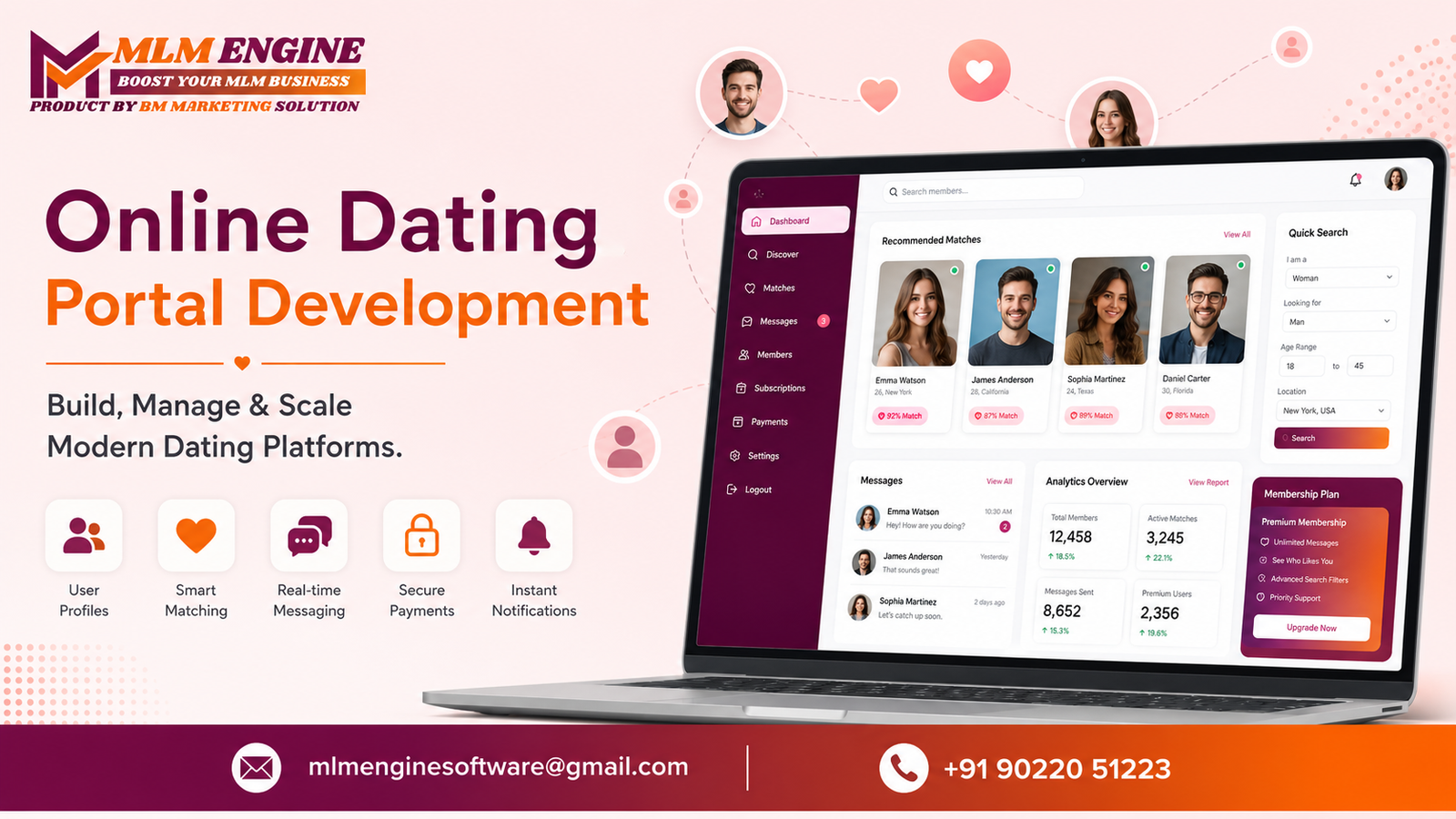
- User Registration & Profiles: Account creation should be quick, with options like email, phone, or social sign-in. Profiles typically include photos, bio details, interests, and preferences, along with some form of verification to reduce fake accounts.
- Advanced Search & Filters: Users want to narrow results by age, location, interests, lifestyle choices, and other relevant criteria. Good filtering reduces frustration and helps people find relevant matches faster.
- Matching Algorithm: Rather than showing every user to everyone, a compatibility-based matching system considers shared interests, preferences, and behavior patterns to suggest more relevant profiles. This is often what separates a forgettable app from one people keep coming back to.
- Real-Time Messaging: Private, responsive chat is central to any dating platform. Read receipts, typing indicators, and media sharing within chat all contribute to a smoother experience.
- Photo & Media Management: Users need control over who sees their photos, along with secure storage and upload handling to prevent misuse.
- User Verification: Email and mobile verification are baseline requirements. Many platforms now add identity verification or photo verification to build trust and reduce fake profiles.
- Privacy & Security: This includes secure authentication (like two-factor login), data protection practices, granular privacy settings, block and report functionality, encrypted communication where possible, and admin-side monitoring to catch abuse early.
- Notifications: Push, email, and in-app alerts keep users engaged a new match, a new message, or a profile view can all prompt a return visit.
- Subscription & Membership Plans: Most platforms combine a free tier with one or more premium tiers that unlock additional features.
- Payment Gateway Integration: Secure, reliable payment processing is non-negotiable for handling subscriptions and one-time purchases like profile boosts.
- Admin Dashboard: Behind the scenes, admins need tools for managing users, moderating profiles and reported content, tracking memberships and payments, reviewing analytics, managing platform content, and adjusting settings without needing a developer for every change.
How an MLM Software Solution Can Support Digital Business Operations
It’s worth being clear here: an MLM Software Solution is built primarily to manage network marketing operations things like distributor hierarchies, commission calculations, genealogy tracking, and payout automation. It is not dating software, and it shouldn’t be marketed or understood as such.
That said, businesses exploring platform development often notice conceptual overlap in the underlying technology layer. Both an MLM platform and a dating portal need reliable user account management, subscription or membership handling, secure payment processing, centralized admin control, and usable analytics. The specific logic differs completely matching algorithms and commission structures solve very different problems but the infrastructure principles (scalability, security, clean admin tooling) are similar.
This is a useful point for founders to keep in mind: technology should be selected based on the actual business model and the features that model requires, not based on which software happens to be available. A company like MLM Engine, which focuses on business automation and software solutions, illustrates this kind of infrastructure-first thinking building systems that are secure, scalable, and manageable from a single dashboard, regardless of the industry they’re eventually applied to. The lesson for dating portal founders isn’t “use MLM software,” but rather “build on the same disciplined foundation.”
Revenue Models for an Online Dating Portal
There’s no single correct way to monetize a dating platform. Most successful portals combine two or three of the following:
- Free and Premium Memberships — a free tier attracts volume, while a paid tier converts engaged users into revenue.
- Monthly or Annual Subscriptions — predictable recurring income, often with a discount for longer commitments.
- Profile Boosts — users pay to temporarily increase their visibility in search results.
- Featured Profiles — similar to boosts, but often placed in dedicated high-visibility sections.
- Premium Messaging — charging for the ability to message beyond a free limit, or to message without a mutual match.
- Virtual Gifts — small in-app purchases that let users express interest in a lighter, low-commitment way.
- Advertisement Revenue — relevant for platforms with high free-tier traffic.
- Partner or Affiliate Promotions — cross-promoting complementary services, like event ticketing or relationship coaching.
The right mix depends on the target audience’s willingness to pay and how competitive the specific niche is.
Technology Considerations for Dating Portal Development
Even for non-technical founders, it helps to understand the moving parts. Responsive design ensures the platform works well on any screen size, which matters given how mobile-heavy dating traffic tends to be. A scalable backend architecture means the platform can handle growth without needing to be rebuilt from scratch. Solid database management keeps profile and match data organized and fast to retrieve, even as the user base grows into the hundreds of thousands.
API integrations connect the platform to external services payment processors, SMS verification, or mapping tools for location-based matching. Cloud hosting provides the flexibility to scale server capacity up or down based on demand. Reliable notification systems keep users engaged without becoming spammy. And underlying all of this, strong security practices and performance optimization determine whether the platform feels trustworthy and fast, or clunky and risky.
How Much Does Online Dating Portal Development Cost?
There’s no honest, fixed number here anyone quoting a flat price without understanding your requirements is likely oversimplifying. Cost depends on several variables: the number and complexity of features, how custom the design needs to be, whether the matching algorithm is basic or advanced, how much admin functionality is required, the number of payment integrations, whether a mobile app is needed alongside the website, any third-party APIs involved, security requirements, hosting infrastructure, and ongoing maintenance needs.
The most practical approach is to define a minimum viable product (MVP) first the smallest feature set that still delivers real value to users and build the budget around that, rather than trying to price out every possible feature from day one.
Why Choose a Custom Dating Portal?
Off-the-shelf dating scripts can get a product to market quickly, but they come with real trade-offs. A custom-built portal offers greater flexibility to design features exactly as needed, better scalability as the user base grows, full ownership of the brand and codebase, and the freedom to adjust monetization strategies without being boxed in by a template’s limitations.
Custom development also means more control over the user experience itself, easier integration with whichever third-party tools the business needs, better ownership and control over platform data, and more flexibility to evolve the platform over years rather than being locked into a rigid structure.
Choosing the Right Development Partner
Selecting a development company is arguably as important as the feature list itself. It’s worth checking a potential partner’s previous experience building similar platforms, their technical depth across frontend, backend, and security, and their track record on data protection specifically dating platforms handle sensitive personal information, so this matters more than usual.
Also look at their UI/UX capabilities, since a dating platform lives or dies by how intuitive it feels to use. Ask about customization options rather than assuming everything is configurable by default, and clarify what post-launch support looks like bugs and feature requests don’t stop the day after launch. Finally, consider how well they communicate and what ongoing maintenance services they offer, since a platform that isn’t maintained tends to degrade in both performance and security over time.
Future of Online Dating Portal Development
A few realistic trends are shaping where dating platforms are headed. AI-assisted matchmaking is becoming more common, using behavioral data rather than just stated preferences to suggest better matches. Recommendation systems are getting smarter at surfacing relevant profiles instead of relying purely on filters.
Video is playing a bigger role too video profiles help reduce catfishing, and built-in video calling lets users vet a match before agreeing to meet in person. AI is also being applied to content moderation, helping platforms catch inappropriate behavior faster than manual review alone. Identity verification methods are improving, which should gradually increase user trust across the industry. And there’s a broader push toward privacy-focused communication and more personalized experiences overall, delivered through mobile-first platforms that lean on data to keep improving the product.
None of these trends are dramatic overnight shifts they’re incremental improvements that, together, are raising the baseline expectation for what a “modern” dating platform looks like.
Conclusion
Building a successful online dating portal comes down to a handful of fundamentals: a smooth, intuitive user experience, strong security and privacy protections, an architecture that can scale as the user base grows, thoughtful personalization, a monetization strategy that fits the audience, and technology that’s reliable rather than just impressive on paper.
Whether a business is building a dating platform, an MLM Software Solution, or any other digital product, the underlying discipline is the same build on solid, secure, and scalable technology from day one. Companies like MLM Engine approach software this way, focusing on dependable infrastructure regardless of the industry it eventually supports.
If you’re planning a dating portal or evaluating your broader software development needs, it’s worth having a detailed conversation before committing to a technology stack or a development partner.
Email: mlmenginesoftware@gmail.com
Phone: +91 90220 51223
Website: mlmengine.com
WhatsApp Channel: https://whatsapp.com/channel/0029Vaj8FP577qVKIi7ooC1d