Get a Free Demo of MLM Engine’s Software Today
Online Dating Portal Development & MLM Software Solution Guide Online dating has moved a long way from static profile listings and slow-loading chat rooms. Today’s

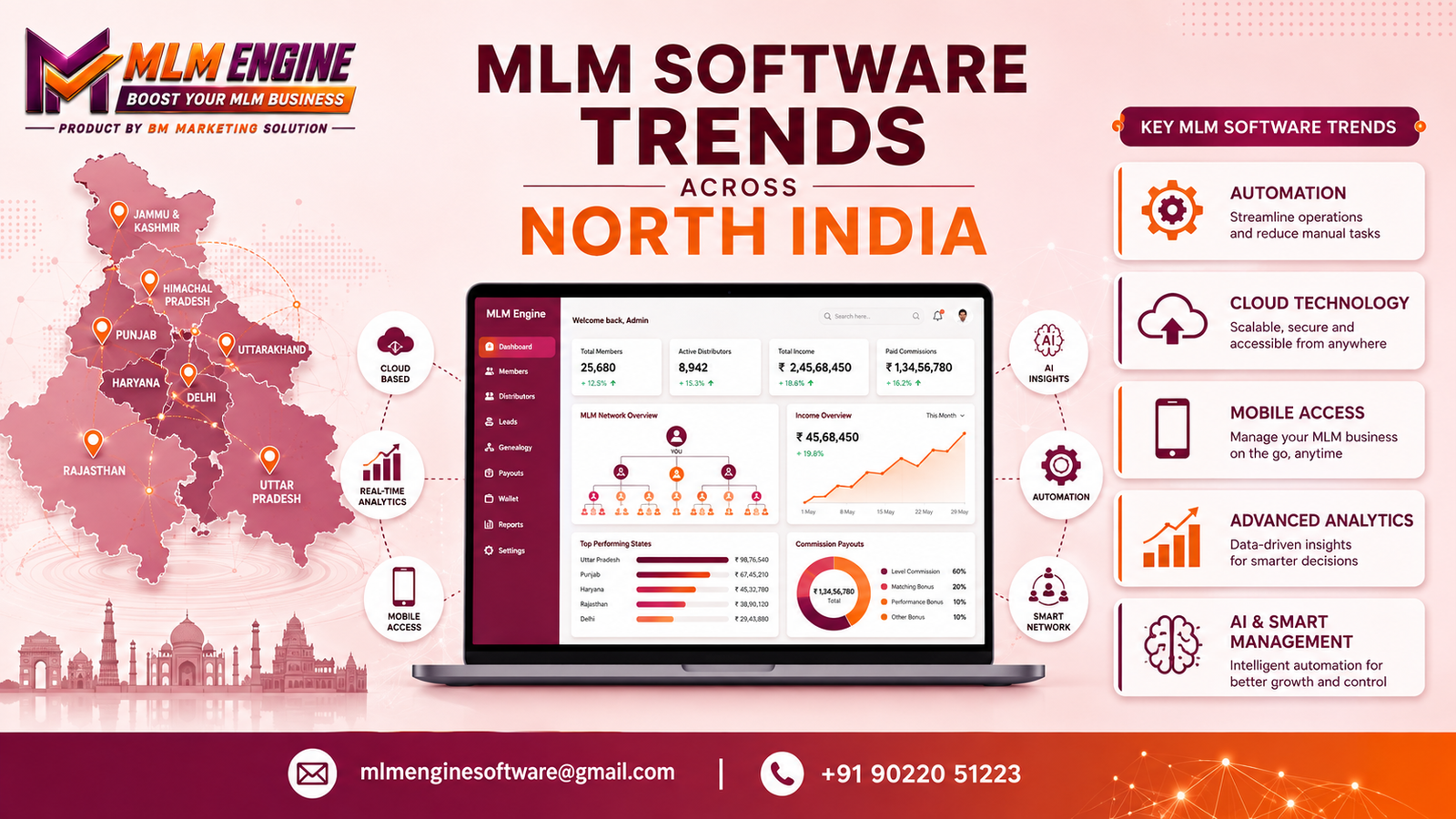
The direct-selling landscape across North India has changed more in the last few years than in the previous decade combined. Companies that once relied on registers, WhatsApp groups, and manual commission sheets are now looking seriously at digital platforms to run their operations. North India MLM Software Trends point clearly toward one direction: businesses want systems that are faster, more transparent, and easier to scale across cities and states.
From Delhi to Chandigarh, and from the plains of Uttar Pradesh to the hill markets of Himachal Pradesh and Uttarakhand, direct-selling companies are dealing with growing distributor networks, more complex compensation structures, and customers who expect instant updates. Meeting these expectations with spreadsheets simply isn’t realistic anymore. This shift is exactly why understanding North India MLM Software Trends matters for any business owner planning to stay competitive.
In this article, we’ll walk through the trends shaping MLM technology adoption in the region, what businesses should look for in a modern platform, and how a solution like MLM Engine fits into this changing landscape.
For years, a large share of MLM and direct-selling companies in North India managed their day-to-day operations manually. Commission sheets were built in Excel, distributor records were kept in physical files or scattered spreadsheets, and rank calculations were often done by hand at the end of every cycle.
This approach worked when networks were small. But as distributor bases grew into the hundreds and thousands, manual processes started causing real problems delayed payouts, calculation errors and frustrated distributors who couldn’t get quick answers about their earnings.
This is the core reason behind the rising adoption of MLM software and MLM business software across the region. A centralized MLM management system removes the guesswork from commission calculation, keeps distributor data in one place, and gives business owners a single dashboard to monitor the entire network. It’s less about chasing a trend and more about solving a genuine operational bottleneck.
One of the clearest shifts in North India MLM Software Trends is the move toward cloud-based MLM software. On-premise systems required dedicated servers, IT staff, and constant maintenance an expensive proposition for small and mid-sized direct-selling businesses.
Cloud-based platforms remove that overhead. Data is stored centrally and accessed securely from anywhere, which matters a great deal for companies with distributors spread across multiple states. A regional manager in Punjab and a business owner sitting in Delhi can view the same live data without waiting for reports to be compiled and shared manually.
Scalability is another major advantage. As a company adds new distributors or expands into a new city, cloud infrastructure adjusts without requiring a hardware upgrade. This flexibility is a big reason why cloud adoption keeps climbing among direct-selling companies in the region.
Distributors don’t sit behind a desktop all day they’re meeting prospects, traveling between cities, and managing their downlines on the move. That’s why mobile responsiveness has become a non-negotiable feature rather than a nice-to-have.
Mobile-friendly distributor panels let network members check their rank, view commission updates and track team performance directly from their phones. Real-time notifications for new joins, achieved targets, or upcoming payouts keep distributors engaged without them needing to log in and search for updates.
For business owners, mobile access to admin dashboards means they can approve requests, monitor sales, or check reports even while traveling something that matters a lot in a region as geographically spread out as North India.
Commission calculation is often the most sensitive and error-prone part of running an MLM business. A single mistake in a payout can damage trust with distributors, and rebuilding that trust takes time.
This is where MLM automation plays a central role. Automated systems calculate commissions, bonuses, ranks, and incentives based on predefined rules, removing the risk of manual errors. When a distributor makes a sale or a downline member hits a target, the system updates the relevant figures instantly rather than waiting for a manual review cycle.
Beyond accuracy, automation also saves significant time. Tasks that once took a finance team days to complete at the end of each cycle can now be processed in a fraction of the time, freeing up staff to focus on distributor support and business growth instead of spreadsheet reconciliation.
No two MLM businesses operate the same way, and their compensation structures reflect that. This is why flexible support for multiple MLM compensation plans has become a key requirement when choosing software.
Some of the common models include:
There’s no single “best” plan among these the right choice depends entirely on a company’s product type, growth strategy and target market. What matters more is that the software can support the chosen model accurately and, ideally, adapt if the business decides to introduce a hybrid or customized structure later.
Running an MLM business without visibility into performance data is like driving without a dashboard. That’s why real-time reporting has become one of the more visible North India MLM Software Trends.
Modern platforms provide dashboards that show sales trends, distributor performance, rank progression and network growth at a glance. Instead of waiting for a monthly report, business owners can spot slowdowns or growth opportunities as they happen and respond quickly.
For regional businesses, this kind of reporting is particularly useful when comparing performance across different cities or states, helping leadership decide where to focus training, incentives, or marketing efforts.
As networks grow, keeping track of individual distributor and customer relationships becomes harder without a proper system. This has pushed many companies toward CRM-style functionality built directly into their MLM platforms.
A good MLM management system maintains detailed distributor profiles, purchase history, communication logs and sales activity in one place. This makes it easier for upline leaders and admin teams to support distributors effectively, follow up with inactive members and maintain accurate customer records over time.
Better relationship management doesn’t just improve internal efficiency it also directly affects distributor retention, since network members feel more supported when their queries and history are readily accessible.
Cash-based or manual bank transfer processes are increasingly being replaced by integrated digital payment workflows. Distributors expect timely, traceable payouts and businesses need clear transaction records for accounting and compliance purposes.
Modern MLM platforms are increasingly designed to support digital payment integration, giving both the company and its distributors a transparent view of transaction history. This reduces disputes, speeds up payout cycles, and creates a cleaner audit trail all important factors as direct-selling companies formalize their operations further.
MLM platforms handle sensitive information distributor personal details, financial records, sales data and network structures. As adoption grows, data security has become a top priority rather than an afterthought.
Key security practices that businesses now look for include:
A secure infrastructure protects not just company data but also distributor trust a factor that directly affects long-term network stability.
Artificial intelligence is beginning to find practical applications within MLM software, though it’s worth being clear about where things stand today versus where they’re heading.
Currently, AI-assisted tools are being used in areas like:
Predictive reporting and more advanced operational automation are emerging areas, but they’re still developing rather than fully mainstream across the industry. Businesses should view AI as a tool that supports human decision-making not a replacement for strategic judgment or genuine distributor relationships.
North India covers a wide and diverse market from major metros to smaller towns spread across Delhi, Chandigarh, Punjab, Haryana, Uttar Pradesh, Rajasthan, Uttarakhand, Himachal Pradesh and Jammu & Kashmir. Managing distributor networks across such a spread-out region brings its own challenges.
Technology helps bridge these gaps. A centralized platform allows a business headquartered in one city to onboard, train and support distributors in another without needing a physical office there. Real-time data ensures that regional teams stay aligned with company policies, current compensation structures, and product updates, regardless of where they’re located.
This ability to manage a geographically diverse network from a single system is one of the more practical reasons technology adoption continues to rise across the region. Looking at North India MLM Software Trends as a whole, this regional spread is arguably the biggest driver behind why centralized, cloud-based platforms have moved from a “nice option” to a practical necessity.
Choosing the right platform isn’t about picking the flashiest option it’s about matching software capabilities to actual business needs. Here’s a practical checklist:
Businesses that evaluate software against this list are far more likely to choose a platform that grows with them rather than one they outgrow within a year or two.
MLM Engine is built around this exact shift helping direct-selling businesses move away from fragmented manual processes toward a centralized, digital way of managing operations.
The platform supports multiple MLM compensation plans, including Binary, Matrix, Unilevel, Generation and Repurchase structures, allowing businesses to choose or customize a model that fits their strategy rather than forcing their business into a rigid template.
Beyond compensation plan flexibility, MLM Engine focuses on areas that matter most to growing networks: distributor management, commission and payout automation, reporting, and administrative controls. For companies operating across multiple cities in North India, having these functions available on a single platform makes it considerably easier to maintain consistency as the network expands.
Rather than positioning itself as a one-size-fits-all solution, MLM Engine is designed to adapt to how each business actually operates which is arguably the most important quality any MLM software can offer.
Looking ahead, a few directions seem likely to shape the next phase of MLM Technology Trends in the region:
None of these directions represent a dramatic overnight shift they’re a continuation of patterns already underway. As North India MLM Software Trends continue to mature, businesses that stay attentive to these shifts will be better positioned to adapt as the market grows.
North India MLM Software Trends make one thing clear: the direct-selling industry in the region is steadily moving toward automation, cloud accessibility, mobile-first management and data-driven decision-making. Businesses that once relied on manual processes are recognizing that scalable growth requires equally scalable systems.
Whether it’s automating commissions, supporting multiple compensation structures, or managing a distributor network spread across several states, the right software can make the difference between a business that struggles to keep pace and one that grows with confidence.
If you’re evaluating your options or looking to modernize how your MLM business operates, it’s worth exploring what a platform like MLM Engine can offer. Reach out to learn more about how it can support your network’s growth.
Email: mlmenginesoftware@gmail.com
Phone: +91 90220 51223
Website: https://mlmengine.com/
WhatsApp Channel: https://whatsapp.com/channel/0029Vaj8FP577qVKIi7ooC1d
Online Dating Portal Development & MLM Software Solution Guide Online dating has moved a long way from static profile listings and slow-loading chat rooms. Today’s
Online Dating Portal Development & MLM Software Solution Guide Online dating has moved a long way from static profile listings and slow-loading chat rooms. Today’s
Online Dating Portal Development & MLM Software Solution Guide Online dating has moved a long way from static profile listings and slow-loading chat rooms. Today’s
How Learning Management System Software Is Reshaping Digital Training for Every Organization Digital learning has quietly become the backbone of how schools, companies and training
How Learning Management System Software Is Reshaping Digital Training for Every Organization Digital learning has quietly become the backbone of how schools, companies and training
How Learning Management System Software Is Reshaping Digital Training for Every Organization Digital learning has quietly become the backbone of how schools, companies and training
Unilevel MLM Software Explained: A Practical Guide for Direct Sellers INTRODUCTION Direct selling and MLM businesses grow fast and once a distributor network crosses a