Every growing e-commerce business eventually hits the same wall the technology that worked fine for one store starts breaking down the moment you try to run five, ten or fifty of them. Separate hosting, separate codebases, separate maintenance schedules it adds up fast, both in cost and in headaches.
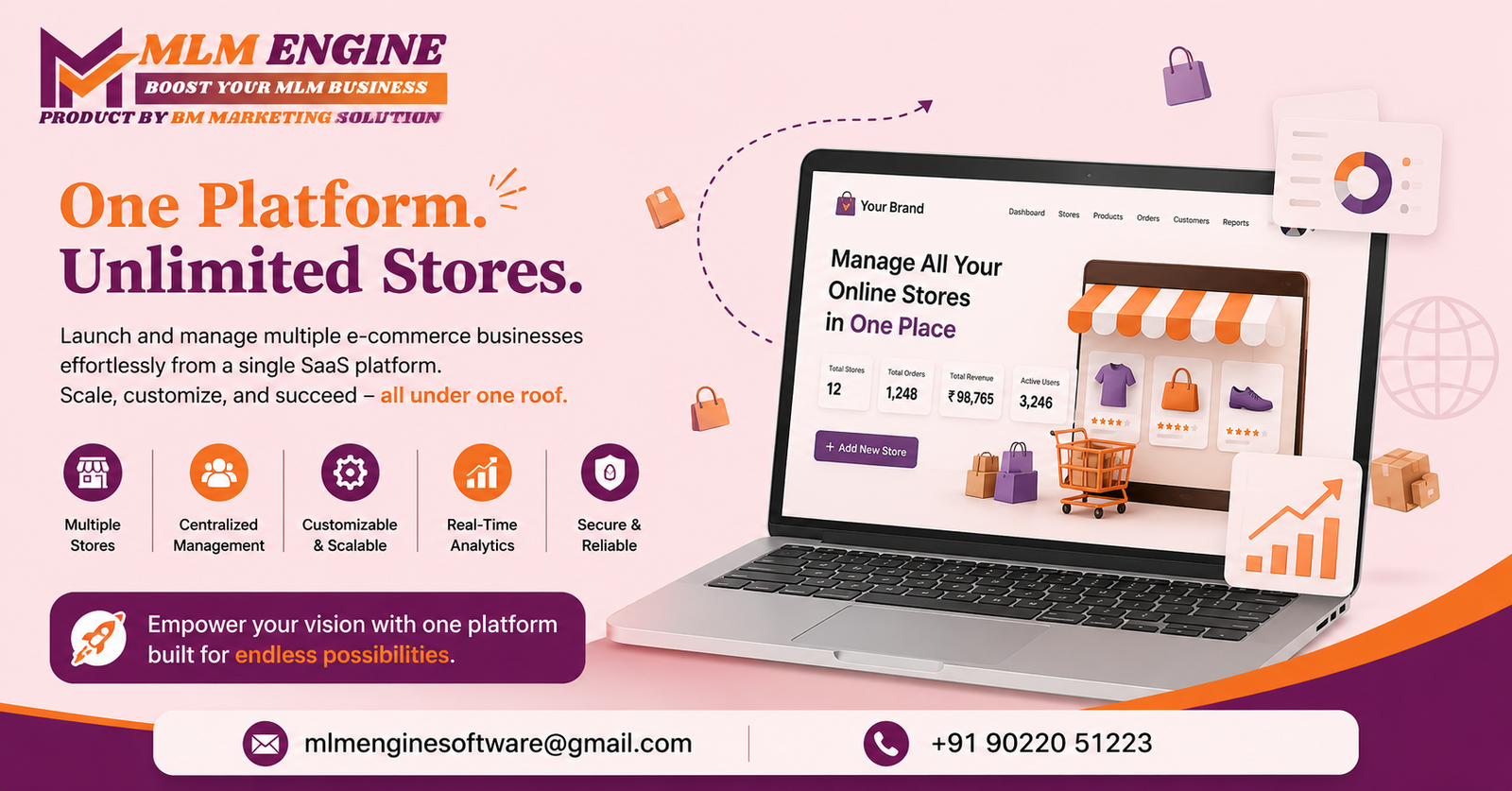
That’s the exact problem a Multi-Tenant E-Commerce SaaS setup solves. Rather than spinning up a brand-new system for every seller or franchise partner, one shared, secure platform powers all of them together each store keeping its own identity, customers and data, while running on common infrastructure behind the scenes.
MLM Engine has spent years building this kind of software, focused on making multi-store management simple instead of chaotic.
What is a Multi-Tenant E-Commerce SaaS Platform?
In simple terms, Multi-Tenant E-Commerce SaaS describes a system where one application instance quietly serves many different businesses or “tenants” at once. Each tenant gets a fully private space for their storefront, orders, and customer data, but they’re all built on top of the same shared engine underneath.
A useful comparison is a large office building. Every company on a different floor has its own locked space, its own setup, its own privacy yet they all rely on the same elevators, electricity, and security system. That shared backbone is what makes the whole building efficient to run, and it’s the same idea powering multi-tenant e-commerce software.
This model works especially well for businesses managing franchise networks, multiple brands, or reseller ecosystems, since there’s no need to rebuild the tech stack every time a new store joins.
Key Features Worth Knowing
- One Dashboard, Full Control: Admins manage every tenant store from a single control panel instead of juggling separate systems.
- Individual Branding: Each tenant can apply their own logo, theme, and domain name, so their store never feels shared or generic.
- Effortless Scaling: Onboarding a new tenant doesn’t mean setting up new servers it happens within the existing infrastructure.
- Strict Data Separation: Shared backend, yes but tenant data stays fully isolated and secure at all times.
- Instant Platform Updates: A single upgrade to the core system rolls out to every tenant automatically.
- Built-In Billing Flexibility: Supports different subscription tiers, commissions and payment structures per tenant.
Benefits for Businesses Ready to Scale
- Significant Cost Savings
Shared infrastructure means businesses aren’t paying for duplicate servers or separate maintenance teams for every store a major saving compared to single-tenant setups. - Quicker Launches
Since the core platform already exists, new sellers, franchisees, or partner stores can go live in a matter of days rather than months. - Simplified Upkeep
One update reaches everyone at once. There’s no chasing down dozens of individual codebases to patch or fix. - Room to Grow Without Limits
As more tenants come on board, a well-built Multi-Tenant E-Commerce SaaS platform absorbs the extra load without demanding a full infrastructure rebuild. - Steadier Performance
Because resources are managed centrally, uptime tends to be more stable and load times more consistent across every tenant store.
How the Architecture Actually Works
Behind the scenes, the platform doesn’t physically separate each tenant it separates them logically. Every tenant is tagged with a unique identifier that keeps their inventory, orders and settings distinct, even though everyone shares the same database engine and application code.
When a new tenant joins, their private workspace is provisioned almost instantly branding applied, settings configured without touching any other tenant’s store. Meanwhile, the platform’s admin layer keeps handling security, performance, and updates for everyone at once, which is exactly what keeps this model so cost-efficient at scale.
Interestingly, this mirrors how well-structured MLM compensation systems operate a single platform managing several independent networks under one framework. MLM Engine’s is a good real-world example of centralized software handling multiple distinct network structures simultaneously.
Why Businesses Choose MLM Engine
MLM Engine builds SaaS platforms designed to be secure, dependable, and straightforward to manage whether the use case is e-commerce, MLM networks, or a mix of both.
- Deep, hands-on experience across SaaS and MLM software
- Serious attention to tenant-level data protection
- Honest, transparent pricing with no hidden add-ons
- Hands-on support during onboarding and customization
- Regular platform improvements that don’t disrupt existing stores
Choosing MLM Engine means working with a team that understands more than just the code they understand how growing, multi-store businesses actually operate day to day.
Conclusion
A Multi-Tenant E-Commerce SaaS platform offers businesses a genuinely smarter path to growth lower costs, easier management and the ability to scale without rebuilding infrastructure every time a new store joins. For companies aiming to expand their online presence efficiently, this isn’t just a nice-to-have anymore it’s quickly becoming the standard.
If you’re considering this model for your own business, MLM Engine can help you build it the right way. Visit mlmengine.com to get started.
Email: mlmenginesoftware@gmail.com
Phone: +91 90220 51223
Website: https://mlmengine.com/
WhatsApp Channel: https://whatsapp.com/channel/0029Vaj8FP577qVKIi7ooC1d