How the Right MLM Software Can Transform MLM Business Growth
Online Dating Portal Development & MLM Software Solution Guide Online dating has moved a long way from static profile listings and slow-loading chat rooms. Today’s

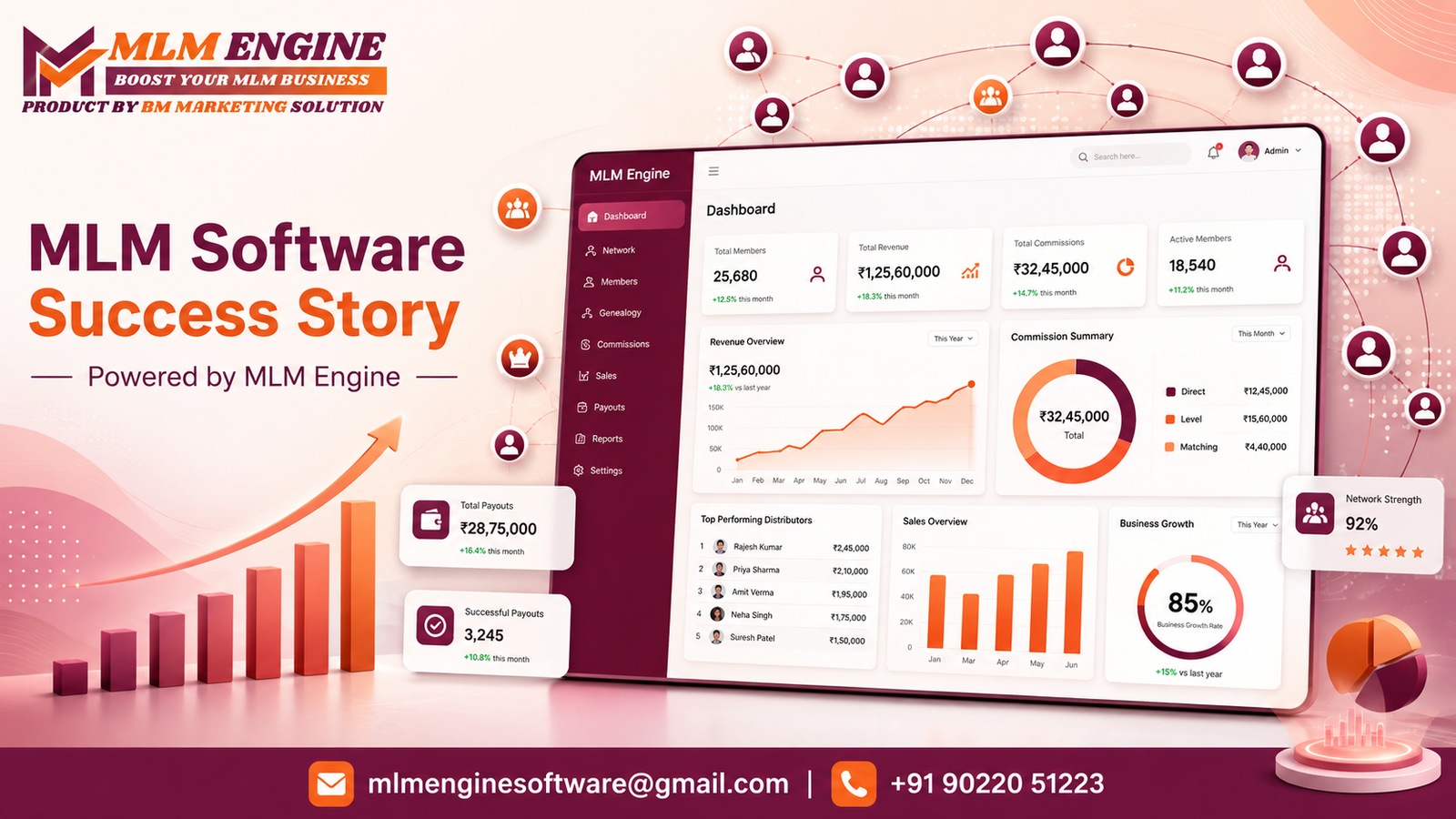
Choosing the right MLM platform can be the single biggest factor that determines whether a network marketing business scales smoothly or gets stuck fighting the same operational problems year after year. Behind every thriving MLM company, there’s usually a turning point a moment when manual processes stopped working and the business had to make a decision about its technology. This is one such MLM Software Success Story, an illustrative look at how a growing MLM company partnered with MLM Engine to move from scattered spreadsheets and manual tracking to a fully automated, scalable system.
While the details here are presented as a representative case rather than naming a specific client, the challenges, decisions and outcomes reflect what many MLM businesses genuinely go through when they outgrow manual management.
Like many growing network marketing companies, this business started small a handful of distributors, simple commission structures and processes that could still be managed by hand. But as the network expanded, cracks began to show.
The team found themselves buried in manual administrative work that ate up hours every single day. Onboarding new distributors, updating records, and tracking activity all had to be done manually, which meant more room for human error and less time for actual business growth.
Complex commission calculations became another major pain point. As the compensation plan grew more layered, calculating payouts accurately using spreadsheets became slow, error-prone, and difficult to audit. A single mistake could mean a distributor being underpaid or overpaid, both of which damage trust.
On top of that, the company struggled with:
These are the same challenges that push many MLM businesses to start looking for a dedicated software solution and it’s exactly where this company’s journey with MLM software began.
When the company began evaluating platforms, they weren’t just looking for software that could handle basic tasks. They needed a system that understood the specific mechanics of MLM operations compensation logic, network structures, and the day-to-day realities of managing a growing distributor base.
This is where MLM Engine stood out. As a purpose-built MLM software platform, it offered the kind of depth and flexibility the business needed, including:
For a company that had been managing everything manually, this combination of automation and flexibility made MLM Engine the clear choice.
Moving from manual processes to a centralized digital system isn’t just about installing software it’s a transition that has to be handled carefully to avoid disrupting an already-running business.
The implementation process began with configuration, where the platform was set up to match the company’s exact compensation plan and business rules. This step matters more than most people realize, since a poorly configured system can create as many problems as it solves.
From there, the focus shifted to testing, ensuring commission calculations, reporting, and distributor workflows behaved exactly as expected before going live. This kind of due diligence helps catch issues early, when they’re easy to fix, rather than after distributors are already relying on the system.
User onboarding was another important piece of the puzzle. Both the internal admin team and the distributor network needed to get comfortable with the new platform, which meant clear guidance and a smooth learning curve.
Finally, careful attention was given to data management and workflow automation, making sure historical records were handled properly and that day-to-day operations from new sign-ups to commission runs could happen automatically going forward.
Once the new system was in place, the shift in how the business operated became clear. Rather than claiming specific numbers or results, it’s worth focusing on the kind of qualitative transformation that businesses in this position typically experience.
Better operational efficiency became noticeable almost immediately, as tasks that once took hours could now be handled in a fraction of the time. Faster administrative processes meant the team could focus less on repetitive data entry and more on supporting distributors and growing the business.
Improved network visibility gave leadership a much clearer understanding of how the distributor network was actually structured and performing, rather than relying on periodic manual reviews. Alongside this came more organized distributor management, with all information centralized instead of scattered across different tools.
Simplified commission processing removed a major source of stress and error, giving both the company and its distributors more confidence in the accuracy of payouts. And because the platform provided consistent, real-time data, the business could shift toward genuinely data-driven decision-making instead of reacting to problems after they’d already happened.
Perhaps most importantly, the company gained improved scalability the confidence that their systems could support continued growth instead of becoming a bottleneck.
The real value in this MLM Software Success Story isn’t just that a business adopted new software it’s what the journey represents for any MLM company facing similar growing pains.
It shows how a company can move from manual management to structured digital operations without losing the personal, relationship-driven nature that makes network marketing work. Automation doesn’t replace the human side of MLM it removes the administrative friction that gets in the way of it.
For business owners currently stuck managing distributors, commissions and reporting by hand, this kind of transition offers a realistic picture of what’s possible with the right technology partner.
Every MLM business is different, but there are some consistent factors worth evaluating before choosing a platform:
This MLM Software Success Story reflects a journey that many growing network marketing businesses can relate to the shift from manual, error-prone processes to a structured, automated system that supports real growth. With the right technology partner, businesses don’t just solve operational headaches; they build a foundation for long-term efficiency, transparency, and scalability.
MLM Engine was built with exactly this kind of transformation in mind, offering the automation, flexibility, and scalability that growing MLM businesses need to move forward with confidence.
If your business is facing similar challenges and you’d like to discuss your MLM software requirements, the MLM Engine team is ready to help.
Email: mlmenginesoftware@gmail.com
Phone: +91 90220 51223
Website: https://mlmengine.com/
WhatsApp Channel: https://whatsapp.com/channel/0029Vaj8FP577qVKIi7ooC1d
Online Dating Portal Development & MLM Software Solution Guide Online dating has moved a long way from static profile listings and slow-loading chat rooms. Today’s
Online Dating Portal Development & MLM Software Solution Guide Online dating has moved a long way from static profile listings and slow-loading chat rooms. Today’s
Online Dating Portal Development & MLM Software Solution Guide Online dating has moved a long way from static profile listings and slow-loading chat rooms. Today’s
Online Dating Portal Development & MLM Software Solution Guide Online dating has moved a long way from static profile listings and slow-loading chat rooms. Today’s
Online Dating Portal Development & MLM Software Solution Guide Online dating has moved a long way from static profile listings and slow-loading chat rooms. Today’s
How Learning Management System Software Is Reshaping Digital Training for Every Organization Digital learning has quietly become the backbone of how schools, companies and training
How Learning Management System Software Is Reshaping Digital Training for Every Organization Digital learning has quietly become the backbone of how schools, companies and training