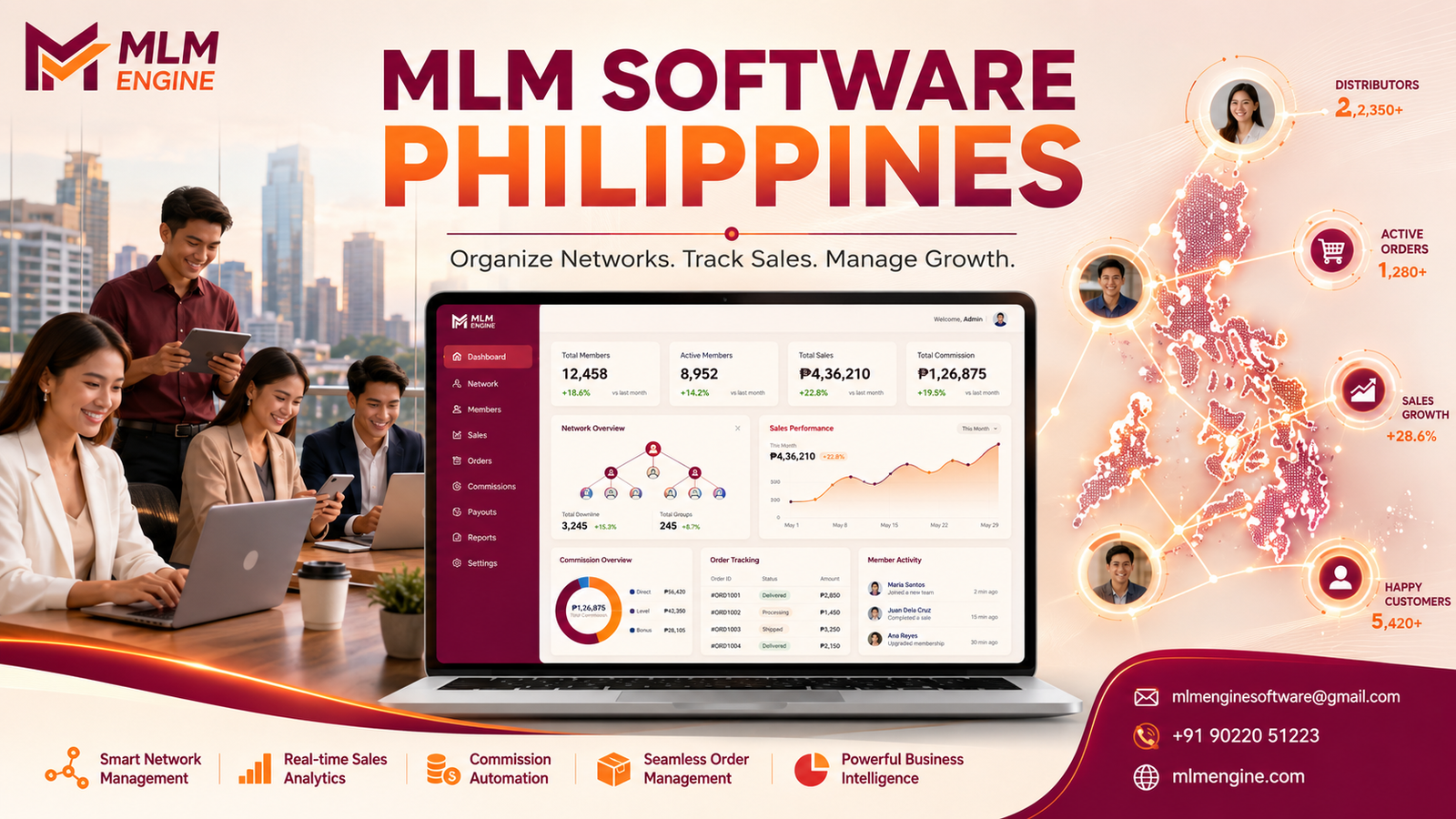
When a direct-selling business is small, spreadsheets and manual notebooks can just about hold everything together. But as a distributor network grows into the hundreds or thousands, that same manual system starts to strain. Commission calculations take longer, records get harder to trace, and business owners spend more time managing paperwork than managing growth. This is where MLM Software Philippines solutions come into the picture not as a magic fix, but as a way to organize the moving parts of a direct-selling business into one manageable system.
Technology platforms like MLM Engine are built around this exact problem: bringing distributor records, sales data, and commission structures into a single, centralized environment. In this article, we’ll walk through why growing MLM businesses in the Philippines need better digital management, what MLM software actually does, the features worth looking for and what to consider before choosing a platform for your business.
Why Growing MLM Businesses Need Better Digital Management
Every MLM or direct-selling business faces a similar turning point. In the early days, a founder or a small team can track everything by memory and spreadsheet. But once the network starts expanding, the same manual approach that worked at 50 distributors starts to break down at 500.
A few challenges tend to show up first:
Increasing distributor records As new members join, keeping accurate, up-to-date profiles contact details, sponsor relationships, joining dates becomes harder to manage by hand.
Managing customer and order information Orders, repeat purchases and product preferences pile up quickly, and manual order management becomes prone to errors and delays.
Tracking team performance Business owners and upline leaders need visibility into how individual distributors and teams are performing, which is difficult to see clearly in scattered spreadsheets.
Commission calculation complexity Once a compensation plan involves multiple levels, bonuses, or matching structures, manual commission tracking becomes time-consuming and error-prone.
Maintaining accurate business records Regulatory and internal audit needs require consistent, traceable records something spreadsheets don’t naturally support at scale.
Reducing repetitive administrative work Data entry, follow-ups and manual report generation eat into time that could be spent on actual business growth.
Giving distributors easier access to information Distributors want to check their own sales, downline activity and earnings without waiting for someone in the office to pull a report.
Generating useful business reports Owners need clear business reporting to make decisions, but assembling reports manually from multiple spreadsheets is slow and often inconsistent.
None of these challenges are unusual they’re a natural part of growth. The real question is how a business chooses to manage them as it scales.
What Is MLM Software Philippines?
MLM Software Philippines refers to specialized digital platforms designed to help direct-selling and network marketing businesses operating in the Philippines manage their day-to-day operations from one centralized system, rather than relying on multiple spreadsheets, manual ledgers, or disconnected tools.
Instead of maintaining separate files for distributor details, sales records, and commission calculations, an MLM software platform brings these functions together. Distributor management, sales tracking and payout information can all be viewed and updated within the same system, which reduces duplication and makes information easier to find.
The difference between manual processes and a centralized platform isn’t just about convenience it’s about consistency. A spreadsheet depends on whoever last updated it being accurate and careful. A properly configured software system applies the same rules and calculations every time, which reduces the chance of human error creeping into commission payouts or sales records.
It’s worth being clear, though software organizes and supports business operations it doesn’t automatically guarantee growth. The value of any MLM Software Philippines platform depends on how well it’s configured to match a business’s actual compensation plan, products, and processes.
Key Features Philippine MLM Businesses Should Look For
Not all MLM software platforms are built the same way. Here are the core features worth evaluating.
Distributor and Member Management
A solid distributor management module should handle registration, distributor profiles, sponsor relationships, and account status. This includes maintaining accurate genealogy information so upline-downline connections stay clear as the network grows.
Commission Management
Commission management tools should let a business configure its specific commission rules, run calculations automatically and maintain clear historical records of earnings and payouts. This is often the single most valuable feature for reducing manual workload.
Sales and Order Tracking
Sales tracking and order management features let businesses monitor product orders, transaction histories, and overall sales activity in real time, rather than compiling this information after the fact.
Genealogy and Network Visualization
Visual representations of the distributor network often shown as a tree or chart structure make it easier to understand sponsor relationships and organizational structure at a glance, which is especially useful as networks grow more complex.
E-Wallet and Payout Management
An e-wallet feature can allow distributors to view their earnings and transaction history in one place, subject to the business’s own configured payout rules, approval processes and applicable banking or regulatory requirements.
Reports and Analytics
Built-in reporting tools help administrators review sales trends, distributor activity levels, commission distribution, and overall network management performance without manually compiling data from multiple sources.
Admin Dashboard
A centralized admin dashboard gives business owners and administrators a single place to oversee operations, approve requests, and monitor the health of the network which becomes increasingly important as the number of distributors and transactions grows.
Choosing the Right MLM Plan for Your Business Model
Not every MLM business runs on the same compensation structure, and software should be configured around the plan that actually fits the business not the other way around. Some common MLM compensation plan types include:
Binary MLM Plan — distributors build two legs, and commissions are often calculated based on balancing volume between them.
Unilevel MLM Plan — distributors can sponsor an unlimited number of people directly, with commissions typically structured across levels.
Matrix MLM Plan — network width and depth are limited to a fixed structure, which shapes how spillover and placement work.
Single Leg MLM Plan — distributors are placed in a single line, creating a straightforward sequential structure.
Hybrid MLM Plan — combines elements of two or more plan types to fit specific business needs.
Other customized compensation structures — some businesses design their own rules that don’t fit neatly into a standard category.
There’s no universally “best” plan what works for one business may not suit another. Before selecting or configuring an MLM compensation plan, a business should have a clear understanding of its products, target customers, sales process, payout rules, and applicable compliance requirements. Software should be built to support that structure accurately, not force the business into a template that doesn’t fit.
How MLM Engine Can Support MLM Business Operations
MLM Engine is a software platform built to help direct-selling businesses manage their network operations from a centralized system. Rather than positioning itself as a one-size-fits-all solution, MLM Engine is designed to be configured around a business’s specific compensation plan and operational needs.
Areas where MLM Engine can support day-to-day operations include:
- Network management across distributor hierarchies and sponsor relationships
- Distributor management, including registration, profiles, and account tracking
- Commission management with configurable calculation rules
- Sales tracking and order management for monitoring transactions
- Business reporting for sales, commissions, and distributor activity
- Dashboard visibility for administrators to oversee operations centrally
- Configurable MLM compensation plan structures, including binary, unilevel, matrix, and hybrid setups
- Centralized administration to reduce fragmented, manual processes
The value of a platform like MLM Engine comes from how well it’s set up to reflect the actual rules and workflows of a given business configuration and ongoing support matter as much as the feature list itself.
Benefits of Using MLM Software Instead of Manual Processes
Moving from manual processes to a structured software platform can bring a number of practical advantages, though the extent of these benefits will vary depending on how well the system is configured and used.
- Less repetitive administrative work since routine data entry and calculations are handled by the system
- Better organization of distributor information with records kept in one consistent place
- Faster access to business reports which potentially reduces the time spent compiling data manually
- More structured commission processing following the same rules consistently
- Easier network monitoring through centralized dashboards rather than scattered files
- Better visibility into sales activity helping teams respond to trends more quickly
- Improved distributor self-service letting members check their own information without added staff workload
- Greater scalability as the business adds more distributors, products, or markets
These are potential benefits rather than guarantees the actual outcome depends on how the software is implemented and how consistently it’s used across the organization.
What Philippine Businesses Should Consider Before Choosing MLM Software
Selecting the right platform is a decision that deserves careful evaluation. Some practical factors to weigh include:
- Compensation plan compatibility — can the software accurately support your specific plan structure?
- Scalability — will it continue to perform well as your distributor base grows?
- Security — how is sensitive distributor and financial data protected?
- Mobile responsiveness — can distributors access the system comfortably from their phones?
- Reporting capabilities — are the available reports detailed and flexible enough for your needs?
- Customization — can the system be adapted to your specific rules and workflows?
- Integration requirements — does it connect with payment systems, communication tools, or other software you already use?
- User experience — is the interface intuitive for both administrators and everyday distributors?
- Technical support — what kind of ongoing support and maintenance is available?
- Data management — how are records backed up, stored, and made accessible for audits?
- Compliance requirements — does the platform allow you to configure processes in line with applicable rules?
It’s important to note that direct-selling businesses in the Philippines operate under specific regulatory, consumer-protection, tax, and data-privacy requirements. Software can support compliant processes, but it isn’t a substitute for proper legal guidance. Businesses should consult qualified legal and financial professionals to confirm their obligations under Philippine law.
Building a More Organized MLM Operation With Technology
Good software works best alongside good business practices it supports strong operations rather than replacing them. A well-run MLM business still needs:
- Clear compensation rules that are documented and consistently applied
- Transparent policies that distributors can easily understand
- Proper distributor onboarding so new members know how the business works
- Accurate product information presented honestly to customers
- Reliable record keeping for both sales and compliance purposes
- Responsible communication between the company and its distributor network
- Regular reporting to track performance and identify issues early
- Customer-focused selling that prioritizes genuine value over pressure tactics
- Appropriate compliance practices aligned with local regulations
Technology can make these practices easier to maintain consistently, but the underlying business discipline still has to come from the company itself.
Conclusion
As direct-selling networks in the Philippines continue to grow, the operational demands that come with that growth distributor management, commission calculations, sales tracking, and reporting become harder to handle manually. This is where MLM Software Philippines solutions offer real, practical value bringing scattered processes into one organized, centralized system.
Platforms like MLM Engine are built to support these operations, from distributor and network management to commission processing and business reporting, with the flexibility to configure different compensation plan structures as a business’s needs evolve. Software alone won’t build a successful MLM business, but it can remove a lot of the administrative friction that slows growth down.
If you’re evaluating MLM Software Philippines options for your business, it may help to speak with a provider directly about your specific compensation plan and operational requirements.
Email: mlmenginesoftware@gmail.com
Phone: +91 90220 51223
Website: https://mlmengine.com/
WhatsApp Channel: https://whatsapp.com/channel/0029Vaj8FP577qVKIi7ooC1d