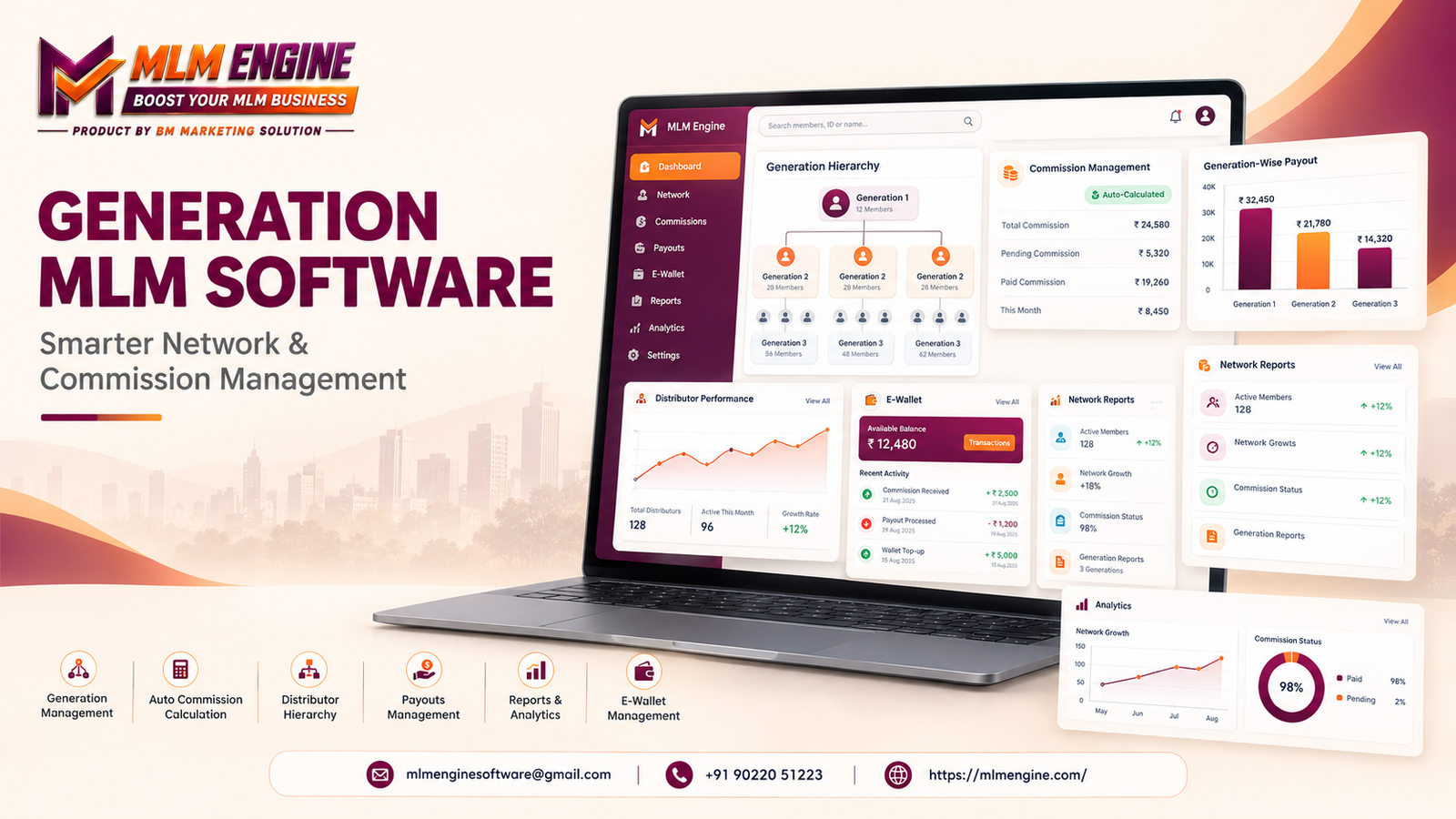
A network with thirty distributors can run on a notebook and a good memory. However, a network with three hundred distributors across several generations needs a more structured approach.
Someone needs to know who sponsored whom, which purchases qualify for each payout, and why one distributor’s monthly figure differs from their expectations. Each question takes time to answer, and repeated calculation errors can affect distributor confidence.
That is often when a direct-selling company starts researching Generation MLM Software Kothrud options. The right platform can organize generation hierarchies, apply commission rules consistently, and keep distributor records, orders, payouts, and reports together.
This guide explains what generation MLM software does, which features to evaluate, what affects pricing, and how to compare providers before making a decision.
What Is Generation MLM Software?
Generation MLM software helps direct-selling businesses organize distributors according to their position in the sponsorship structure and calculate commissions based on generation levels.
For example, imagine a simple family tree. The people you directly sponsor form your first generation. The people they sponsor form your second generation. Their recruits then become your third generation.
A generation-based compensation plan can assign different commission rates to each level. The business may also apply conditions such as minimum purchases, active status, qualifying volume, or payout limits.
As the network grows, manual management becomes increasingly difficult. Software can place new members in the correct position, trace transactions through the upline, apply configured commission rules, and maintain records for future review.
Why Businesses in Kothrud Need Structured MLM Management
Whether a company operates from a Kothrud office or manages distributors working from different locations, administrative complexity increases as the network grows.
Several challenges usually appear first:
- Growing distributor networks: Every new member adds a profile, sponsor relationship, and future transaction history.
- Multiple generations: Tracking several levels manually increases the chance of mistakes.
- Commission calculations: Repeating calculations for every cycle consumes administrative time.
- Member records: Contact details, KYC information, joining dates, and banking details can become difficult to manage across separate files.
- Payouts: Distributors often need clear information about how and when they received a payment.
- Activity monitoring: Management needs a practical way to identify active and inactive members.
- Reporting: Manually prepared reports can take considerable time and may become outdated quickly.
Structured software brings these activities into one environment. As a result, teams can spend less time checking spreadsheets and more time supporting distributors and managing business operations.
Key Features to Check Before Buying
A long feature list does not automatically make software suitable for your business. Instead, examine what each feature actually does for your compensation plan.
Commission and Compensation Controls
- Generation-wise commission management: The platform should support different commission rates for different generations and allow you to configure the required depth.
- Automated commission calculation: Rule-based calculations can apply the same logic to every qualifying transaction and maintain records for later review.
Network and Member Management
- Genealogy and network visualization: A clear genealogy tree helps administrators and distributors understand the network structure quickly.
- Distributor and member management: Registration, KYC status, profile updates, and member status should remain within one centralized system.
- Repurchase and order management: If your compensation plan depends on purchases, orders and product activity should connect with commission calculations.
Money Movement
- E-wallet management: An integrated wallet can show balances, credits, deductions, and withdrawals in one place.
- Payout processing: Look for configurable payout cycles, approval workflows, and support for the deductions your business requires.
- Payment gateway integration: Confirm that the platform supports the payment gateways your business currently uses and can accommodate future integrations.
Reporting and Control
- Income and transaction reports: Detailed statements can help distributors understand how the system calculated their figures.
- Admin dashboard: A centralized dashboard can display new registrations, pending payouts, network activity, and important business metrics.
- Role-based access: Administrators should control which employees can access member data, financial information, and commission settings.
- Notifications and communication: Automated notifications can reduce repetitive follow-ups for registrations, purchases, payouts, and account updates.
Technical Foundation
- Mobile-friendly access: Many distributors manage their accounts from smartphones, so the interface should work properly across smaller screens.
- Security and data protection: Since the system stores personal and financial information, security should remain a core requirement.
- Scalability: Ask how the platform handles increasing member numbers and transaction volumes.
- API and integration support: APIs can connect MLM software with CRM, accounting, logistics, or other business systems.
- Backup and reliability: Confirm how frequently the provider backs up data and how the team can restore information if a problem occurs.
Understanding Generation-Based Commission Management
A simple hypothetical example can make the concept easier to understand. The rates below only illustrate how generation calculations can work. They do not represent a recommended compensation plan.
Imagine four distributors in one sponsorship line:
A → B → C → D
Suppose the company configures:
- Generation 1: 5%
- Generation 2: 3%
- Generation 3: 2%
Now assume D makes a qualifying purchase of ₹1,000.
From D’s position:
- C sits one generation above D, so C receives 5%, or ₹50.
- B sits two generations above D, so B receives 3%, or ₹30.
- A sits three generations above D, so A receives 2%, or ₹20.
However, real compensation plans often include additional conditions.
For example, the company may require a distributor to maintain active status or reach a minimum purchase level. It may also apply monthly limits or other qualification rules.
Therefore, the software needs to apply every configured condition consistently.
Typically, the system follows these steps:
- It records the qualifying purchase or activity.
- It identifies the buyer’s upline.
- It determines each upline member’s generation.
- It checks each member against the configured eligibility rules.
- It calculates the applicable commission.
- It credits the amount to the correct account.
- It records the transaction for future review.
As a result, the main advantage comes from consistent rule application rather than simple calculation speed.
Manual Management vs Automated Software
Manual management can work for a very small network. However, automation becomes more useful as the number of members, generations, and transactions increases.
- Network tracking: Manual systems rely on individual records, while automated platforms maintain a centralized hierarchy.
- Commission calculation: Manual calculations require repeated checking, while software applies predefined rules consistently.
- Payout records: Separate files can make reconciliation difficult, while automated systems connect payout records with transactions.
- Reporting: Manual reports require preparation, while automated reports can use current system data.
- Member management: Separate spreadsheets and chats can scatter information, while centralized software keeps member data together.
- Scalability: Manual processes become harder to maintain as the network expands, while suitable software can support larger operational workloads.
However, automation does not remove the need for proper configuration. If a business enters incorrect commission rules, the software can repeat those mistakes efficiently. Therefore, businesses should test every major rule before launching the system.
Security and Reliability Considerations
Your MLM platform may store personal details, banking information, transactions, and commission records. Therefore, security deserves careful attention during vendor evaluation.
Consider these areas:
- Data security: Ask how the provider protects information during storage and transmission.
- User access controls: Check whether the system supports role-based permissions and controlled access to sensitive settings.
- Secure transactions: Confirm how the platform handles payment and withdrawal processes.
- Regular backups: Ask about backup frequency, storage methods, and recovery procedures.
- Cloud infrastructure: Understand where the platform runs and who manages its infrastructure.
- System reliability: Ask about maintenance schedules, downtime procedures, and support response times.
- Privacy considerations: Confirm how the provider handles member information and supports your privacy obligations.
- Audit records: Transaction and activity logs can help teams investigate changes and resolve disputes.
In addition, direct-selling businesses should review applicable regulations with a qualified legal professional. Software can manage configured business rules, but it cannot determine whether a compensation plan complies with applicable law.
Customization and Business Model Flexibility
Compensation plans can change over time. A business might add another generation, change commission rates, introduce a new reward, or launch another product category.
For that reason, ask providers how their platform handles:
- Custom commission rules, including eligibility requirements, caps, and qualifying volumes.
- Generation configuration, including the number of payable levels.
- Payout settings, such as cycles, minimum withdrawal amounts, and deductions.
- Business workflows, including approvals and order processes.
- Payment and API integrations, so the software can connect with your existing systems.
- Custom reports, based on the information your management team actually needs.
- Branding and white-label requirements, if you want the platform to reflect your company identity.
- Future requirements, including features you may need as your business expands.
Ready-made platforms can offer faster implementation. On the other hand, customized development can provide more flexibility for businesses with unusual compensation rules.
MLM Engine is one provider you can evaluate if your business needs generation-based management alongside other MLM plan structures.
How to Evaluate an MLM Software Provider
During a product demonstration, ask the provider to show each important capability rather than simply describing it.
Use this checklist:
- Generation structure: Can the system support the number of generations in your plan?
- Commission rules: Can you configure rates, conditions, limits, and eligibility requirements?
- Genealogy: Can administrators easily navigate and manage the network tree?
- Reports: Can the system generate income, payout, transaction, and activity reports?
- Payments: Does it support the payment gateways your business requires?
- Scalability: Can the infrastructure support increasing members and transactions?
- Support: Can you reach technical support when you need assistance?
- Customization: Can the provider adapt the system when your compensation plan changes?
- Usability: Can both administrators and distributors use the platform without unnecessary complexity?
- Security: Can the provider clearly explain its security controls?
- Implementation: Do you understand the setup, hosting, maintenance, and support requirements?
A practical test can make the evaluation even more useful. Give the provider a complicated scenario from your actual compensation plan and ask them to demonstrate how the system handles it.
That demonstration can reveal more about the platform than a standard product presentation.
Cost and Pricing Considerations
MLM software prices vary according to business requirements. Instead of relying on a single average price, examine the factors that influence the total cost.
These can include:
- Number of users: Larger networks may require additional infrastructure and resources.
- Compensation-plan complexity: More rules and conditions can require additional configuration and testing.
- Customization: Unique business logic may require development work.
- Integrations: Payment gateways, accounting systems, CRM tools, and other integrations can affect project cost.
- Mobile applications: Dedicated Android or iOS applications can add development and maintenance costs.
- Hosting: Check whether hosting comes with the package or requires a separate arrangement.
- Support: Understand what support the provider includes and what requires an additional fee.
- White-label requirements: Custom branding may affect implementation costs.
- Custom development: Additional features outside the standard package can increase the overall project budget.
Always request a clear breakdown of one-time and recurring charges.
The lowest initial quotation may not represent the lowest overall cost. A platform that requires frequent workarounds or cannot support your compensation plan may create additional administrative and development expenses later.
Benefits of Choosing Suitable Generation MLM Software
When a platform matches the compensation plan and the business configures it correctly, it can improve several operational areas.
For example:
- Better network visibility: Management can view the structure and activity of the network from one system.
- Less manual administration: Automated rules reduce repetitive calculations and data entry.
- Consistent commission processing: The system applies configured rules across transactions.
- Simpler distributor management: Registrations, updates, and status changes remain centralized.
- Connected business information: Member records, orders, payouts, and reports can work together.
- Faster reporting: Teams can access reports without rebuilding spreadsheets for every request.
- Improved operational control: Permissions, logs, and approval workflows provide greater visibility.
- Support for growth: A suitable platform can reduce administrative pressure as the network expands.
These benefits depend on the quality of the software, configuration, business processes, and ongoing management.
Why Consider MLM Engine?
If you are creating a shortlist, MLM Engine is one provider you can evaluate. The platform supports multiple MLM structures, including generation, binary, matrix, unilevel, board, repurchase, single-leg, and hybrid models.
For a generation-based business, focus your product demonstration on the features that directly affect your compensation plan:
- Network management: Review the genealogy structure and distributor records.
- Commission handling: Check how generation rules and eligibility conditions work.
- E-wallet functionality: Examine how balances, credits, and withdrawals appear.
- Reporting: Review income, transaction, and network reports.
- Payment integration: Confirm support for the gateways your business requires.
- Customization: Ask how the platform handles unique compensation rules.
- Business automation: Identify which repetitive administrative activities the platform can handle.
As with any software provider, verify each capability against your own compensation plan before making a decision.
A useful demonstration should focus on your business requirements rather than only showing standard features.
Final Buying Checklist for Generation MLM Software Kothrud
Before selecting a platform, confirm the following:
- Compensation-plan compatibility: The software can represent your plan accurately.
- Generation management: The platform supports your required generation depth and rates.
- Commission automation: Calculations follow defined rules and remain traceable.
- Genealogy management: The network structure remains clear and manageable.
- Payment integration: Required payment gateways and payout methods are available.
- Reporting: Your essential reports are available and easy to access.
- Security: The provider can explain its security controls, permissions, and backup processes.
- Scalability: The platform can support your expected growth.
- Customization: The provider can accommodate future changes to your plan.
- Support: You understand how and when you can contact the support team.
- Mobile accessibility: Distributors and administrators can comfortably use the platform on mobile devices.
- Total cost: One-time, recurring, optional, and development costs are clearly explained.
Conclusion
Choosing software for a generation-based network requires more than comparing feature lists. You need a platform that fits your compensation plan today and can adapt as your business changes.
Functionality shows what the system can do now. Flexibility shows how well it can handle future changes. Security protects the information your distributors trust you with, while scalability and support become increasingly important as the network grows.
Therefore, businesses researching Generation MLM Software Kothrud should start with a practical demonstration based on their own compensation plan. Compare providers using the same checklist, test complicated scenarios, and review the complete cost before making a commitment.
If you want to explore generation-based MLM software options, you can contact the MLM Engine team: