Introduction
Every business handles customers differently. A real estate firm tracks property inquiries and site visits, a SaaS company manages trial-to-paid conversions, and a manufacturing unit follows long B2B sales cycles with multiple decision-makers. Yet most businesses are pushed toward the same generic CRM platforms that were built for the “average” company not for their specific workflows.
This is where Custom CRM Software Development becomes valuable. Instead of forcing a business to adapt to a pre-built tool, custom CRM development creates a platform shaped around the company’s actual sales process, customer management needs, automation requirements, and reporting expectations. As businesses scale and customer data grows more complex, off-the-shelf systems often fall short which is why more organizations are turning to CRM development services that build software around their operations rather than the other way around.
Companies working in this space, including technology providers like MLM Engine, focus on building CRM software development solutions that align with how a business actually functions, not how a generic template assumes it should function.
What Is Custom CRM Software Development?
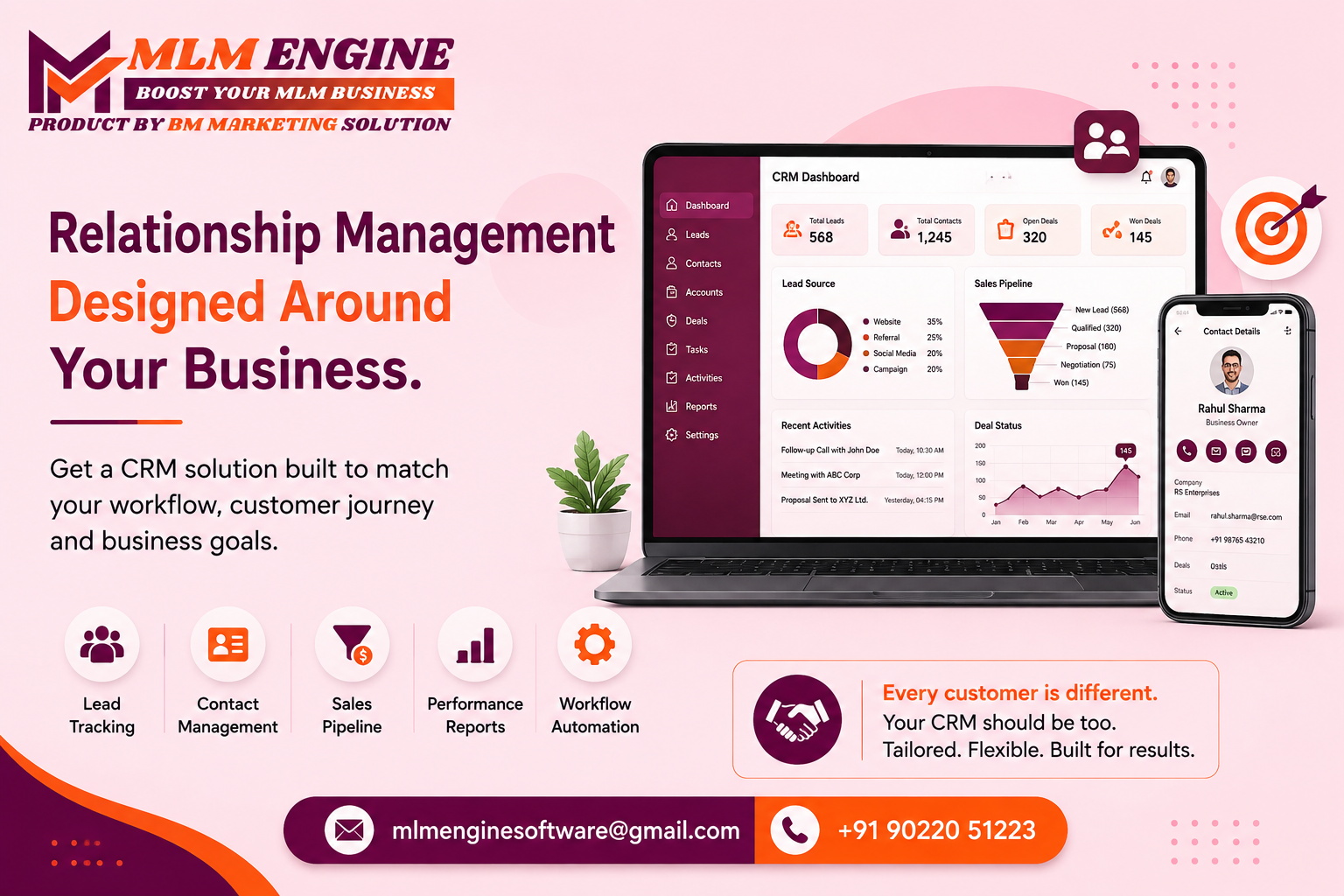
Custom CRM software development is the process of designing and building a customer relationship management system tailored specifically to a company’s operations, rather than using a one-size-fits-all product.
A custom CRM differs from ready-made platforms in a few key ways:
- It is built around the business’s existing workflows instead of asking the business to restructure itself around the software
- Only the modules a company actually needs are included, avoiding paid clutter
- It can integrate deeply with a company’s existing tools, databases, and internal systems
- It scales in the direction the business grows, whether that means new departments, new regions, or new customer segments
Businesses choose custom CRM solutions when their sales cycles, customer types, or internal processes are too specific or too important to compromise on. A logistics company tracking shipments alongside customer accounts, or an MLM business managing distributor networks and commissions, simply has different requirements than a retail store managing walk-in customers.
Why Businesses Need Custom CRM Software
Generic CRM platforms work reasonably well for standard use cases, but many businesses eventually run into limitations:
- Limited customization — Fields, modules, and workflows are locked into the vendor’s design
- Unnecessary features — Businesses pay for modules they never use, while still lacking the ones they need
- Integration restrictions — Connecting internal tools, ERPs, or industry-specific software can be difficult or impossible
- Workflow limitations — Sales and support processes are forced to match the software’s logic instead of the business’s own
- Scalability concerns — Adding users, departments, or new business units often triggers steep licensing costs
- Data management challenges — Reporting and analytics may not reflect the metrics that actually matter to the business
- Higher long-term costs — Add-ons, per-user fees and premium tiers can make “affordable” CRM software expensive over time
These challenges are a major reason businesses look into custom CRM development not because ready-made tools are poorly built, but because they aren’t built for every business.
Key Features of Custom CRM Software
A well-built custom CRM typically includes the following capabilities, each designed to solve a specific operational need:
- Lead Management — Captures, organizes, and tracks leads from multiple sources so sales teams never lose visibility on a potential customer.
- Contact & Customer Management — Maintains a centralized customer profile, including communication history, preferences, and past interactions.
- Sales Pipeline Management — Visualizes every deal’s stage, helping teams identify bottlenecks and prioritize follow-ups.
- Opportunity Management — Tracks potential deals with relevant details like deal value, probability, and expected closing timelines.
- Task & Follow-Up Management — Assigns and tracks tasks so no lead or customer request is missed.
- Email & Communication Management — Centralizes email threads and communication logs directly within customer records.
- Sales Automation — Automates repetitive tasks like lead assignment, follow-up reminders, and status updates.
- Workflow Automation — Streamlines internal approval chains, notifications, and multi-step processes.
- Reports & Analytics — Delivers real-time insight into sales performance, team productivity, and customer trends.
- Customer Support Management — Tracks support tickets and service requests alongside sales data for a complete customer view.
- Role-Based Access Control — Restricts data visibility based on user roles, protecting sensitive business information.
- Third-Party Integrations — Connects with accounting tools, marketing platforms, ERPs, and communication apps.
- Mobile-Friendly Interface — Allows sales and support teams to manage customer data on the move.
- Notifications & Reminders — Keeps teams updated on deadlines, follow-ups, and pending actions.
- Data Security & Backup — Protects sensitive customer information with structured access controls and backup protocols.
- Custom Dashboard — Displays the metrics that matter most to a specific business or department.
- API Integration — Connects the CRM with external applications and internal systems for seamless data flow.
- Document & File Management — Stores contracts, proposals, and customer-related documents within the CRM itself.
Benefits of Custom CRM Software Development
- Business-specific workflows that mirror how the company actually operates
- Better productivity through automation of repetitive administrative tasks
- Improved customer relationships driven by centralized, accurate customer data
- Better sales visibility across the entire pipeline
- Process automation that reduces manual errors
- Improved reporting aligned with the metrics that matter to the business
- Scalability that grows alongside the organization
- Integration flexibility with existing tools and systems
- Better data control, since the business owns its infrastructure and data model
- Reduced operational complexity by eliminating unnecessary features
- Long-term business value, as the CRM evolves with the company instead of becoming obsolete
Custom CRM vs Ready-Made CRM
| Factor | Custom CRM | Ready-Made CRM |
|---|
| Customization | Fully tailored to business needs | Limited to vendor-defined options |
| Features | Only what the business requires | Fixed feature bundles |
| Scalability | Built to scale with the business | Often requires costly plan upgrades |
| Integration | Deep, flexible integrations | Limited to supported integrations |
| User Experience | Designed around actual user workflows | Generic interface for all industries |
| Data Control | Business owns data and infrastructure | Data often hosted by third-party vendor |
| Pricing Approach | One-time or milestone-based development cost | Recurring subscription/per-user fees |
| Maintenance | Managed by development partner or in-house team | Handled by CRM vendor |
| Business Suitability | Ideal for unique or complex workflows | Suitable for standard, simple use cases |
Custom CRM Software Development Process
- Requirement Analysis — Understanding business goals, sales processes, and customer management needs
- Business Workflow Planning — Mapping how the CRM should reflect real operational workflows
- UI/UX Design — Designing an interface that’s intuitive for the actual end users
- Technology Selection — Choosing the right frontend, backend, and database technologies
- CRM Development — Building core modules and features
- Third-Party API Integration — Connecting with existing business tools
- Testing & Quality Assurance — Validating functionality, security, and performance
- Deployment — Launching the CRM in a live business environment
- Training — Onboarding teams to use the system effectively
- Maintenance & Updates — Ongoing support, bug fixes, and feature enhancements
Technology Stack for Custom CRM Development
While the exact stack depends on business requirements, custom CRM platforms are typically built using a combination of:
- Frontend — Modern JavaScript frameworks for responsive, interactive interfaces
- Backend — Scalable server-side frameworks suited to the business’s transaction volume
- Database — Relational or NoSQL databases depending on data structure needs
- APIs — RESTful or GraphQL APIs for integration with external systems
- Cloud Infrastructure — Cloud hosting for scalability, uptime, and remote accessibility
- Security — Encryption, authentication protocols, and role-based access frameworks
- Mobile Applications — Native or cross-platform frameworks for mobile CRM access
The right combination depends on business size, budget, and long-term scalability goals.
How Much Does Custom CRM Software Development Cost?
There’s no single fixed price for custom CRM software development cost depends heavily on scope. That said, businesses can generally expect the following tiers:
- Basic CRM — Covers core modules like contact management, lead tracking, and basic reporting. Suitable for small teams with straightforward sales processes.
- Mid-Level CRM — Includes sales automation, workflow automation, integrations, and more detailed analytics. Suitable for growing businesses with multiple departments.
- Enterprise CRM — Involves advanced automation, multiple integrations, custom dashboards, high-level security, and scalability for large user bases.
Cost is influenced by the number of modules, complexity, UI/UX requirements, number of users, required integrations, automation needs, mobile app requirements, security standards, hosting infrastructure, and ongoing maintenance and support. Businesses should request a detailed scope-based quote rather than relying on generic price estimates, since CRM development cost varies significantly project to project.
Factors That Affect CRM Development Cost
- Number of Modules — More modules mean more development and testing effort
- CRM Complexity — Advanced automation and logic increase development time
- UI/UX Requirements — Custom-designed interfaces take longer than template-based ones
- Number of Users — Larger user bases may require additional infrastructure planning
- Integrations — Each third-party integration adds development and testing work
- Automation Requirements — Complex automation rules require more engineering effort
- Mobile Application Requirements — Native apps typically cost more than responsive web interfaces
- Security Requirements — Higher security standards require additional development layers
- Hosting Infrastructure — Cloud hosting costs vary based on scale and redundancy needs
- Maintenance & Support — Ongoing updates and support add to the total cost of ownership
How to Choose a Custom CRM Software Development Company
- Technical expertise across relevant technologies and industries
- Previous CRM projects that demonstrate real-world experience
- Customization capabilities rather than templated solutions
- Integration experience with common business tools and APIs
- Security practices that protect sensitive customer data
- Development methodology that includes clear milestones and communication
- Post-launch support for updates, bug fixes, and scaling needs
- Scalability planning for future business growth
- Transparent pricing without hidden costs
Providers such as MLM Engine approach CRM development as part of a broader technology and business software solutions offering, which can be useful for companies that may need related systems such as automation tools or business management platforms alongside their CRM. More details are available at https://mlmengine.com/.
Why Choose Custom CRM Software for Your Business?
Every business has a slightly different definition of what “managing customers well” looks like. A custom CRM lets a business design its software around real workflows, real customer touchpoints, and real reporting needs instead of adjusting internal processes to match a generic platform’s limitations. Over time, this alignment tends to reduce operational friction and gives teams a system that actually reflects how they work.
Conclusion
Custom CRM Software Development gives businesses the ability to build a system that genuinely reflects how they manage leads, customers, sales processes, and reporting rather than adapting to the constraints of a generic platform. From lead management and automation to integrations and scalability, a custom CRM can be shaped around exactly what a business needs today, while remaining flexible enough to support future growth.
For businesses exploring CRM development services or looking for a technology partner to build a tailored solution, MLM Engine offers CRM software development as part of its broader software solutions. Learn more at https://mlmengine.com/.
Email: mlmenginesoftware@gmail.com
Phone: +91 90220 51223
Website: https://mlmengine.com/
WhatsApp Channel: https://whatsapp.com/channel/0029Vaj8FP577qVKIi7ooC1d