What an MLM Software Solution Really Does for Your Business
How Learning Management System Software Is Reshaping Digital Training for Every Organization Digital learning has quietly become the backbone of how schools, companies and training

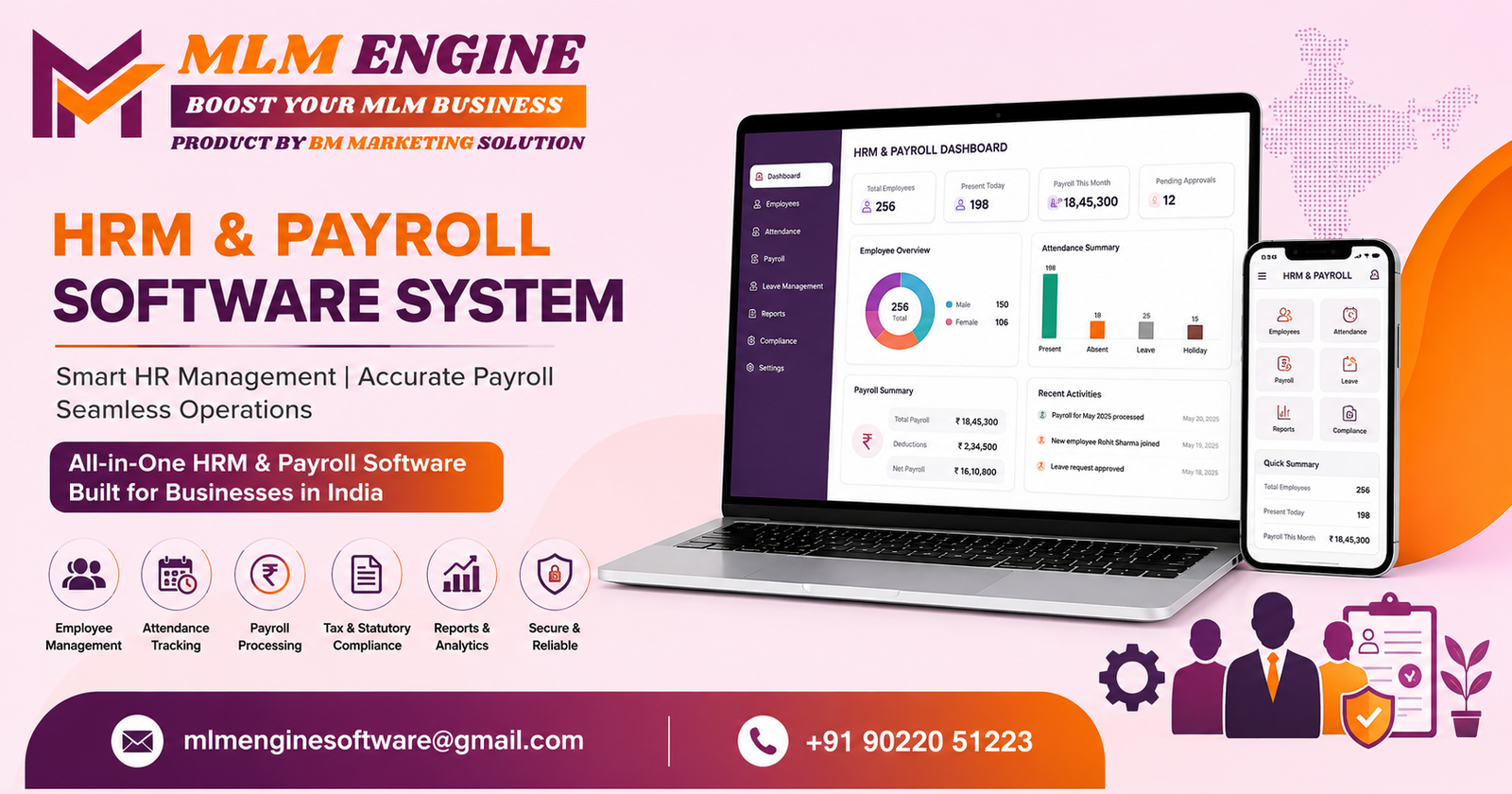
Finding the Best HRM payroll system India is essential for businesses looking to simplify employee management, automate salary processing, and ensure compliance. A powerful HRM payroll system India helps companies manage attendance, payroll, and HR operations efficiently.
This is where a dedicated HRM and Payroll system steps in to change the game entirely.
This guide covers everything you need to understand about HRM and payroll software in India, why your business needs one right now, what features to look for and how the right solution can transform the way your organization operates.
An HRM system, short for Human Resource Management system, is a digital platform that centralizes all employee-related data and processes under one roof. From recruitment and onboarding to attendance tracking, performance evaluation, and exit management, an HRM system covers the full employee lifecycle.
A payroll system, on the other hand, handles the financial side of employment. It calculates salaries, manages deductions for PF, ESI, TDS, and professional tax, generates pay slips and ensures that salary disbursements happen accurately and on time every month.
When both systems are integrated into a single platform, businesses gain a powerful tool that eliminates data duplication, reduces errors and gives HR managers and business owners real-time visibility into their workforce.
India’s regulatory environment for employment is one of the most detailed in the world. Businesses must comply with the Employees’ Provident Fund Act, the Employees’ State Insurance Act, the Payment of Gratuity Act, the Shops and Establishment Act and numerous other state-level and central regulations. Missing a deadline or filing an incorrect return can result in penalties, legal complications, and reputational damage.
Beyond compliance, the expectations of the modern Indian workforce have also changed. Employees expect digital payslips, self-service portals where they can apply for leave or check their attendance and transparent communication about their salaries and benefits. A manual HR process cannot meet these expectations.
Additionally, as businesses scale across cities and states in India, managing remote teams, multiple pay structures and varying local compliance requirements becomes exponentially more difficult without a robust software system.
HRM software solves all of this in a structured, automated and scalable way.
Payroll is one of the most sensitive functions in any organization. An error in salary calculation or a delay in disbursement can significantly damage employee morale and trust. A dedicated payroll system eliminates these risks by automating the entire process.
With dozens of options available in the Indian market, selecting the right HRM and payroll system requires careful evaluation.
Look for a platform that covers the complete HR lifecycle from recruitment to exit and not just payroll processing. Ensure it supports Indian statutory compliance natively, including PF, ESI, TDS, professional tax and gratuity. Verify that the software integrates with your existing tools such as accounting software, ERP platforms, or CRM systems. Assess the user interface carefully because a complicated system that employees resist using defeats the entire purpose. Check whether the vendor offers local support and regular compliance updates since Indian regulations change frequently.
Also consider whether the platform offers a mobile application so that employees and managers can perform HR tasks from anywhere, which is especially relevant for businesses with field teams or remote workers spread across India.
While every business with employees benefits from HRM and payroll software, certain industries in India see the most immediate impact.
Manufacturing and production units with large workforces and shift-based attendance systems gain enormous efficiency from automated tracking and payroll. IT and technology companies benefit from streamlined onboarding, performance cycles, and compliance management for high-turnover environments. Retail chains with multiple locations need centralized HR management to maintain consistency across branches. Direct selling companies and network marketing organizations often have complex compensation structures involving commissions, bonuses and incentives that require sophisticated payroll engines to calculate and disburse accurately. Healthcare organizations, educational institutions, logistics companies, and construction firms all have specific workforce management challenges that dedicated HRM software addresses effectively.
The right HRM and payroll system is not a luxury. For businesses operating in India’s competitive and regulation-heavy environment, it is a necessity. It protects you from compliance risk, saves hours of manual effort every month, keeps your employees satisfied, and gives your leadership team the data they need to make informed workforce decisions.
If your business is ready to move beyond spreadsheets and manual HR processes, MLM Engine offers robust HRM and payroll solutions built for the Indian market. Whether you are managing a direct selling network, a growing startup, or a multi-location enterprise, the platform is designed to handle your workforce with precision and ease.
Explore the complete suite of business software solutions at https://mlmengine.com and take the first step toward smarter HR management today.
Get in Touch with MLM Engine
Email: mlmenginesoftware@gmail.com
Phone: +91 90220 51223
Website: https://mlmengine.com
Reach out today to schedule a free demo and discover how the right HRM and payroll system can transform the way you manage your most valuable asset your people.
How Learning Management System Software Is Reshaping Digital Training for Every Organization Digital learning has quietly become the backbone of how schools, companies and training
How Learning Management System Software Is Reshaping Digital Training for Every Organization Digital learning has quietly become the backbone of how schools, companies and training
Unilevel MLM Software Explained: A Practical Guide for Direct Sellers INTRODUCTION Direct selling and MLM businesses grow fast and once a distributor network crosses a
Website Development for SEO How the Right Foundation Turns Visitors into Customers Every business today competes for attention online and the difference between a website
Role-Based ERP System: Smarter Security for Every Team If you’ve ever watched an employee accidentally delete financial records because they had access they never should
How to Build a Profitable Mobile Recharge MLM Business From Scratch Picture this someone in a small town needs to top up their phone at
Beyond Generic CRM: What Custom CRM Software Development Really Offers Your Business Introduction Every business handles customers differently. A real estate firm tracks property inquiries
HRM software manages the full employee lifecycle including recruitment, attendance, performance and exit processes. Payroll software specifically handles salary calculations, statutory deductions and disbursements. An integrated platform combines both for maximum efficiency.
Absolutely. Even small businesses benefit significantly from automating attendance, leave, and payroll. It reduces errors, saves time, and ensures compliance from day one of operations.
A good HRM and payroll system for India automates the calculation and filing of PF, ESI, TDS, professional tax and gratuity. It generates the required statutory forms and keeps the business compliant with central and state regulations throughout the year.
Yes. Most modern HRM platforms offer self-service portals and mobile apps where employees can check their attendance, apply for leave, download payslips, and update personal information without needing to contact HR.
Implementation timelines vary based on the size of the organization and the complexity of the configuration required. A typical deployment for a small to mid-sized business can be completed within a few weeks, including data migration and user training.