Unilevel MLM Software Explained: A Practical Guide for Direct Sellers
Unilevel MLM Software Explained: A Practical Guide for Direct Sellers INTRODUCTION Direct selling and MLM businesses grow fast and once a distributor network crosses a

Digital learning has quietly become the backbone of how schools, companies and training institutes operate. Whether it’s onboarding new employees, running an online course or managing certification programs, organizations are moving away from paper records and scattered spreadsheets. This shift has made Learning Management System Software one of the most searched-for solutions in the education and corporate training space today.
Managing courses, learners, assessments, certificates and reports manually is time-consuming and error-prone. Trainers lose track of who completed what. Institutions struggle to measure real learning outcomes. Businesses find it hard to scale employee training programs without a centralized system. This is exactly the gap that a modern learning platform is built to close.
Platforms like MLM Engine are increasingly being explored by organizations that want a structured, centralized way to handle their digital learning needs without getting overwhelmed by technical complexity.
At its core, Learning Management System Software is a digital platform that allows organizations to create, deliver, manage and track learning programs from one centralized dashboard. Instead of juggling emails, spreadsheets and physical attendance registers, everything related to a course content, learners, assessments and results lives in one place.
An LMS typically supports both self-paced and instructor-led learning, making it flexible enough for schools, coaching centers and corporate training departments alike. Administrators can enroll learners, upload course material, monitor participation, and generate reports without manually chasing updates from multiple people.
Adopting an online learning platform isn’t just a trend it solves real operational problems that grow more painful as an organization scales.
A capable learning management platform typically combines several features that work together rather than in isolation.
Admins can build, organize, and update courses in modules, making it easy to structure content logically for different learner groups.
Every learner’s profile, enrollment history, and progress is tracked individually, giving trainers a clear picture of participation.
Secure sign-up and login processes ensure only authorized learners and staff can access specific courses or data.
Live or recorded sessions allow learners to attend classes remotely, which is especially valuable for geographically spread teams or students.
Course materials, PDFs, presentations, and reference documents are stored centrally so learners always know where to find them.
Built-in testing tools let instructors evaluate understanding immediately after a module, rather than waiting for a separate exam cycle.
Learners can submit tasks digitally, and instructors can review and grade them within the same platform.
Visual indicators show how far along each learner is, helping both the learner and the administrator stay accountable.
Automated certificate generation upon course completion adds credibility and motivates learners to finish what they start.
Trainers and educators can be assigned to specific courses, with visibility into their own learner groups and performance data.
Automated alerts keep learners informed about deadlines, new content, or upcoming live sessions.
For paid courses, built-in billing tools handle subscriptions, one-time payments, and renewals without manual invoicing.
Detailed reports help administrators understand completion rates, engagement patterns, and areas needing improvement.
A centralized view gives administrators, instructors, and learners quick access to what matters most to their role.
Different permission levels ensure admins, instructors, and learners only see what’s relevant to them.
Responsive design allows learners to study from smartphones or tablets, not just desktop computers.
Learner records, assessment results, and payment details are protected through structured access controls and secure storage.
Organizations that adopt an eLearning software solution typically notice improvements across several areas:
For example, a corporate HR team can track which employees have completed mandatory compliance training without manually following up with every department head.
An online training software solution isn’t limited to one type of organization. It adapts across sectors:
MLM Engine offers a platform that organizations can explore when looking to bring structure to their digital learning operations. Rather than positioning itself as a one-size-fits-all solution, MLM Engine focuses on core administrative needs that most learning-driven organizations face.
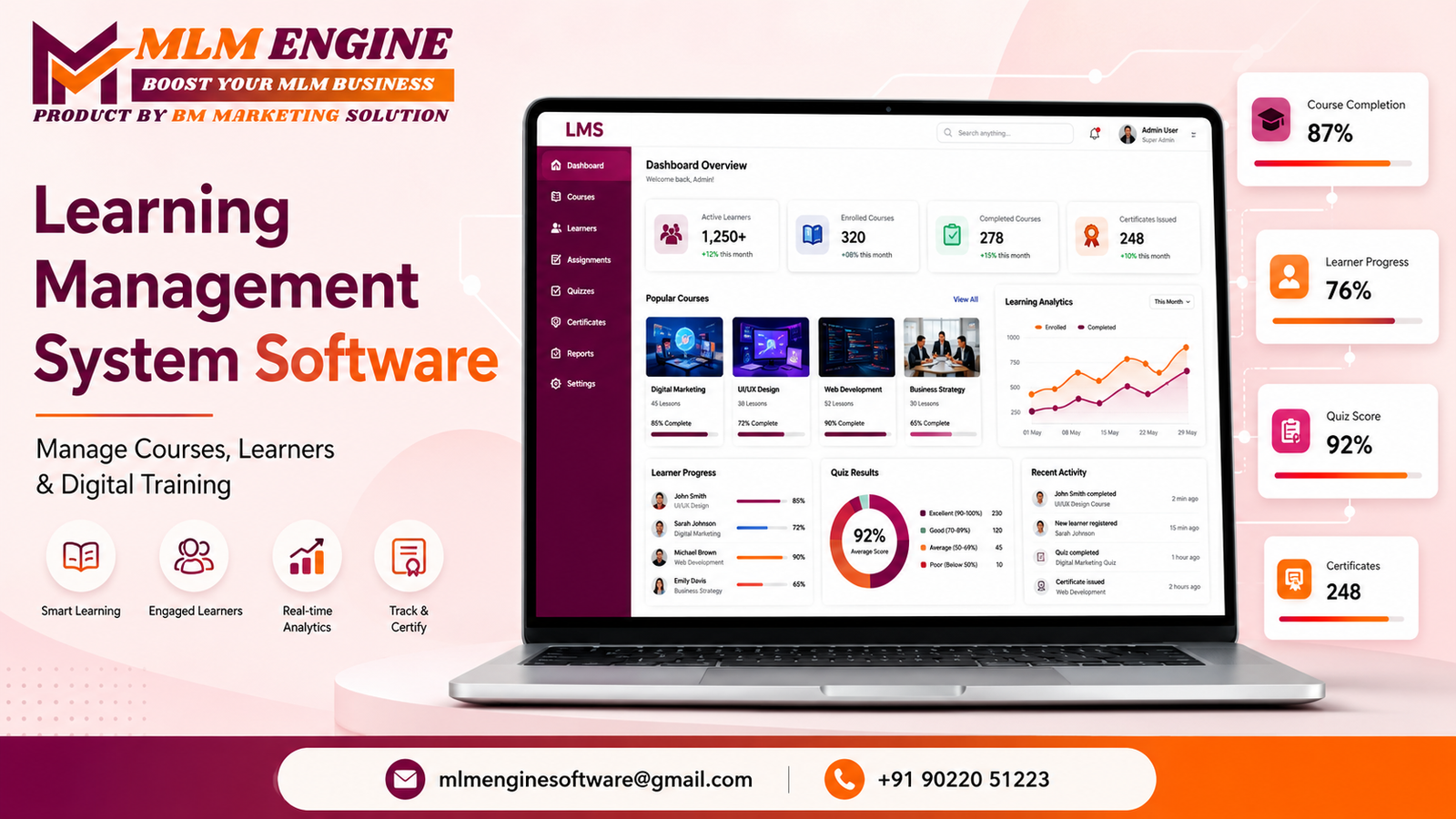
Capabilities relevant to digital learning management include course management, learner management, and instructor management, allowing administrators to organize training programs without switching between multiple tools. Assessment handling and progress tracking give a clear view of learner performance, while reporting features help teams evaluate outcomes over time.
User dashboards provide role-specific views for admins, instructors, and learners, and subscription or payment management supports organizations running paid training programs. Centralized administration ties these functions together, reducing the operational overhead of managing learning activities across separate systems.
Organizations evaluating MLM Engine for learning management purposes are encouraged to assess these capabilities against their specific requirements before deciding on implementation.
| Factor | Traditional Training | Learning Management System Software |
|---|---|---|
| Accessibility | Limited to physical location/time | Available anytime, anywhere |
| Administration | Manual, paper-based tracking | Automated, centralized management |
| Cost | Higher due to venue, printing, travel | Lower long-term operational cost |
| Progress Tracking | Manual attendance and grading | Automated, real-time tracking |
| Assessments | Often paper-based or scheduled separately | Built-in digital quizzes and assignments |
| Reporting | Time-consuming to compile | Instant, data-driven reports |
| Scalability | Difficult to scale without more staff | Easily scales to hundreds of learners |
Selecting a course management software solution should be based on organizational needs rather than trends. Consider the following before making a decision:
The direction of employee training platform technology points toward more intelligent, personalized systems. AI-assisted learning is beginning to help recommend content based on individual learner performance, rather than applying the same material to everyone.
Personalization is likely to deepen further, with platforms adjusting pacing and difficulty based on how learners actually engage with content. Automation will continue reducing manual administrative work, from grading to certificate issuance.
Mobile-first education is becoming the default expectation rather than an added feature, and data-driven learning will play a larger role in shaping how organizations refine their training programs. Interactive and virtual learning formats are also expected to grow, supported by better analytics that help administrators understand not just completion rates, but actual skill retention.
Learning Management System Software has moved from being a nice-to-have to a practical necessity for schools, businesses, and training organizations that want to manage digital education efficiently. From course creation and learner tracking to assessments, certificates, and reporting, a well-structured digital learning platform removes much of the manual burden that traditional training methods carry.
Organizations exploring solutions in this space can consider MLM Engine as a platform to support their digital learning and training management requirements. If you’d like to learn more about how MLM Engine can fit into your organization’s training workflow, feel free to reach out.
Email: mlmenginesoftware@gmail.com
Phone: +91 90220 51223
Website: mlmengine.com
WhatsApp Channel: https://whatsapp.com/channel/0029Vaj8FP577qVKIi7ooC1d
Unilevel MLM Software Explained: A Practical Guide for Direct Sellers INTRODUCTION Direct selling and MLM businesses grow fast and once a distributor network crosses a
Website Development for SEO How the Right Foundation Turns Visitors into Customers Every business today competes for attention online and the difference between a website
Role-Based ERP System: Smarter Security for Every Team If you’ve ever watched an employee accidentally delete financial records because they had access they never should
How to Build a Profitable Mobile Recharge MLM Business From Scratch Picture this someone in a small town needs to top up their phone at
Beyond Generic CRM: What Custom CRM Software Development Really Offers Your Business Introduction Every business handles customers differently. A real estate firm tracks property inquiries
How to Launch Your MLM Business in 30 Days with the Right Software Starting a multi-level marketing business used to take months of planning, manual
Why Every Business Needs Professional MLM Website Development Services Introduction Starting a multi-level marketing business today means competing in a digital-first world. Distributors expect real-time