What an MLM Software Solution Really Does for Your Business
How Learning Management System Software Is Reshaping Digital Training for Every Organization Digital learning has quietly become the backbone of how schools, companies and training

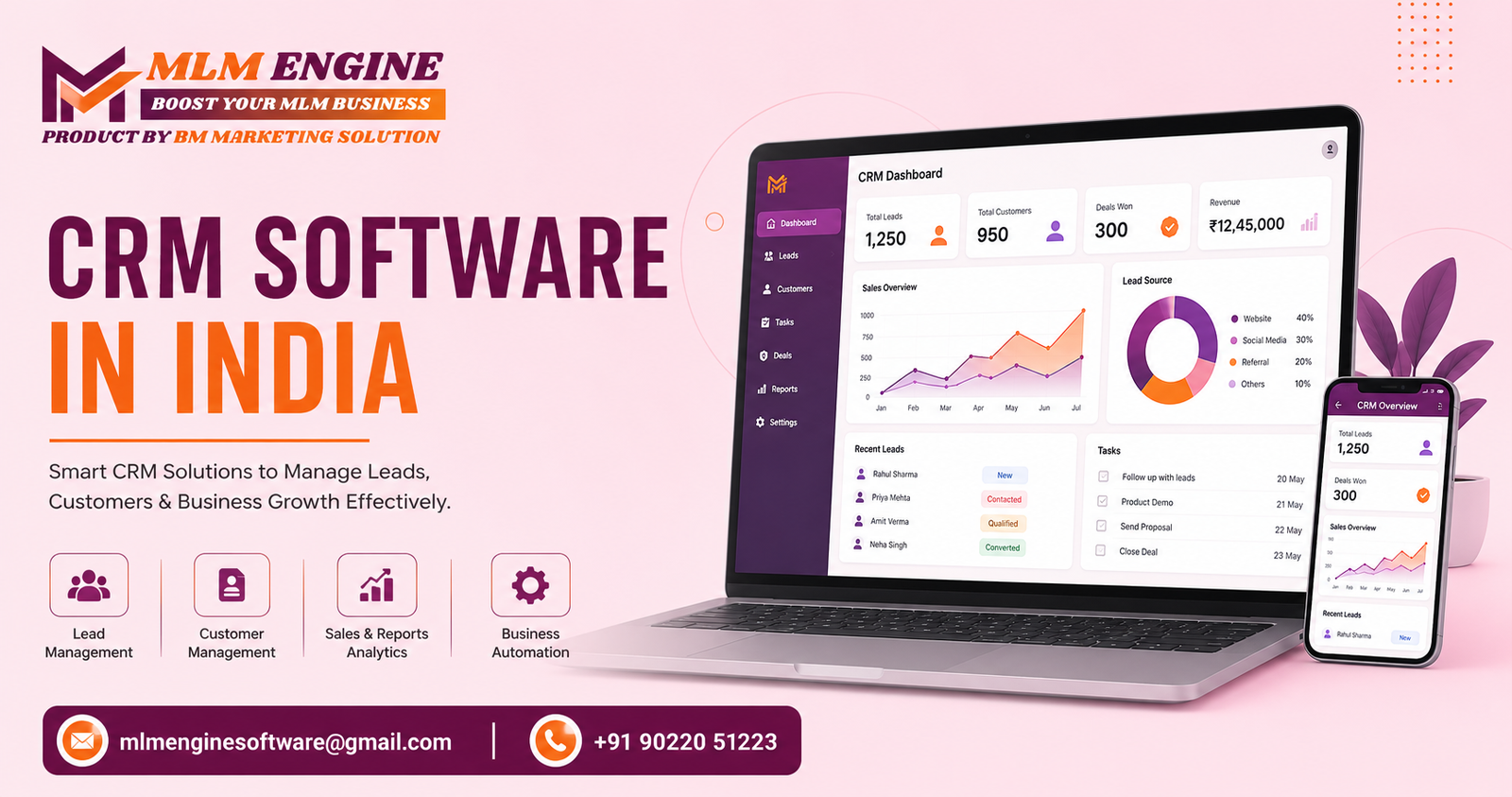
CRM Software in India is becoming essential for businesses looking to manage leads, improve customer relationships and boost sales efficiently. With increasing competition, companies across India are adopting advanced CRM solutions to streamline operations, automate processes and enhance customer engagement. Whether you’re a startup or an established enterprise, choosing the right CRM can significantly impact your business growth.
CRM stands for Customer Relationship Management. At its core, a CRM system is a software platform that helps businesses manage their interactions with current customers and potential leads. It stores contact information, tracks communication history, monitors deal progress and automates repetitive tasks so teams can focus on building relationships rather than managing data.
Modern CRM platforms do far more than store names and phone numbers. They integrate with email, WhatsApp, calling tools, marketing automation systems and even billing software. They generate reports that show which campaigns are converting, which sales reps are performing and where deals are getting stuck in the funnel.
For businesses operating with large networks, multiple branches or distributed sales teams, a CRM becomes the single source of truth for everything customer-related.
India added millions of internet users in the last five years. Digital transactions, online inquiries and social media leads are now a primary driver of business for companies across every sector. Managing this volume manually is not just inefficient, it is impossible.
Several factors are pushing Indian businesses toward CRM adoption at a faster rate than ever before.
The shift to remote and hybrid work has made centralized data essential. When sales reps work from different cities or even different countries, a shared CRM platform ensures no one is operating in a silo.
GST compliance and documentation requirements have made organized record-keeping a legal priority, not just a business best practice. CRM systems that integrate with invoicing and payment tools reduce the compliance burden significantly.
Competition has intensified in almost every vertical. The business that responds to a lead first, follows up consistently and personalizes their communication wins. CRM software makes all of this systematic rather than dependent on individual effort.
Customer expectations have risen. People want faster responses, relevant offers and businesses that remember their preferences. A CRM enables this level of service even as the customer base grows.
Not all CRM systems are built the same. Before selecting a platform, businesses need to understand which features genuinely matter for day-to-day operations.
Direct selling and network marketing businesses face unique CRM challenges. They manage large distributor networks, track multi-level commissions, handle KYC documentation, and need to monitor both customer purchases and distributor recruitment activity simultaneously.
A standard CRM rarely covers these needs adequately. Businesses in this sector need platforms that combine CRM functionality with MLM-specific tools such as genealogy tree management, commission wallet tracking, downline performance reporting, and replicated website management.
MLM Engine offers software solutions built specifically for this environment. The platform integrates CRM features with the specialized tools that direct selling businesses actually need, from TDS and GST-compliant commission processing to distributor back-office management, all within a single system designed for the Indian market.
Finding the best CRM system in India is not about picking the most popular name or the most feature-rich platform. It is about identifying the solution that fits your business model, your team’s working style, and your growth ambitions.
For most businesses, the right CRM will reduce manual work, improve lead conversion, strengthen customer relationships, and give leadership the visibility they need to make better decisions. The investment pays back quickly when the system is properly implemented and consistently used.
If you are in the direct selling or network marketing space, the requirement goes beyond a standard CRM. You need a platform that understands the structure of your business and can manage the complexity of multi-level networks, commission calculations and distributor management alongside standard CRM functions.
MLM Engine is built exactly for this purpose. Explore the full range of solutions at https://mlmengine.com and take the first step toward a more organized, more efficient, and more scalable business operation.
Ready to see how the right software can transform your sales and distribution operations? Connect with the MLM Engine team today and get a personalized walkthrough of the platform.
Email: mlmenginesoftware@gmail.com
Phone: +91 90220 51223
Website: https://mlmengine.com
WhatsApp Channel: https://whatsapp.com/channel/0029Vaj8FP577qVKIi7ooC1d
How Learning Management System Software Is Reshaping Digital Training for Every Organization Digital learning has quietly become the backbone of how schools, companies and training
How Learning Management System Software Is Reshaping Digital Training for Every Organization Digital learning has quietly become the backbone of how schools, companies and training
Unilevel MLM Software Explained: A Practical Guide for Direct Sellers INTRODUCTION Direct selling and MLM businesses grow fast and once a distributor network crosses a
Website Development for SEO How the Right Foundation Turns Visitors into Customers Every business today competes for attention online and the difference between a website
Role-Based ERP System: Smarter Security for Every Team If you’ve ever watched an employee accidentally delete financial records because they had access they never should
How to Build a Profitable Mobile Recharge MLM Business From Scratch Picture this someone in a small town needs to top up their phone at
Beyond Generic CRM: What Custom CRM Software Development Really Offers Your Business Introduction Every business handles customers differently. A real estate firm tracks property inquiries
A CRM system is software that helps businesses manage customer relationships by organizing contact data, tracking interactions, automating follow-ups and providing reporting on sales performance. It improves efficiency, reduces manual work, and helps teams close more deals.
Any business that deals with leads, customers, or a sales team can benefit from CRM software. It is particularly valuable for businesses with large customer bases, multiple sales reps, or complex sales cycles.
Absolutely. Many CRM platforms are designed to scale with business size. Small businesses benefit from the structure and automation a CRM provides and can expand their usage as the team and customer base grow.
Look for platforms that support GST invoicing, INR currency, WhatsApp integration, UPI or NEFT payment tracking and local language support. Also prioritize vendors that offer Indian-based customer support and onboarding assistance.
Can a CRM be integrated with other business software?
Yes. Most modern CRM platforms support integrations with email tools, accounting software, marketing automation platforms and payment systems. Integration capability is a key factor to evaluate before selecting a platform.
Yes. MLM Engine provides software solutions that combine CRM functionality with direct selling-specific tools including genealogy tree management, commission processing, KYC handling, distributor back-office access and GST-compliant invoicing, all designed for the Indian market.