Most conversations about donation software begin with features. A better starting point is a simpler question: what does your program need to remember, who needs to see it, and what rules decide what happens next? Those three things, records, roles, and rules, sit underneath every peer-to-peer donation operation, whether it has forty members or four thousand.
Software built for this purpose organizes all three in one place. That is the idea behind Donation MLM Software Katraj, a search many entrepreneurs, program administrators and network managers in Katraj and Pune make when informal methods stop keeping up. Messages get buried, entries disagree, and the administrator becomes the only reliable source of memory.
This guide uses the records, roles, and rules lens to explain what donation MLM software does, what to evaluate, and how to buy sensibly. It avoids bold promises on purpose. Features differ between providers, and everything discussed here should be verified directly with the software company you consider.
First, a Plain Definition
Donation MLM software is a platform for administering donation plans within a member-based network. In a peer-to-peer arrangement, members contribute directly to other members as the plan describes. The software does not decide your plan. It stores the network, follows the rules the administrator configures, logs contributions, tracks statuses, and builds reports.
That is quite different from centralized recordkeeping, where a single office receives everything and keeps a single ledger. In peer-to-peer donation management, activity is spread across many participants, so the record must capture who contributed, to whom, when, under which reference, and with what confirmation status.
Depending on the provider, related functions may include:
- Member registration and profile management
- Network and referral tracking
- Donation and contribution recordkeeping
- Donation-plan administration
- Transaction status monitoring
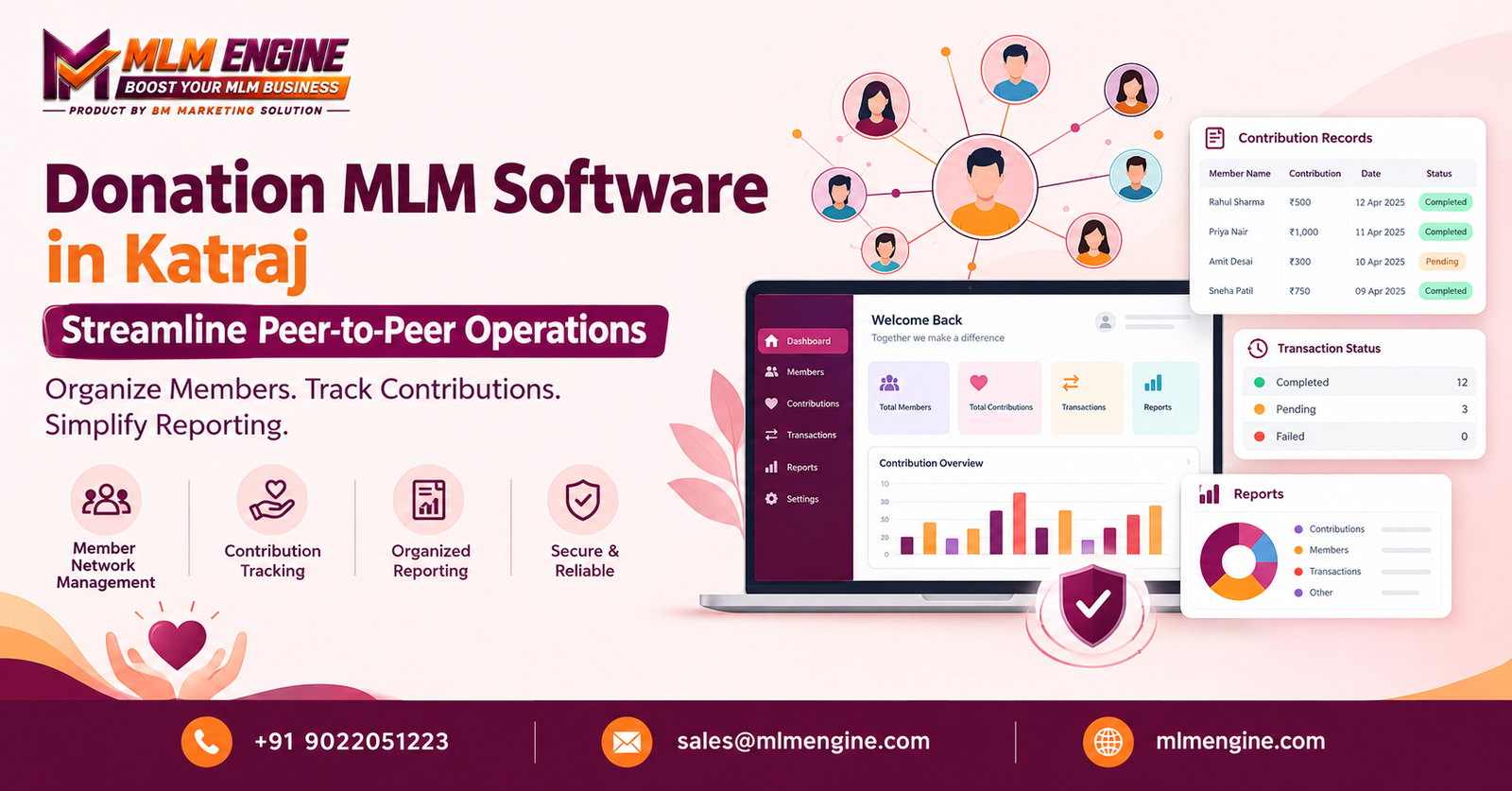
- Administrative dashboards
- Reporting and record exports
Treat that list as a set of questions to put to a provider. Functionality varies between products and between configurations of one product. Sound peer-to-peer operations also need documented plan rules, open contribution records, and administrators who actually review what the system shows.
Pillar One: Records
Records are what you point to when a member asks, “Was my contribution received?” When records are weak, every conversation becomes a negotiation. Typical trouble spots include:
- Duplicated or inconsistent entries, where one contribution appears twice or member details differ across lists.
- Missing references, which make it hard to trace a payment later.
- Unclear statuses, where nobody knows whether a contribution is pending, confirmed, or failed.
- Slow reporting, since summaries built by hand take time and invite errors.
Good donation tracking software gives each contribution one traceable entry with a reference, a status, and the parties involved. Ask what happens when an entry is wrong. Who may correct it, and does the system keep a visible trail of the change? Ask also how the software helps you reconcile its records against actual payment confirmations. Without reconciliation, even a tidy database can drift away from reality.
Remember the limits, too. Software does not remove errors on its own, guarantee transparency, or prevent misuse of funds. It makes accurate records easier to keep and easier to review.
Pillar Two: Roles
A peer-to-peer program involves more than members. There may be administrators, reviewers, support staff, and group leaders, each with different responsibilities. Strong member network management reflects that reality.
When you evaluate a platform, look at how members register, what profile details are stored, how relationships between members are represented, and how roles and permissions are assigned. Two questions matter most. First, can the software express your actual network structure without awkward workarounds? Second, can you limit what each role sees and does?
Permissions are also a privacy matter. Secure donation records rely on role-based access, secure authentication, careful handling of personal information, backups, and defined retention policies. Generic promises are not enough. Ask the provider to describe its actual practices, and judge the answer on specifics.
Pillar Three: Rules
Rules decide everything downstream: who may participate, how contributions are expected to move, what conditions apply, and how exceptions are handled. Donation plan management in software means turning those rules into configuration.
Before you look at any product, write your rules in plain language. Then check whether the platform can support them without forcing a different model. The software should serve your intended operating model without creating contribution structures that members find confusing or misleading. If a rule is hard to explain to a newcomer, it will be hard to configure and hard to defend later.
Features Worth Testing in Donation MLM Software Katraj
With the three pillars in mind, here is how common features map to practical questions.
Reporting and Administrative Dashboards
Useful donation reporting tools answer everyday questions. How many contributions are confirmed, and how many are pending? Which members have been active? Can the data be downloaded for review? Reports support oversight and operational decisions, and they should never be read as forecasts of financial outcomes.
Payment Tracking and Notifications
Ask which payment gateways are supported, how confirmations are received, what happens when a payment fails, and how notifications reach members. Integration availability can change, so request confirmation from the provider before you buy.
Customization and Scalability
Think about next year as well as this month. Ask about customization, integrations, maintenance, technical support, and whether the system can handle a larger membership without a rebuild. Settle your must-have requirements before the demonstration so you can judge the product against your own needs.
What a Well-Run Workflow Might Look Like
The following is a generic illustration, not a verified demonstration of any MLM Engine feature. Real workflows depend on your rules, your chosen software, and the integrations available.
- A participant registers and receives an individual member profile.
- Authorized administrators verify the relevant registration details.
- A contribution is recorded through the approved process.
- The transaction status is updated when confirmation is available.
- Relevant records become accessible to authorized users.
- Administrators review reports and resolve any discrepancies.
- Members receive updates according to the configured communication process.
Look at how the three pillars show up. Records are created at steps three and four, roles decide who sees what at steps two and five, and rules govern the whole sequence. If a software demo cannot show something similar using your scenario, keep asking questions.
An Eight-Step Buying Process for Katraj and Pune Buyers
Step 1: Define your peer-to-peer model. Write down participants, administrative duties, contribution flow, network relationships, and reporting needs.
Step 2: Prepare a feature checklist. Separate essentials from optional items such as advanced dashboards, custom reports, and integrations.
Step 3: Evaluate the total cost. Add setup charges, recurring fees, customization, payment integration, maintenance, training, and future upgrades. Published packages are listed on the MLM Engine pricing page, though current terms should always be confirmed directly.
Step 4: Request a live demonstration. Ask the provider to show registration, contribution records, transaction reconciliation, and report generation in realistic scenarios.
Step 5: Review data security. Ask how personal information, user permissions, backups, and authorized access are handled.
Step 6: Confirm integrations and customization. Verify which payment services, notification channels, accounting integrations, and custom workflows are supported.
Step 7: Understand support and ownership. Review training, documentation, support arrangements, data export options, cancellation terms, and ownership of stored records.
Step 8: Check legal and operational suitability. Before implementation, obtain appropriate legal guidance on your donation structure, payment practices, participant communications, and applicable Indian laws and regulations. A software platform does not make a business model legally compliant.
Mistakes That Quietly Cause Problems
- Letting price decide: A low quote can leave out customization, integrations, or support you will need.
- Believing the brochure: Assuming every advertised feature is included leads to unpleasant surprises, so get the scope in writing.
- Treating reconciliation as optional: Records that cannot be matched to confirmations weaken every report.
- Leaving permissions wide open: Excess access puts member data at risk.
- Skipping real-world tests: A demo on sample data tells you little about your own operation.
- Forgetting running costs: Maintenance and integration expenses accumulate.
- Ignoring exit options: Without data export, changing providers later becomes difficult.
- Starting with vague rules: Unclear donation, referral, or participation terms cause disputes no tool can settle.
- Expecting guaranteed outcomes: No platform can promise network growth or financial results.
- Skipping legal review: Having software available says nothing about whether your model is permitted.
Points to Confirm With Every Provider
Use these as a conversation guide and request written responses.
- Confirm that the platform can support your specific peer-to-peer donation workflow.
- Learn which member and network management features are included.
- Understand how contributions are recorded and reconciled.
- Verify that administrators can view transaction histories and export reports.
- Confirm which payment gateways and integrations are currently supported.
- Find out how member permissions and personal data are managed.
- Check that donation-plan rules can be configured to match your model.
- Request a clear view of setup, subscription, customization, and maintenance costs.
- Clarify what training and technical support are available.
- Ask for a demonstration of your own use cases before implementation.
- Establish what happens to your data if you discontinue the service.
- Discuss the legal and operational considerations to address before launch.
Speaking With MLM Engine
For readers weighing Donation MLM Software Katraj options, MLM Engine is a team you can contact to talk through your requirements: how you plan to handle contributions, how your network is organized, what reports you need, and what customization you expect. The Donation MLM Plan page offers background on the peer-to-peer model, and the plans overview shows the wider range of models covered.
Ask for a demonstration and confirm current features, integrations, pricing, support arrangements, and contract terms before deciding. Anything not confirmed in writing should be treated as unverified. You can start at mlmengine.com.
Final Checklist
- Clear contribution workflows
- Accurate member records
- Organized network management
- Reliable transaction tracking
- Useful administrative reports
- Appropriate data security
- Suitable integrations
- Transparent pricing
- Scalability and customization
- Technical support
- Legal and operational suitability
The right software is the one that fits your actual program, supports clear recordkeeping, and gives administrators sensible controls. A long feature list matters far less than that fit.
Conclusion
Records, roles, and rules are the foundation of every peer-to-peer donation program. When those three are organized, administrators spend less time chasing details and more time running the program responsibly. Software can support that by keeping contributions traceable, limiting access sensibly, and producing reports that help with review. It works best alongside clear rules, honest oversight, and proper legal advice.
If you are exploring Donation MLM Software Katraj, start by writing down your own model, decide what you cannot do without, and test providers against realistic scenarios. Request a demonstration, verify features and integrations in writing, and consult a legal professional before launch. To discuss your needs with MLM Engine, use the details below.
Contact MLM Engine