Running a donation network looks manageable at the start. A handful of donors, a small group of members and a few dozen entries a week can be handled with notebooks and chat groups. Then the network grows. Members bring in other members, contributions arrive through different channels, and someone has to answer a simple question who gave what, and through whom?
That is the point where many organizations begin looking at Donation MLM Software Baner options. The right platform brings donors, members, transactions, records, communication and reporting into one organized system, so administrators spend less time chasing information and more time running the programme. Software cannot promise higher donations or guaranteed outcomes, but it can bring visibility and consistency to daily operations.
This guide explains what donation-focused MLM software does, why local organizations seek it out, which features deserve a close look, and how to choose carefully.
Understanding Donation MLM Software
Donation MLM software is a management platform built for organizations that collect contributions through a structured, multi-level network of members. It combines two jobs that are often handled separately donation management and MLM network management.
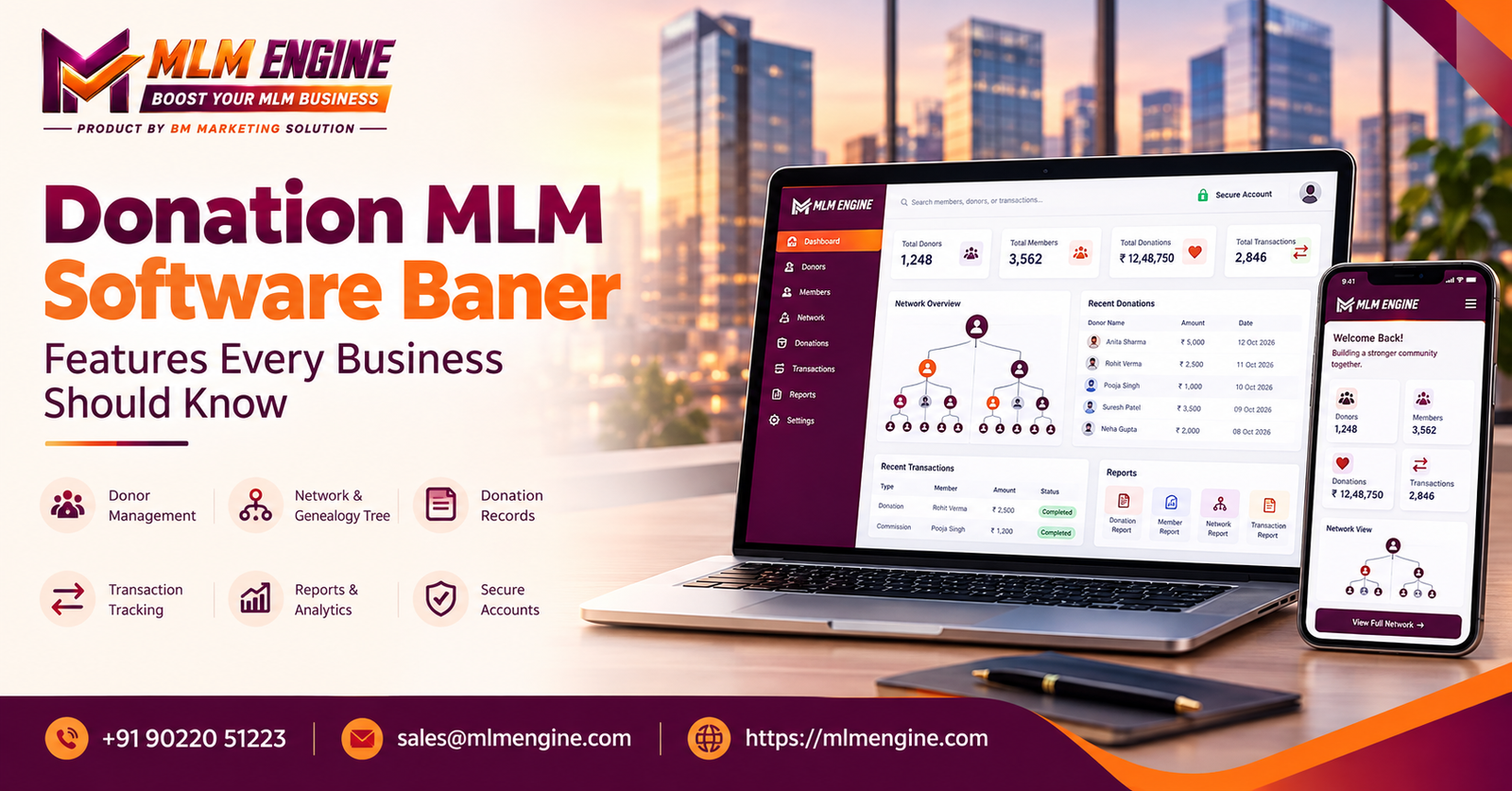
What Donation MLM Software Baner Typically Covers
A well-built platform usually separates its work into clear areas:
- Donation management: recording contributions, linking them to donors and keeping a clean history.
- Member and network management: storing member profiles and showing how members connect to one another.
- Transaction records: keeping a dated, traceable entry for every donation or internal movement.
- Reporting: turning raw entries into summaries administrators can act on.
- Communication: sending confirmations, reminders and announcements.
- Administrative controls: deciding who can see, create, edit or approve what.
Platforms such as MLM Engine are examples of software that can bring these areas together, so a team is not stitching several tools into a single process.
Why Businesses in Baner Are Looking for Better Donation Management Systems
Baner has a mix of growing businesses, startups, service firms and community-driven organizations, many of which run teams that work partly outside the office. When donation-related work depends on manual files, messaging groups, paper receipts or tools that do not talk to each other, familiar problems appear:
- Manual data entry: The same donor detail gets typed in several places, and small typing errors multiply.
- Hard-to-trace records: Finding one contribution from months ago can mean searching through several files and chats.
- Scattered donor information: Phone numbers, addresses and giving history sit with different people.
- Limited reporting: Producing a clear monthly summary takes hours of assembly.
- Reconciliation effort: Matching received contributions against recorded entries becomes slow and stressful.
- Network coordination: Without a visible structure, it is difficult to see who belongs where.
- Administrative workload: Skilled staff end up on repetitive clerical tasks.
None of this is specific to one locality, and no statistic is needed to see it. Any organization whose network outgrows manual handling will meet these issues sooner or later.
Donation MLM Software Baner: Features Every
Business Should Evaluate: Not every platform offers the same depth. The features below are worth checking one by one, ideally in a live demo using your own scenarios.
Donor and Member Management: A centralized profile for every donor and member is the foundation. Look for contact details, member status, joining date, donation history and notes in a single record. When an administrator opens a profile, the full picture should be visible without hunting through other files. Good donor management also lets you search and filter, for example by status or by the member who brought someone in.
Donation Transaction Tracking: Structured donation transaction management means every entry carries a date, amount, donor, status and reference. Administrators can monitor incoming entries, spot gaps and keep an organized history. Check whether entries can be corrected with a visible trail rather than silently overwritten, since that distinction matters during any review.
MLM Network and Genealogy Management: The genealogy view shows how members relate to one another across levels. Depending on the structure your organization uses, the software should let you view parent-child relationships, placement, levels and downlines. Ask how the tree behaves with thousands of members, and whether placement changes are recorded properly.
Automated Commission or Distribution Rules: Some organizations need rule-based calculations for commissions, incentives or internal distributions. A flexible platform allows these configurable rules to be set up and applied automatically. Be clear on one point: the actual structure depends entirely on your organization’s model, internal policy and the rules that apply to you. Software applies the rules you define; it does not decide what is appropriate or lawful.
Digital Wallet and Ledger Management: A wallet and ledger module keeps internal balances and movements in order. Every credit, debit or adjustment appears as a ledger entry, which makes later checking far easier. Look for clear statements, filters by date and member, and a record of who approved adjustments.
Real-Time Dashboards: Dashboards give administrators and authorized users a quick summary: recent donation entries, new member registrations, pending items and general activity. The best ones are uncluttered and let different users see different summaries, so a branch coordinator is not shown company-wide data they do not need.
Reports and Analytics: Reporting is where software often pays back its setup effort. Expect donation reports, member reports, transaction reports and network reports, ideally with date filters and downloadable output. A strong donation reporting system lets you answer questions as they arise instead of rebuilding data by hand each time.
Role-Based Access Control: Not everyone should see everything. Role-based access control lets you assign permissions to administrators, managers, members and other authorized users separately. A finance reviewer may need transaction views, while a member needs only a personal profile. Narrow permissions reduce accidental errors and protect sensitive information.
Notifications and Communication: Depending on the platform, notifications may include email, SMS and in-system alerts for registrations, donation confirmations or reminders. Confirm which channels are actually supported and whether message templates can be edited, as external SMS or email services may involve separate arrangements.
Mobile-Friendly Access: Team members often review information away from a desk. Mobile-friendly, responsive access means dashboards, profiles and reports remain readable on a phone. Test the screens you would genuinely use on the move, not just the login page.
Security and Data Protection: Donor and member data deserves careful handling. Review authentication options, access restrictions, encrypted data handling, regular backups and audit trails that log who changed what. Ask the provider to explain, in plain language, how data is stored and recovered. Security should be a conversation, not a line on a brochure.
How MLM Engine Can Support Donation Network Management
The strength of a platform lies less in individual modules and more in how they connect. With MLM Engine, depending on configuration, the flow for a donation network can look like this:
- Member registration: a new member’s profile is created with the required details.
- Network placement: the member is positioned in the network structure.
- Donation entry: a contribution is recorded against the relevant donor or member.
- Transaction record: the entry becomes a dated, traceable record.
- Dashboard update: summaries reflect the new activity.
- Reporting: administrators pull reports from the same underlying data.
Because each step feeds the next, data is entered once and reused, which cuts duplication. Role permissions, notifications and wallet records can sit alongside this flow, again subject to how the system is set up for your organization. Exact modules and options should always be confirmed with the provider during a demo.
Donation MLM Software vs. Manual Management
A fair comparison shows where each approach fits.
- Data organization: Manual methods spread data across files and chats; software keeps it in one structured database.
- Donation records: Manual records depend on whoever wrote them; software stores consistent, time-stamped entries.
- Member management: Manual tracking works for small groups; software handles profiles, statuses and history at larger scale.
- Reporting: Manual reports take time to compile; software generates them from live data.
- Network visibility: Manual structures live in diagrams or memory; software shows genealogy views.
- Access control: Manual files are shared widely or not at all; software offers role-based permissions.
- Notifications: Manual reminders are sent one by one; software can automate them where supported.
- Scalability: Manual effort grows with every new member; software absorbs growth more steadily.
- Administrative workload: Manual work is repetitive; software reduces it, though setup and training still take effort.
Manual management is not wrong for a very small group. It simply becomes harder to sustain as complexity rises.
How to Choose the Right Donation MLM Software in Baner
Use these points as an evaluation checklist when speaking with providers.
- Feature requirements: The platform should cover the donor, network and transaction needs you have written down, not just a generic list.
- Customization: Fields, rules, reports and workflows should be adjustable to your model.
- Ease of use: Staff with ordinary computer skills should be able to complete routine tasks after short training.
- Security: The provider should explain authentication, access control, backups and audit logging clearly.
- Scalability: The system should remain responsive as members and records increase.
- Reporting: Reports should be tested with your own sample data before purchase.
- Mobile responsiveness: Key screens should work properly on phones and tablets.
- Integration capabilities: Payment gateways, messaging services and other tools you rely on should connect without awkward workarounds.
- Support and maintenance: Response times, update policies and training arrangements should be stated clearly.
- Pricing and long-term ownership: Setup costs, recurring charges, customization fees and data ownership terms should all be written down.
Beyond this list, ask the provider to walk through your actual workflow on screen, explain how data can be exported if you ever switch systems, and describe how updates are delivered.
Common Mistakes to Avoid When Selecting Donation MLM Software
- Choosing on price alone: A cheap tool that lacks reporting or security usually costs more later.
- Ignoring security: Donor and member data needs real protection, not assumptions.
- Buying unnecessary features: A long feature list adds complexity if half of it goes unused.
- Skipping customization checks: Your model may differ from the default setup.
- Not testing reports: A polished dashboard means little if the reports you need are awkward to produce.
- Overlooking mobile usability: Field teams will notice immediately if screens are hard to use on a phone.
- Neglecting support: Even good software needs help occasionally.
- Assuming every MLM platform fits donation workflows: Donation records, receipts and ledger needs differ from standard product-sales setups, so confirm the fit directly.
Conclusion
Choosing the right Donation MLM Software Baner means looking well beyond basic member lists. The platform you pick should keep donation records organized, show network visibility clearly, produce dependable reports, protect data through sensible security, reduce repetitive work through automation, adapt through customization and keep working as your network grows.
No software can guarantee donations or financial outcomes and it should never be sold that way. What it can do is give your team a clearer, more reliable way to run daily operations. Businesses exploring structured MLM and donation network management can look at MLM Engine as one option and request a walkthrough based on their own workflow.
To discuss your requirements or arrange a demo, get in touch:
Email: sales@mlmengine.com
Phone: +91 9022051223
Website: https://mlmengine.com/
WhatsApp Channel: https://whatsapp.com/channel/0029Vaj8FP577qVKIi7ooC1d