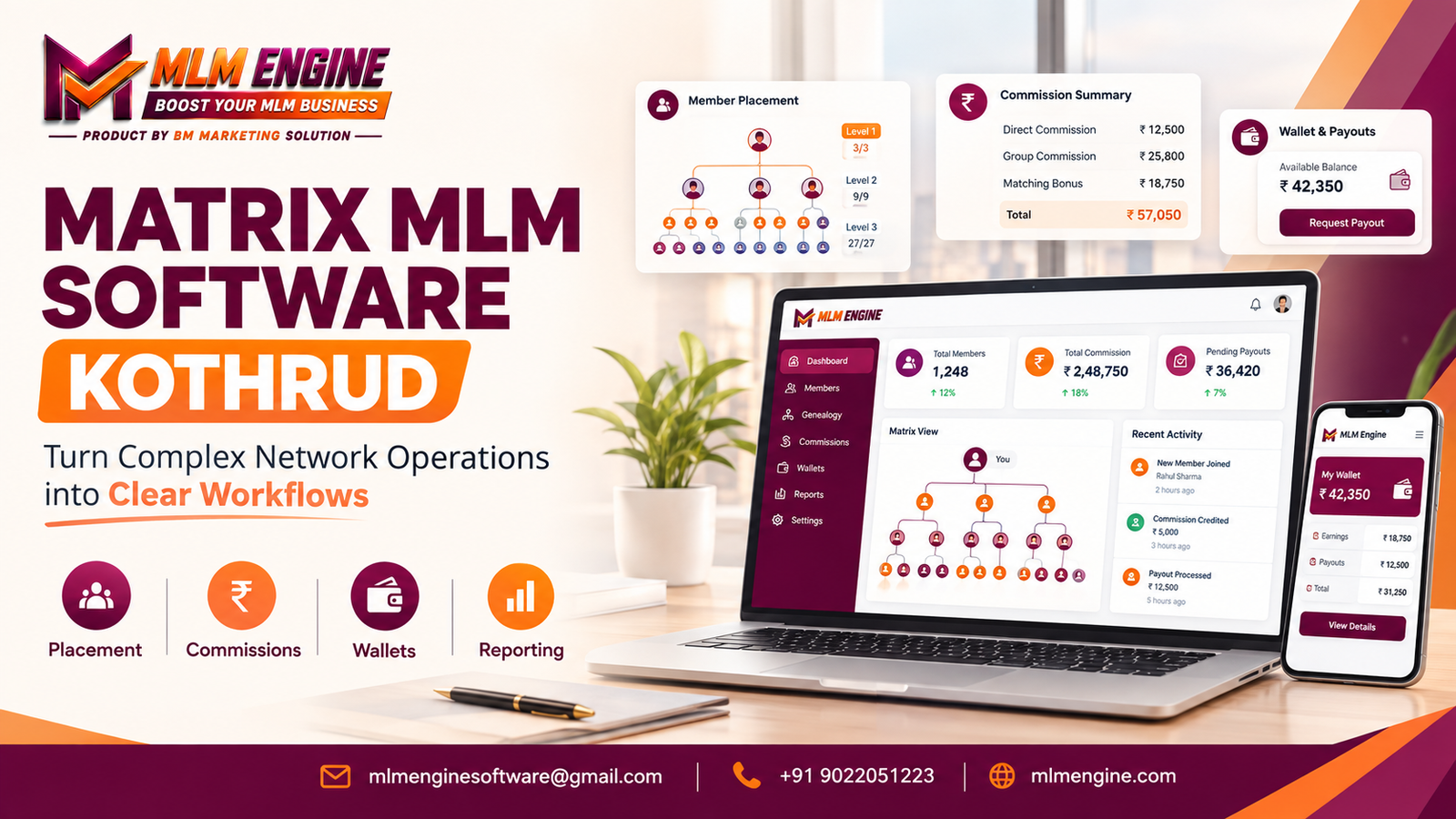
When Network Growth Creates Operational Friction
A matrix-based network usually starts small enough that a spreadsheet feels adequate. Then membership grows, transactions multiply, and placements start arriving faster than anyone can verify them by hand. Support tickets pile up asking why a commission hasn’t posted. Genealogy relationships become harder to trace when a new member’s exact position in the structure isn’t obvious at a glance. Payout verification slows down because someone still has to cross-check numbers manually before funds move.
This is the point where most businesses start looking seriously at Matrix MLM Software Kothrud options not because a spreadsheet stopped working outright, but because it stopped scaling safely. Delayed placements, unclear wallet balances and limited visibility into overall network activity are signs that the operational layer underneath the business needs to change, even if the compensation plan itself is sound.
The Real Role of a Matrix Platform
It helps to think of matrix software as more than a member directory. A well-built platform connects registration, placement logic, genealogy records, transaction data, commission rules, wallet activity and administrative reporting into a single operational chain. When one part moves, the rest should move with it automatically.
Matrix structures are typically described by width and depth for example, a 3×7 matrix allows three members directly under each sponsor, extending seven levels down. A new member joining doesn’t just get added to a list; they occupy a specific position that affects how commissions flow both upward and across the structure. The software’s job is to reflect the business’s actual compensation logic, not to force the business into a rigid structure that only approximates it. If a platform can’t represent the plan exactly as designed, the mismatch tends to surface later as commission disputes.
A Buyer’s View: What Should the System Make Easier?
Rather than working through a feature list in isolation, it’s more useful to look at how software behaves during the tasks a business actually performs every day.
When a new member joins, the expected sequence runs from registration and identity verification through sponsor assignment, matrix placement, account activation, and dashboard access ideally without manual intervention at each step.
When a transaction is recorded, the system should connect that transaction to commission calculations, wallet credits, order history, and reporting in real time, so no one has to reconcile figures separately at month-end.
When a distributor checks their progress, a clear dashboard should show their position in the genealogy, earnings history, wallet balance, team activity, and downloadable reports reducing the number of support requests the admin team receives.
When the administrator reviews the business, centralized visibility matters most users, placements, transactions, commissions, payouts, configuration settings and any exceptions that need attention should all be reachable from one place, not scattered across separate tools.
Local Business Considerations for Kothrud-Based Operations
Businesses operating from or serving customers around Kothrud face the same practical demands as any growing network teams that aren’t always in the same location, distributors who expect to check their accounts remotely, and administrators who need dependable access without depending on manual, paper-based processes. Multiple user roles have to be supported cleanly an admin’s view is not a distributor’s view and records need to stay consistent as the business potentially expands into new areas beyond its current base.
For a company evaluating Matrix MLM Software Kothrud providers, this usually comes down to a fairly simple question can the system support the way the team already works, without adding friction that wasn’t there before?
A Practical Comparison: Ready-Made or Tailored?
Ready-made MLM software tends to suit businesses whose compensation structure is fairly standard, who need to launch within a shorter timeframe, and who don’t require extensive customization. It’s a reasonable starting point when the plan logic fits within common templates.
Custom software becomes more appropriate when the business needs unique compensation rules, specialized approval workflows, integrations that off-the-shelf products don’t support, a distinct distributor experience or specific data ownership arrangements. Businesses evaluating providers like MLM Engine often go through exactly this comparison checking whether a ready-made matrix module covers their needs, or whether custom configuration is worth the additional time.
Warning Signs During Product Demonstrations
A demo tends to reveal more than a sales pitch does. Watch for a provider who can’t clearly explain how matrix placement actually works, who shows commission logic only through static slides rather than a live system or whose dashboard feels difficult to navigate even for simple tasks. Reports that can’t be filtered or exported, vague answers about security controls and no discussion of how payment failures or reversals are handled are all worth flagging. If mobile usability isn’t demonstrated, if pricing quietly excludes implementation or support or if the provider avoids questions about scalability and data ownership, it’s worth asking directly ideally by requesting a demonstration built around your own business scenario rather than a generic walkthrough.
Security, Reliability and Governance
MLM platforms hold sensitive financial and personal data, so governance isn’t optional. Secure login and authentication, role-based permissions, encrypted data transmission, regular backups, audit trails and controlled administrative access all matter. Responsible payment handling and a clear data-retention policy give the business confidence that a disruption technical or otherwise won’t mean losing records. None of this should be assumed; it’s worth confirming directly with any provider rather than taking it as a given.
Where MLM Engine May Fit
MLM Engine is one provider businesses can evaluate when comparing options. Its relevant capabilities to explore during a consultation include Matrix MLM Software, support for multiple MLM plan types, genealogy management, e-wallet management, commission and payout handling, separate admin and distributor dashboards, reporting and analytics, payment integrations, custom business logic, mobile-friendly access, and a scalable architecture. These are worth confirming directly and testing during a live demonstration rather than treated as guaranteed outcomes.
Closing Decision Note
Choosing the right platform ultimately comes down to fit matching the company’s compensation plan, daily operational habits, user expectations, integration requirements, and future growth plans against what a given system can actually deliver. For businesses comparing Matrix MLM Software Kothrud providers, the goal isn’t finding the platform with the longest feature list, but the one that fits how the business genuinely operates today and where it’s heading next.
To discuss specific requirements, reach MLM Engine at:
Email: mlmenginesoftware@gmail.com
Phone: +91 9022051223
Website: https://mlmengine.com/
WhatsApp Channel: https://whatsapp.com/channel/0029Vaj8FP577qVKIi7ooC1d