A growing MLM company often outgrows spreadsheets fast. What once fit into a single Excel file now spans dozens of tabs. As a result, formulas break every month, and teams spend hours reconciling payouts before every cycle closes. Consequently, this is usually the moment a business starts looking seriously at dedicated software.
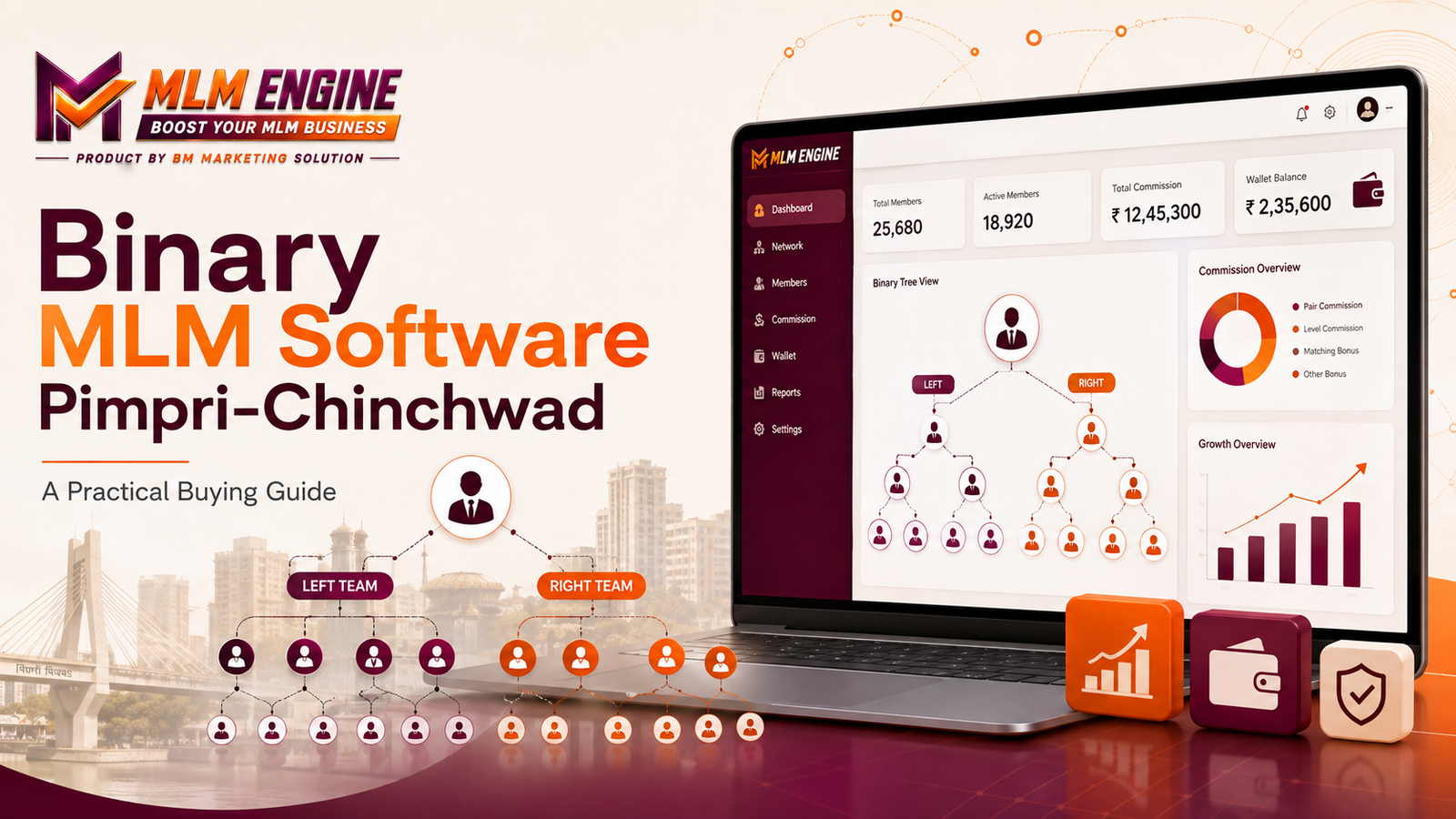
Binary MLM Software Pimpri-Chinchwad businesses explore today addresses exactly this shift. Since a distributor network expands into two legs, left and right, manual tracking of team volume, pairing, and carry-forward becomes error-prone. It also eats up time. Fortunately, a dedicated platform automates these calculations, keeps records centralized, and gives administrators and distributors real-time visibility into their network. Companies like MLM Engine build these systems to handle the operational complexity that binary compensation plans create as a business scales.
Understanding How a Binary MLM Structure Works
A Binary MLM Plan gives every distributor exactly two downline positions. Businesses commonly call these the Left Leg and the Right Leg. When a new distributor joins, the system places them under an existing member in one of these two positions, and the network grows outward from there in a tree-like shape.
Each leg builds its own business volume as distributors within it make sales or purchases. Businesses call this team volume. Through a process known as pairing, or matching, the system compares volume on the left side against volume on the right side, then pays a commission based on the smaller, matched amount. Meanwhile, volume that exceeds the pair on one side often carries forward to the next cycle, depending on the company’s specific carry-forward rules.
Here’s a simple example: say the left leg generates one volume amount and the right leg generates a different amount in a given cycle. Typically, only the matched portion between the two qualifies for a payout, while the surplus rolls over. This calculation looks simple for a handful of distributors. However, once a network grows into hundreds or thousands of members across multiple levels, manual tracking of pairing, carry-forward, and commission automation becomes nearly impossible to get right. On top of that, payout cycles add another layer of complexity. Whether weekly, bi-weekly, or monthly, every cycle needs a fresh, accurate calculation across the entire network.
Why Pimpri-Chinchwad MLM Businesses Are Moving Beyond Spreadsheets
Businesses running binary plans in Pimpri-Chinchwad’s diverse commercial environment face a familiar set of challenges as their distributor base grows. For instance, growing distributor databases become hard to search, filter, or update accurately in spreadsheets or paper records. In addition, manual commission calculations take time and invite formula errors, especially with carry-forward rules or multiple bonus types involved. Without a visual, automated genealogy structure, teams also can’t monitor left and right team performance in real time.
Delayed payout processing frustrates distributors and can hurt trust in the business, particularly when calculations need manual verification first. At the same time, businesses struggle to maintain accurate member records, such as joining dates, status changes, KYC documents, and account activity, as the network grows.
The Operational Bottlenecks That Follow
Tracking sales and business volume across products and distributors requires linking transaction data to the binary structure, and that kind of linking isn’t something spreadsheets handle well. Beyond that, manual withdrawal handling means checking balances, verifying eligibility, and processing payments one at a time. Generating reports for compliance, planning, or distributor queries also takes far longer without a centralized system. As a result, owners lack centralized business visibility and can’t get a clear picture of overall network health at any given moment. Ultimately, scaling operations becomes the biggest long-term risk, since a process that works for 200 distributors often breaks down entirely at 2,000.
Essential Features to Check in Binary MLM Software Pimpri-Chinchwad
A capable platform lets administrators organize member profiles in one place, including joining details, current status, sponsor information, and account activity history, so everything stays searchable and editable in one system rather than split across separate files. Similarly, a visual Genealogy Management view lets administrators and distributors see the two-leg network structure at a glance, spot who sits where, gauge how each leg performs, and decide where new placements make sense.
Commission Automation, meanwhile, applies the business’s specific pairing and carry-forward rules consistently across the network, which removes the risk of manual calculation errors during every payout cycle. Alongside this, an E-Wallet gives each distributor a running record of credits, debits, and available balance, so both the business and its members always know exactly where funds stand.
Payout Management tools let administrators review, approve, and process withdrawal requests in an organized queue instead of tracking requests through messages or spreadsheets. Sales Tracking, in turn, connects directly to the binary network, ensuring every purchase correctly contributes to the right distributor’s volume, which matters for accurate commission calculation. Additionally, configurable rank rules let a business set up achievement-based incentives that update automatically as distributors hit qualifying volume or team milestones, instead of requiring manual tracking.
Reports and Analytics cover sales, commissions, distributor activity, and payouts, so business owners get the information they need without compiling data manually every time. Separate dashboards for administrators and distributors then show each user exactly what’s relevant to them: admins get network overview and controls, while distributors see personal performance and earnings. On top of this, a Mobile-Friendly Dashboard lets distributors check their team volume, earnings, and network status conveniently, without needing to sit at a desktop computer. Finally, Data Security should include secure authentication and role-based permissions that limit what each user type can access, along with regular backups and responsible handling of sensitive distributor and financial information.
Why Customization Matters in Binary MLM Software
No two MLM companies run identical operations. Businesses differ in their commission rules, pairing logic, payout schedules, rank structures, bonus types, package offerings, registration workflows, KYC requirements, payment gateway preferences, and reporting needs.
Because of this, a business shouldn’t pick software just for a long feature list. A platform with dozens of mismatched features still forces workarounds, manual adjustments, or a costly rebuild later. Instead, customization matters far more than raw feature count: the ability to configure pairing rules, carry-forward logic, and payout structures to match the business’s actual plan is what counts. This is why companies like MLM Engine focus on configurable, rule-based systems instead of one-size-fits-all templates.
Binary MLM Software Buying Checklist for Pimpri-Chinchwad Businesses
Compensation-plan flexibility means the software should adapt to your specific binary rules, not force you to adjust your plan to fit the software. Similarly, binary tree management matters because a clear, accurate genealogy view forms the foundation of the entire system. Commission automation calculations, meanwhile, should run consistently and stay easy to audit, while wallet and payout functionality gives distributors transparent, real-time visibility into their earnings.
A good distributor dashboard lets members track their own performance without contacting support for basic updates, and strong admin controls let administrators manage accounts, approve payouts, and adjust settings as needed. Beyond that, reports and analytics save real time during planning and compliance reviews, while security through role-based access and data protection safeguards the business and its distributors. Since distributors increasingly expect to manage accounts from a phone, mobile responsiveness matters too. Finally, the system should evolve through customization as the compensation plan or business needs change, and integration capability should let payment gateways, SMS, or email services connect smoothly with the platform. Ongoing technical support and maintenance after deployment matter just as much as the initial feature set.
Common Mistakes Businesses Make When Choosing MLM Software
Choosing based only on price often creates hidden costs later, when the cheaper platform can’t support the actual compensation plan without expensive customization. Likewise, skipping a real test of the binary calculation means a business may not catch pairing or carry-forward errors until real payouts go wrong. Ignoring customization requirements upfront often produces a system that technically works but doesn’t match how the business actually operates, and overlooking security exposes sensitive distributor and financial data to unnecessary risk.
Skipping scalability checks leads to performance issues once the network outgrows the original setup, while a confusing distributor interface increases support requests and can hurt distributor satisfaction and retention. Ignoring support and maintenance terms can leave a business without help exactly when an issue needs urgent attention. Failing to clarify ownership and source-code terms before signing can create problems if the business ever needs to migrate or modify the system independently, and skipping integration discussions upfront can surface payment gateway or third-party service issues only after deployment.
How MLM Engine Can Support a Binary MLM Business
MLM Engine works as an MLM software solution that handles the operational demands of a Binary MLM Plan, from network structure through to payouts. Its core capabilities cover what matters most for binary businesses: Binary MLM Management for left and right leg placement and pairing logic, Genealogy Management for a clear visual network structure, and Commission Automation for consistent, rule-based payout calculations.
Beyond that, MLM Engine also provides Distributor Management for organizing member records, Wallet and Payout Management for transparent fund handling, and Reports and Analytics for on-demand business visibility. Separate Admin and User Dashboards give each user type the tools they need, while built-in Customization lets the platform configure around a business’s specific compensation rules instead of a fixed template. Since the system runs on Scalable Architecture, it keeps performing as a distributor network grows. It also offers Mobile-Friendly Access, so distributors can check their status from anywhere.
Why Local Business Requirements Should Influence Your Software Choice
A Pimpri-Chinchwad business should evaluate software against its own operational requirements rather than defaulting to whichever platform people talk about locally. Consider your current distributor network size, expected growth, your specific product or service model, and your exact compensation structure. Also weigh payment collection and disbursement needs, the support level you expect after go-live, integration needs with existing tools, your budget, and future expansion plans. Matching software capabilities to these real requirements, rather than marketing claims, produces a far more reliable long-term fit.
Basic Software Versus Business-Ready Binary Software
The gap between a basic tool and a business-ready binary platform usually shows up once a network starts to scale. A basic setup typically offers only a limited binary tree view, weak commission automation that may not handle carry-forward well, simple distributor management, and standard reporting. By contrast, a business-ready platform offers an advanced binary tree with clear visualization, fully configurable commission automation, centralized distributor management, integrated wallet functionality, advanced reporting, flexible customization, admin controls that scale with the business, and an architecture that handles growth. Knowing which category a piece of software actually falls into, regardless of how it markets itself, helps during evaluation.
Conclusion
Choosing the right Binary MLM Software Pimpri-Chinchwad businesses can depend on comes down to a few genuinely important factors. Look for binary plan functionality that matches your actual compensation rules, reliable automation, strong security, meaningful customization, and an architecture that scales. Also look for a distributor experience that’s easy to navigate and support you can depend on. Ultimately, a platform that checks these boxes holds up well as a distributor network grows, instead of forcing a costly switch later. MLM Engine builds its systems around exactly these priorities, giving businesses a foundation they can rely on as operations expand. If your business is ready to discuss its specific binary MLM software requirements, reach out for a conversation.
📧 Email: mlmenginesoftware@gmail.com
📞 Phone: +91 9022051223
🌐 Website: https://mlmengine.com/
💬 WhatsApp Channel: https://whatsapp.com/channel/0029Vaj8FP577qVKIi7ooC1d