Binary MLM Software Kothrud: A Complete Guide for Local Businesses
How Wakad Businesses Can Choose the Right Binary MLM Software for Sustainable Network Growth Operating a direct selling or network marketing enterprise from Pune’s bustling

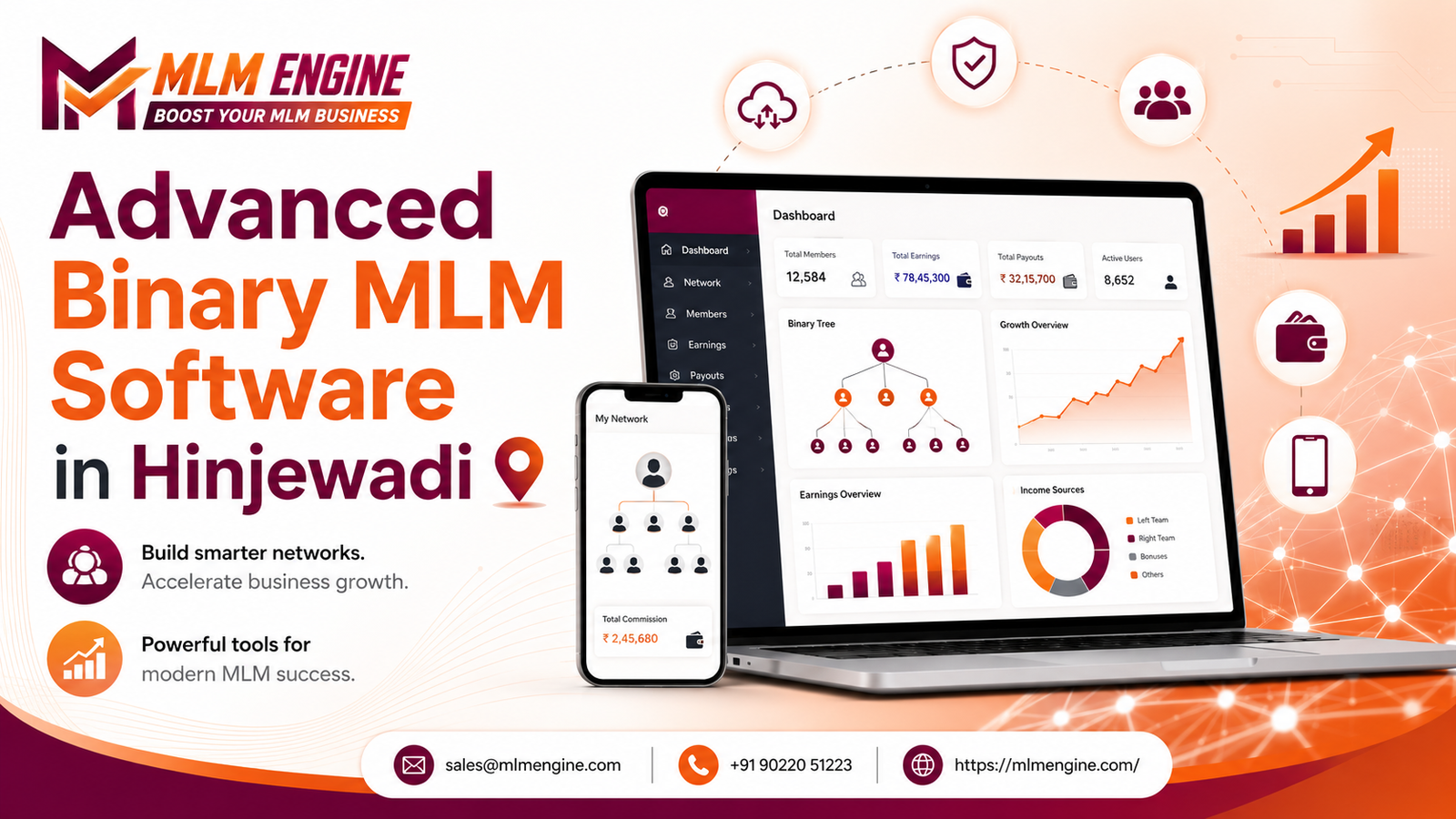
Hinjewadi has established itself as one of Maharashtra’s most prominent technology and commercial centers. While the region is widely known for enterprise IT infrastructure, it is also home to a diverse ecosystem of product distributors, consumer brands, and direct-selling enterprises. As network marketing organizations expand their distributor footprint across Pune and regional markets, operational complexity increases significantly. Managing thousands of independent distributors, complex genealogy placements, and routine financial entries using spreadsheets or disconnected tools quickly leads to operational bottlenecks.
To maintain structured operations, modern direct-selling enterprises operating in this tech hub increasingly deploy specialized Binary MLM Software Hinjewadi. Having a centralized digital foundation ensures that distributor profiles, team placements, product orders, and payout calculations remain organized, transparent, and accurate as the business evolves.
Expanding a direct-selling company without specialized software introduces significant operational friction. The binary compensation model, while structured, requires precise record-keeping across both sides of the network.
When managed manually or across disparate tools, growing organizations often face distinct administrative hurdles:
Managing a larger distributor base without duplicate entries, incomplete KYC records or missing profile details.
Maintaining accurate left and right team structures to prevent genealogy placement errors that distort team trees.
Recording sales and transactions precisely so that direct sales, team points and repeat purchases map to the right node.
Applying commission rules consistently, including pairing criteria, matching bonuses, carry-forward volume and payout capping limits.
Monitoring payout requests smoothly to prevent backlogs and administrative delays during high-volume withdrawal cycles.
Tracking distributor activity, rank advancements and customer order histories from a single database.
Preparing business reports on inventory movement, regional performance, and commission liabilities without manual spreadsheet compilation.
Maintaining visibility across the network so leadership teams can monitor operational health in real time.
Relying on manual administrative processes increases the risk of calculation errors, creates record discrepancies, and limits overall operational visibility.
The binary compensation model is built on a two-leg organizational structure. Each distributor who joins the network can directly sponsor or place two frontline members: one on their Left Team (left leg) and one on their Right Team (right leg).
Subsequent recruits sponsored by an existing distributor are placed under earlier members within the tree. This placement dynamic is known as spillover.
Core components of a binary plan include:
Two-Leg Network Arrangement: Every node in the network tree branches into two sub-positions, keeping structural depth manageable.
Left and Right Teams: Sales activity is tracked independently across the two distinct operational legs.
Distributor Placement: Automated or manual placement rules determine where new enrollments sit within the downline.
Team Sales Volume: Commission points accrue from product purchases and package sales across both sub-trees.
Pairing or Matching Rules: Companies define specific volume ratios (such as 1:1 or 1:2) required between the left and right legs to trigger a commission payout.
Commission Conditions: Thresholds such as active distributor status, personal sales volume, and rank requirements qualify members for earnings.
Carry-Forward Mechanisms: Unmatched sales volume from the stronger leg carries forward into subsequent calculation cycles rather than expiring, subject to company policies.
Clearly Defined Compensation Rules: Establishing transparent rules regarding daily or weekly payout ceilings (capping) prevents over-allocation of company revenue.
Because the exact calculation method depends on an organization’s specific compensation plan and business policies, network marketing businesses rely on configurable MLM software solutions to record network activity and execute compensation rules consistently.
Operating a growing direct-selling enterprise requires a robust administrative platform. Specialized Binary MLM Software Hinjewadi centralizes core business functions into unified workflows, helping administrative teams manage operational complexity with clarity.
Key system capabilities include:
Automated Distributor Registration: Seamless digital registration with automated sponsor verification, placement validation and document upload.
Binary Genealogy and Tree Management: Real-time visual trees that allow both administrators and distributors to inspect left and right sub-trees dynamically.
Commission Calculation: Configurable calculation engines that evaluate pairing bonuses, sponsor rewards and rank advancements automatically.
Wallet Management: Digital ledgers that record earnings credits, service deductions, transfer histories and available balances.
Payout Request Tracking: Systematic approval workflows that verify payment requests against eligibility criteria before disbursement.
Sales and Order Management: Direct mapping between physical product purchases, e-commerce checkouts and network volume attribution.
Rank and Performance Monitoring: Automated tracking of member milestones, qualifications and performance badges.
Real-Time Dashboards: Instant summaries of key business metrics, sales volume and distributor enrollment rates.
Reports and Analytics: Detailed exports covering tax deductions, sales distribution, inventory turnover and commission summaries.
Administrative Controls: Centralized settings to update compensation parameters, manage member access and oversee system operations.
User Permissions: Granular role-based controls for administrative staff, warehouse managers, support agents and field distributors.
Notification Management: Automated system alerts for successful registrations, order confirmations, commission credits and payout status updates.
Consolidating these features into a unified platform reduces repetitive administrative work, improves record accuracy, and provides leadership teams with actionable operational data.
When evaluating platforms for binary MLM plan management, businesses should look for comprehensive functional modules that support sustainable administration:
Visual Binary Genealogy Mapping: An interactive tree view that helps users understand left- and right-leg placement, identify downline relationships, and maintain accurate network records as the organization expands.
Rule-Based Commission Engine: A configurable calculation engine that processes pairing, matching, rank, and performance bonuses consistently while eliminating manual calculation errors.
Personalized Distributor Workspace: A role-based portal that consolidates profile details, team activity, sales volume progress, e-wallet balances, tasks and system alerts in one place.
Centralized Business Control Center: A unified console allowing administrators to manage members, compensation settings, orders, transactions, approvals, permissions and system configurations.
Live Network Intelligence: Continuously updated metrics that help administrators identify changes in enrollment, sales activity, team balance, order volume, and overall network performance without waiting for manual reports.
Digital Earnings Ledger: A built-in financial ledger that organizes wallet credits, debits, commission entries, payout requests, approval stages, transaction references, and payment histories for clear accounting.
End-to-End Order Attribution: Direct connection between orders, distributors, retail customers, products, and binary trees to provide a transparent view of sales contributions.
Location-Independent Network Access: Responsive web and mobile interfaces that allow distributors and administrators to review updates, monitor activity, approve requests, and complete essential tasks from any location.
Connected Payment Workflows: Secure payment integrations that streamline order checkout, transaction verification, refund handling, and approved payout releases.
Permission-Based Data Protection: Enterprise security controls, including role-specific access, secure authentication, audit logging, encrypted data storage, and automated backups.
Growth-Ready System Foundation: Scalable software architecture designed to handle expanding user bases, large transaction volumes, deep binary trees, and increased network activity without latency.
Plan Logic Configuration: Flexible settings that allow businesses to configure pairing ratios, eligibility rules, capping limits, and rank criteria without being constrained by rigid templates.
Manual administration often creates friction as a network expands. Automation handles structured, repetitive tasks so management teams can focus on product development, distributor relations, and regulatory compliance.
Key operational improvements include:
Faster Distributor Onboarding: New members can register, submit KYC documentation, and select product packages independently in minutes.
Automatic Profile Creation: User accounts, unique IDs, and default e-wallets are generated instantly upon registration.
Centralized Record Management: All member records, contact details, and transaction histories reside within a single secure database.
Consistent Commission Processing: Calculations execute automatically based on verified sales volume rather than manual data entry.
Easier Payout Tracking: Administrative teams review organized payout queues with automated balance verification and payment status updates.
Reduced Manual Data Entry: Eliminating duplicate data inputs between spreadsheets, billing software, and payout sheets reduces human error.
Faster Report Generation: Comprehensive business reports on sales, active distributors, and commission liabilities can be generated on demand.
Better Visibility into Team Activity: Real-time dashboards provide live visibility into leg volume balance and active distributor performance.
Automated Notifications: SMS, email, or in-app alerts keep distributors informed about new placements, earnings credits, and order updates.
Easier Management of Large Groups: Scalable workflows allow small administrative teams to oversee thousands of active distributors effectively.
While automation simplifies routine administrative work, it is a management tool that supports rather than replaces sound business planning, ethical practices, strong customer service and active leadership.
Enterprises operating in the Hinjewadi tech corridor often have regional, national, or international growth plans. An organization starting with a few hundred local distributors across Pune may quickly expand across states or into overseas markets.
A scalable software platform must accommodate:
More Registered Users: Maintaining fast response times as active distributor accounts grow from hundreds to tens of thousands.
Higher Transaction Volumes: Processing high-volume sales checkouts and concurrent commission calculations during month-end cycles smoothly.
Larger Binary Trees: Rendering deep, multi-tiered genealogy structures without performance lag.
Additional Products: Adding new SKUs, combo packages, and digital vouchers without modifying underlying plan rules.
More Reports: Generating complex, multi-variable analytical reports without slowing down live administrative operations.
Multiple Administrative Roles: Accommodating specialized sub-admin roles across finance, customer support, and warehouse operations.
Increased Customer Support Requirements: Providing self-service account tools that reduce routine support inquiries.
Future Compensation-Plan Adjustments: Accommodating promotional bonuses or revised commission ratios as business strategies evolve.
Selecting a cloud-accessible, high-performance platform backed by reliable technical support and integration flexibility reduces the need for expensive, disruptive system replacements as the enterprise expands.
When evaluating specialized platforms, direct-selling organizations often look for solutions that combine functional versatility with operational stability. MLM Engine is an enterprise-grade MLM software solution designed to help businesses organize, manage, and scale network marketing operations through centralized digital tools.
MLM Engine provides comprehensive features tailored for binary and hybrid network models:
Binary MLM Management: Flexible configurations for pairing criteria, matching bonuses, capping thresholds, and carry-forward rules.
Distributor Management: Streamlined member registration, automated verification workflows, and personalized distributor workspaces.
Commission Automation: Accurate computational engines that calculate earnings consistently and update distributor ledgers in real time.
Network Monitoring: Interactive visual genealogy maps and downline performance trackers.
Analytics and Reporting: Centralized business intelligence dashboards covering sales trends, payout liabilities, and network expansion.
Wallet and Payout Management: Built-in digital earnings ledgers for managing credit disbursements, service deductions, and payout requests.
Product and Order Management: Unified order processing that links e-commerce transactions directly to binary leg volume attribution.
Administrative Controls: Granular security permissions, system configuration tools, and operational audit logs.
Scalable MLM Operations: High-performance infrastructure capable of supporting network growth without system slowdowns.
User Dashboards: Clean, responsive interfaces for both administrators and independent field distributors.
Business Data Organization: Secure data management practices that keep customer, transaction, and distributor records structured.
Direct-selling companies are encouraged to evaluate how MLM Engine aligns with their specific compensation structure, product delivery model, compliance requirements, and long-term operational plans.
Selecting an administrative platform is a critical business decision. Management teams should evaluate prospective software against a practical checklist:
Compensation Plan Compatibility: Verify that the platform natively supports your exact binary plan logic, pairing ratios and bonus rules.
Customization Options: Ensure system workflows, registration forms, and payout settings can be configured to match your operating model.
Security Standards: Look for role-based access control, database encryption, secure authentication, and robust data protection practices.
Scalability: Confirm that the underlying architecture can handle expanding user numbers and high transaction volumes without lag.
Ease of Use: Evaluate whether the platform is straightforward for administrative staff and non-technical distributors to navigate.
Distributor Experience: Review the distributor portal to ensure real-time access to genealogy views, earnings ledgers, and order tracking.
Administrative Controls: Verify that administrators have complete visibility over approvals, payouts, reports, and system settings.
Reporting Quality: Ensure the software provides clear, exportable reports on revenue, commissions, sales volume, and tax deductions.
Payment and Integrations: Check for compatibility with preferred payment gateways, SMS providers, and e-commerce systems.
Mobile Responsiveness: Confirm that dashboards render clearly across smartphones, tablets, and desktop computers.
Technical Support: Review the availability of responsive customer support, ongoing maintenance, and technical assistance.
Data Ownership: Ensure your business retains full ownership and control over distributor, customer, and transaction data.
Backup and Recovery Processes: Verify that automated data backups and disaster recovery protocols are in place.
Future Expansion Requirements: Confirm that the software can adapt to new product lines, international currencies, or plan adjustments.
Implementation Timeline: Clarify the setup timeframe, data migration procedures, and deployment milestones.
Training and Onboarding Support: Ensure the vendor provides structured training and documentation for your administrative team.
Requesting a comprehensive product demonstration, reviewing live workflows, and clarifying technical requirements beforehand helps businesses select the right platform for their needs.
The direct-selling sector continues to embrace modern enterprise technology. Forward-thinking companies are moving away from disconnected legacy software in favor of cloud-hosted, mobile-first platforms that unify operations.
Key technology trends shaping the sector include:
Cloud-Based Management: Accessing administrative tools and databases securely from any location without maintaining dedicated on-site servers.
Mobile Dashboards: Giving field distributors instant access to genealogy tracking, order placement, and earnings summaries on mobile devices.
Real-Time Analytics: Monitoring network volume, regional sales trends, and payout liabilities through dynamic data visualizations.
Automated Workflows: Reducing administrative overhead through automated registration, instant commission calculations, and structured payout approvals.
Centralized Data Systems: Eliminating fragmented data by connecting distributor management, order processing, and accounting into one platform.
Integrated Payment Tools: Enabling fast customer checkouts and direct, verified distributor payouts through secure payment gateways.
Digital Onboarding: Streamlining distributor sign-ups with digital KYC verification and automated placement rules.
Improved Reporting: Providing granular financial and operational reports that support clear regulatory compliance and internal audits.
Role-Based Access: Protecting sensitive commercial data by restricting access based on defined administrative responsibilities.
Flexible Platforms: Adopting modular software that easily scales alongside network expansion and market diversification.
While modern software provides the tools needed to administer complex networks efficiently, sustainable business development also requires genuine product value, ethical marketing practices, regulatory compliance, strong customer service, and responsible leadership.
Managing a modern binary network requires accuracy, structural transparency, and consistent operational oversight. Deploying specialized Binary MLM Software Hinjewadi enables businesses to organize distributor information, manage binary structures, automate repetitive calculations, improve reporting, track payouts, and maintain operational visibility as their network expands.
When planning for long-term administration and growth, utilizing a reliable platform such as MLM Engine helps businesses establish a structured, scalable digital foundation.
Email: sales@mlmengine.com
Phone: +91 90220 51223
Website: https://mlmengine.com/
WhatsApp Channel: https://whatsapp.com/channel/0029Vaj8FP577qVKIi7ooC1d
How Wakad Businesses Can Choose the Right Binary MLM Software for Sustainable Network Growth Operating a direct selling or network marketing enterprise from Pune’s bustling
How Wakad Businesses Can Choose the Right Binary MLM Software for Sustainable Network Growth Operating a direct selling or network marketing enterprise from Pune’s bustling
Why Viman Nagar Businesses Are Moving Toward Automated MLM Management Running an MLM business involves a lot more than just recruiting members and processing orders.
Why Viman Nagar Businesses Are Moving Toward Automated MLM Management Viman Nagar has grown into one of Pune’s busier commercial pockets and with that growth,
MLM Software for Nigeria: Building Smarter Direct-Selling Operations When an independent distributor in Port Harcourt submits an order via WhatsApp while another in Ikeja registers
MLM Software for Nigeria: Building Smarter Direct-Selling Operations When an independent distributor in Port Harcourt submits an order via WhatsApp while another in Ikeja registers
MLM Software for Nigeria: Building Smarter Direct-Selling Operations When an independent distributor in Port Harcourt submits an order via WhatsApp while another in Ikeja registers