MLM Software Magarpatta: Powering Smarter MLM Businesses in Pune’s Corporate Hub
MLM Software Magarpatta: Powering Smarter MLM Businesses in Pune’s Corporate Hub Magarpatta City in Pune stands as a bustling center for modern commerce, hosting IT

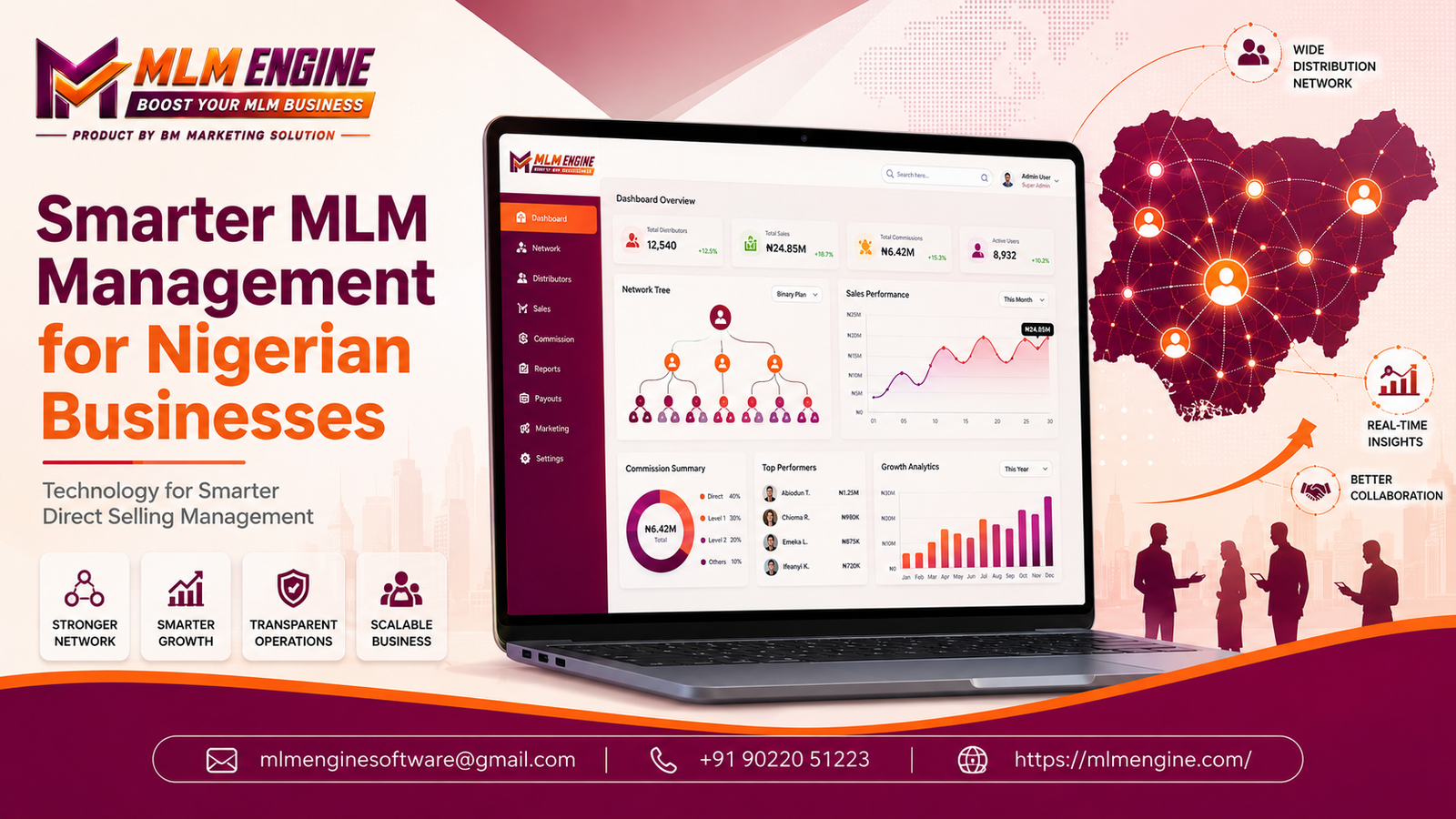
When an independent distributor in Port Harcourt submits an order via WhatsApp while another in Ikeja registers three new downline members on paper, administrative friction begins to surface. At month-end, compiling multiple spreadsheets, verifying bank deposits, and manually computing multi-tier payouts turns standard operations into a bottleneck. Deploying dedicated MLM Software for Nigeria provides the operational structure required to replace fragmented administrative tools with a unified digital system. A purpose-built platform coordinates distributors, customers, orders, sales, commissions, team structures, incentives, and overall business performance without requiring constant manual intervention.
Direct selling and network marketing operations rely heavily on interpersonal trust, fast product movement, repeat orders, and geographically dispersed distributor networks. In the Nigerian commercial ecosystem where teams operate across major commercial hubs like Lagos, Abuja, Kano, and Aba a business model powered by word-of-mouth requires rigorous operational discipline behind the scenes.
As an organization grows from a few dozen founding leaders to thousands of field representatives, maintaining order via ad-hoc methods becomes unsustainable. Without a centralized system, field sales activity cannot be verified rapidly, inventory reconciliation between stockists stalls, and distributor inquiries regarding compensation calculations consume valuable administrative hours. A structured operating system introduces standardized recordkeeping, ensuring that each transaction is accurately associated with the correct sponsor tree, retail customer, or local depot.
Relying on spreadsheets, paper logbooks, and messaging groups introduces structural vulnerabilities that compound with sales volume.
Distributor Record Fragmentation: Contact details, onboarding forms, and sponsor assignments stored in disconnected documents lead to mismatched data and outdated leader registries.
Genealogy Visibility Gaps: Visualizing deep unilevel, binary, or matrix trees across multiple generations is nearly impossible on static sheets, making it difficult to verify structural qualifications for leadership bonuses.
Commission Calculation Errors: Manually calculating direct bonuses, leg volumes, rank advancements, and compression rules requires hours of calculation, increasing the likelihood of payout discrepancies.
Order and Stockist Disconnects: When orders originate from multiple regional pick-up centers or mobile direct orders, reconciling bank alerts against physical inventory creates stock allocation errors.
Administrative Overhead: Instead of focusing on product development, field enablement, and compliance checks, operations teams spend their work cycles tracking down lost receipts and correcting data entries.
A single miscalculation on an active leader’s commission statement can damage organizational trust. When hundreds of transactions occur weekly, automated business rules are required to ensure data integrity.
MLM Engine functions as a centralized administrative platform designed to modernize direct-selling workflows. Rather than managing operations through separate accounting and spreadsheet software, the platform consolidates core operational requirements into a single administrative workspace.
Key operational modules within MLM Engine include:
Distributor Administration: Centralized onboarding, profile management, and identification verification records.
Network & Genealogy Architecture: Dynamic visual tree mappings supporting real-time sponsor placements and leg balancing.
Compensation Execution: Configurable commission engines that automatically calculate rank advancements, retail margins, and team bonuses according to defined plan criteria.
Sales and Transaction Ledgers: Consolidated recordkeeping for retail orders, distributor product packages, and promotional bundles.
Dedicated Portals: Separate web dashboards for administrators to supervise business operations and for field representatives to track personal performance, volume points, and earnings.
Systemwide Reporting: Live operational overviews that aggregate sales trends, regional activity, and inventory movement without requiring manual data compilation.
Selecting software requires an understanding of the specific functional layers that sustain a direct-selling venture.
The platform must maintain accurate records of sponsor-downline relationships from the moment of registration. It should visually display genealogies such as unilevel, binary, matrix, or hybrid structures while allowing administrators to monitor account statuses, placement requests, and personal volume points across every operational tier.
A dependable system processes mathematical calculations based strictly on verified transaction data. It should handle rank qualifications, dynamic compression, matching bonuses, and spillover rules automatically, generating traceable payout summaries that internal finance teams can inspect and verify prior to final distribution.
Direct selling depends on clear sales records. Software must link every product order to an exact customer or distributor account, register associated point volumes, and generate digital purchase invoices to maintain clear transaction trails.
Operations personnel need system health metrics such as daily transaction volume, top-performing sales regions, and inventory depletion rates. Concurrently, distributors require focused dashboards highlighting personal sales volume, current rank qualification meters, downline activity, and accrued payout histories.
Administrative access must be compartmentalized. Warehouse staff handling dispatch should not have access to compensation plan configurations, and customer support agents should not be able to alter payout ledgers. Role-based permission controls protect data integrity across all operational touchpoints.
The system infrastructure must handle high concurrency, processing simultaneous orders and heavy member portal logins during month-end closing cycles without performance degradation.
Implementing specialized software transforms daily commercial workflows by replacing manual tasks with automated, rule-based operations:
Accelerated Commission Audits: Automated calculations reduce the time required to review, verify, and close multi-tier commission cycles.
Transparent Distributor Metrics: Representatives can check their personal points, team volume, and structure on their own, drastically cutting down on routine balance inquiries sent to support teams.
Coordinated Regional Operations: Administrative headquarters and regional stockists share a single database, eliminating discrepancies between local stock allocations and central sales tallies.
Auditable Transaction Archives: Digital transaction records simplify financial reviews and dispute resolution when reconciling payment confirmations.
Data-Driven Decision Making: Management can evaluate product performance, enrollment trends, and regional sales figures directly from central analytics, bypassing the need to consolidate disconnected reports.
Evaluating MLM Software for Nigeria requires assessing how well a vendor’s system matches your company’s operational model.
Compensation Plan Flexibility: Verify that the software natively supports your company’s structural rules (binary, matrix, generation, unilevel, or custom hybrids) rather than forcing your business into a rigid template.
Network Tree Management: Ensure administrators and distributors can view real-time placement trees, search downline accounts, and inspect group volume effortlessly.
Commission Auditing Capabilities: Confirm that the platform provides granular ledger breakdowns for every generated bonus, showing precisely how each payout was derived.
Reporting and Analytics: Determine whether the platform provides actionable administrative reports on retention, product velocity, and payout-to-revenue ratios.
Data Security and Permission Controls: Check for role-based administrative rights, secure database management, and robust data protection measures.
Infrastructure Scalability: Ensure the underlying database architecture can scale smoothly as registration and transaction volumes increase.
User Experience (UX): Evaluate the distributor back office for simplicity, ensuring non-technical members can navigate their dashboards with minimal training.
Workflow Customization: Confirm whether custom registration fields, local delivery methods, and administrative workflows can be adjusted as business requirements change.
Integration Capabilities: Assess the platform’s capacity to connect with external communication channels, specialized accounting platforms, and payment notification gateways.
Vendor Support and Maintenance: Clarify the level of post-deployment technical assistance, software patching, and system administration support provided by the vendor.
Mobile Accessibility: Ensure distributor interfaces are fully responsive, given that the vast majority of field representatives will run their businesses from smartphones.
Transaction Compatibility: Verify that the system accommodates local pricing displays in Naira (NGN) and supports practical bank transfer confirmation workflows.
Software systems developed without an understanding of regional operational realities often cause friction when deployed on the ground.
Mobile-Centric Field Usage: Direct sellers in Nigeria primarily conduct business over smartphones. Distributor dashboards must load quickly across standard mobile browsers and low-bandwidth connections.
Currency and Denomination Accuracy: Systems must natively process transactions in Nigerian Naira (NGN), displaying product costs, qualification thresholds, point values, and earnings without conversion errors.
Flexible Payment Reconciliation: Because transactions occur through various payment channels including direct bank transfers, mobile apps and card processors the software must accommodate both digital checkout pathways and manual administrative deposit verifications.
Stockist and Depot Workflows: Many Nigerian direct-selling operations rely on regional third-party stockists who hold inventory and service local teams. Software should help track and separate central warehouse stock from local depot product claims.
Mistakes Companies Make When Choosing MLM Software
Selecting Based Solely on the Lowest Initial Price: Choosing budget scripts often results in hidden expenses later due to poor code quality, security vulnerabilities, or database corruption during peak traffic.
Overlooking Long-Term Scalability: Deploying a tool designed for a few hundred accounts can lead to system failures when the network expands to tens of thousands of active distributors.
Skipping Rigorous Compensation Stress-Testing: Failing to simulate complex payout scenarios such as high-volume compression and structural edge cases before launch can cause severe overpayment or underpayment issues.
Ignoring Role-Based Security: Allowing staff members unchecked administrative access increases the risk of accidental data deletion or unauthorized balance modifications.
Accepting Inadequate Reporting Modules: Relying on software that logs transactions without providing structured business metrics leaves leadership blind to real operational trends.
Neglecting the Distributor Experience: A clunky, unintuitive back office discourages field leaders, driving up support requests and hampering member retention.
Overlooking Vendor Support Agreements: Choosing a vendor without reliable post-deployment technical support can leave the business stranded during sudden system outages or commission cycle runs.
Purchasing Without an Interactive Demonstration: Committing to an administrative platform without thoroughly testing live back-office and front-office workflows often leads to unmet operational expectations.
| Operational Area | Manual or Disconnected Processes | Dedicated MLM Platform |
| Distributor Records | Information is scattered across spreadsheets, paper forms, and messaging apps, causing data mismatch. | A centralized database tracks profile information, sponsor records, and member activity status in real time. |
| Commission Calculations | Manual, formula-heavy calculations are time-consuming and carry high risks of human error. | Defined compensation rules are automatically applied to verified sales data, generating clear payout ledgers. |
| Reporting & Insights | Pulling reports requires manual data collation, resulting in stale metrics and delayed business reviews. | Administrative dashboards surface real-time sales volume, registration rates, and product performance metrics. |
| Order Tracking | Orders are tracked through fragmented chat receipts and bank slips, complicating order verification. | Sales, customer orders, and distributor point allocations are centrally logged and tied directly to user profiles. |
| Data Management | Version control issues and duplicate entries create confusion across administrative departments. | A unified data architecture ensures all departments work from the same live operational records. |
| Scalability | Every new distributor increases the manual workload, straining back-office operations. | The system processes transactions automatically, supporting business growth without requiring proportional staff increases. |
| Staff Workload | Administrative teams spend most of their time fixing data errors and answering repetitive queries. | Routine processes are automated, freeing operations teams to focus on field support and fulfillment. |
| Operational Visibility | Management has limited insight into real-time team structures, regional trends, or network activity. | Comprehensive dashboards give leadership clear oversight of field performance and organizational health. |
Sustainable direct-selling growth depends on sound business fundamentals: quality products, consistent customer service, active leadership development, and clear compliance policies. Technology does not replace these core elements rather, it provides the operational framework needed to support them at scale.
MLM Engine helps businesses run more efficiently by centralizing sales records, network genealogies, distributor accounts, and compensation calculations into a structured management platform. By automating routine administrative tasks and minimizing manual data entry, MLM Engine allows executive and operational teams to focus on managing field relationships, optimizing fulfillment networks, and making informed strategic decisions.
The operational infrastructure supporting direct-selling enterprises continues to evolve alongside advances in digital commerce:
Mobile-Optimized Management: The ongoing shift toward mobile-first back offices gives distributors full visibility over downline activity and sales performance right from their phones.
Integrated Digital Reconciliation: Better connectivity between business systems and local banking workflows will continue to simplify transaction matching and settlement processes.
Structured Customer Management: Modern direct-selling businesses are adopting dedicated retail CRM modules to better balance direct consumer sales with distributor network growth.
Advanced Analytics and Operations Automation: Growing organizations will increasingly rely on automated anomaly detection to spot policy violations, monitor inventory thresholds, and track network retention trends.
Building an enduring, dependable network marketing or direct-selling organization in Nigeria requires moving past disconnected spreadsheets and manual administrative tasks. Choosing and implementing the right MLM Software for Nigeria gives direct-selling enterprises the infrastructure to maintain clear genealogy trees, automate commission cycles, verify sales transactions, and provide field distributors with reliable digital tools. A dedicated solution like MLM Engine equips growing enterprises with the centralized stability, administrative control, and operational clarity needed to support sustainable, long-term expansion.
To evaluate how MLM Engine can help streamline your direct-selling operations, configure your custom compensation structure, and organize your network administration, contact the technical team today.
Contact Details
Email: mlmenginesoftware@gmail.com
Phone: +91 90220 51223
Website: https://mlmengine.com/
WhatsApp Channel: https://whatsapp.com/channel/0029Vaj8FP577qVKIi7ooC1d
MLM Software Magarpatta: Powering Smarter MLM Businesses in Pune’s Corporate Hub Magarpatta City in Pune stands as a bustling center for modern commerce, hosting IT
MLM Software for Indonesia: Compliance, Localization & Smarter Network Management Launching and expanding a direct selling or network marketing enterprise in Southeast Asia’s largest digital
MLM Software Hadapsar: A Practical Guide to Choosing the Right Platform for Your Business Most MLM founders don’t feel the need for better software until
MLM Software for Malaysia: Building a More Connected Direct Selling Business Introduction Most direct-selling companies in Malaysia begin with the basics spreadsheets to track sales,
MLM Software for Malaysia: Building a More Connected Direct Selling Business Introduction Most direct-selling companies in Malaysia begin with the basics spreadsheets to track sales,
MLM Software for Malaysia: Building a More Connected Direct Selling Business Introduction Most direct-selling companies in Malaysia begin with the basics spreadsheets to track sales,
How MLM Software Is Transforming Network Marketing Across Pune District How MLM Software Is Transforming Network Marketing Across Pune District How MLM Software Is Transforming