MLM Software Hinjewadi: Powering the Next Wave of Network Marketing Growth
Generation vs Repurchase MLM: Which Model Fits Your Business? Choosing a compensation plan is one of those decisions that quietly shapes the entire future of

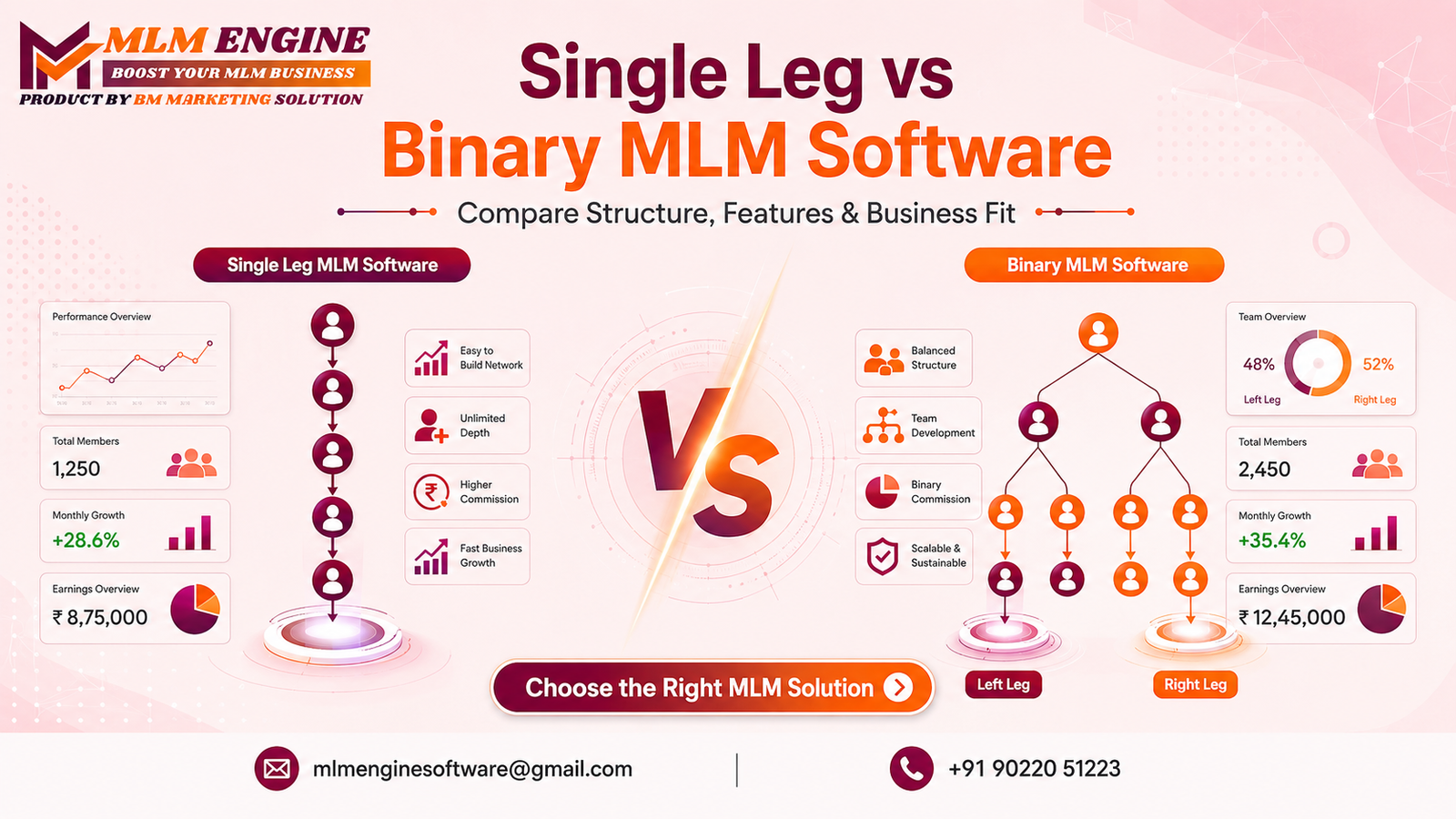
Choosing the right compensation structure is one of the most important decisions an MLM entrepreneur makes before launching a business. The plan you choose affects how distributors are placed, how commissions are calculated, and how the entire network grows over time. Two of the most widely used structures in the direct selling industry are the Single Leg model and the Binary model, and the debate around Single Leg vs Binary MLM Software comes up constantly among founders evaluating their options.
Both models can be fully automated through modern MLM software, but the underlying network logic, placement rules, and commission calculations are quite different. Understanding these differences before you invest in a platform can save you significant time, cost, and operational headaches later. This guide breaks down both models in plain language so you can decide which one actually fits your business.
Single Leg MLM software is built around a single-line network structure. Every new member who joins is placed one after another in a straight line, rather than being split across multiple branches. Think of it as a queue: each distributor sits below the one who joined before them, forming one continuous chain.
This structure keeps things simple for both the business and the distributors. There’s no need to think about “which side” a new referral should go on, because there’s only one line to manage.
Key aspects of how Single Leg MLM software typically works include:
Because there’s only one structure to visualize and manage, many business owners find this model easier to explain to new distributors, especially those who are new to network marketing altogether. Software platforms like MLM Engine support this kind of automation so that placement, tracking, and payouts happen without manual intervention, letting the business focus on growth rather than backend calculations.
Binary MLM software, by contrast, is designed around a two-leg structure. Every distributor has exactly two positions directly under them commonly referred to as the left leg and the right leg. When a new member joins, they’re placed into one of these two legs based on the plan’s placement rules.
This creates a very different dynamic compared to the single-line model:
The exact commission rules how pairing works, whether there’s a capping limit, how carry-forward is handled depend entirely on the compensation plan the company designs. Binary MLM software needs to be configured carefully to reflect those specific rules accurately, which is why it tends to involve more setup than a single-line system.
The clearest way to compare the two is side by side. Here’s how they typically differ across the areas that matter most to a growing MLM business:
| Feature | Single Leg MLM Software | Binary MLM Software |
|---|---|---|
| Network Structure | Single linear structure | Two-leg structure |
| Placement | Sequential/linear | Left and right placement |
| Management Complexity | Generally simpler | Requires more configuration |
| Commission Logic | Plan-dependent | Often based on paired/leg volume |
| Team Monitoring | Single-line tracking | Left/right leg tracking |
| Spillover | Can be configured | Commonly supported |
| Reporting | Linear network reports | Binary leg and matching reports |
| Best Fit | Businesses wanting simpler structures | Businesses using two-leg compensation |
Neither model is universally “better” they’re built for different compensation philosophies, and the right choice depends on how your company wants to reward distributors.
Commission logic is where the two models diverge the most.
In a Single Leg MLM Plan, commissions are generally tied to linear or level-based structures. A distributor might earn a referral bonus for direct sign-ups, plus smaller rewards as their single line extends deeper. Because there’s only one line, commission calculation tends to follow a straightforward, level-by-level logic.
In a Binary MLM Plan, commissions typically depend on matching or pairing volume between the left and right legs. If one leg generates significantly more volume than the other, the excess may carry forward rather than being paid out immediately, depending on the plan’s capping and carry-forward rules.
Both models can also include:
A simple hypothetical example (not a promise of actual earnings): Suppose a distributor in a binary plan has ₹50,000 in business volume on the left leg and ₹30,000 on the right leg in a given cycle. If the plan pairs volume at a 1:1 ratio up to the lower leg’s total, ₹30,000 worth of volume would be matched and eligible for commission, while the remaining ₹20,000 on the left leg might carry forward to the next cycle depending entirely on how the company’s plan is configured. This is purely illustrative; actual payout structures vary by company and are never guaranteed.
A well-built Single Leg MLM platform typically includes:
A capable Binary MLM platform generally covers:
This depends largely on operational complexity rather than one model being objectively “easier” in every sense.
Single Leg structures tend to be simpler to manage day-to-day because there’s only one line to track, and the placement logic doesn’t require constant monitoring of two competing legs. New distributors also tend to grasp the concept quickly, since it mirrors a straightforward queue.
Binary structures require more detailed configuration on the software side. The system needs to continuously monitor two legs, apply matching rules, handle spillover and enforce carry-forward or capping logic all while keeping the reporting accurate in real time. This doesn’t make binary software inferior it simply means the underlying compensation plan is more intricate, and the software needs to reflect that complexity accurately.
There’s no one-size-fits-all answer here. The right choice depends on your product line, target audience, compensation philosophy, and long-term business strategy.
Consider a Single Leg model when your business needs:
Consider a Binary model when your business needs:
Ultimately, the decision should be driven by the compensation plan your company has designed, the products or services you’re selling, and how you want distributors to be rewarded not by which model sounds more popular.
Regardless of which structure your business adopts, the software you choose to run it on matters just as much as the plan itself. MLM Engine is built to support businesses running different MLM compensation structures, including both Single Leg and Binary models, without forcing them into a rigid, one-size-fits-all system.
Some of the capabilities MLM Engine brings to the table include:
MLM Engine doesn’t promise guaranteed business outcomes no software can do that. What it does offer is a reliable, configurable backend so that whichever compensation model you choose, the technical execution stays accurate and transparent.
When it comes to Single Leg vs Binary MLM Software, the right choice isn’t about which model is inherently superior it’s about which structure aligns with your compensation plan, product strategy, and target distributor base. Single Leg software offers a simpler, linear approach that’s easy to explain and manage, while Binary software supports more intricate two-leg compensation logic with matching and spillover functionality.
Whichever direction your business takes, having software that can accurately automate placement, commissions, and reporting is essential. MLM Engine is designed to support both models and others giving businesses the flexibility to configure their compensation plan the way it was actually designed, without technical limitations getting in the way.
If you’re evaluating your options and want to discuss which structure and software setup would work best for your MLM business, the team is ready to help.
Email: mlmenginesoftware@gmail.com
Phone: +91 90220 51223
Website: https://mlmengine.com/
WhatsApp Channel: https://whatsapp.com/channel/0029Vaj8FP577qVKIi7ooC1d
Generation vs Repurchase MLM: Which Model Fits Your Business? Choosing a compensation plan is one of those decisions that quietly shapes the entire future of
Generation vs Repurchase MLM: Which Model Fits Your Business? Choosing a compensation plan is one of those decisions that quietly shapes the entire future of
MLM Software for Pimpri-Chinchwad Businesses: Features That Matter Pimpri-Chinchwad has grown into one of Maharashtra’s most active business and industrial hubs, and that growth is
Online Dating Portal Development & MLM Software Solution Guide Online dating has moved a long way from static profile listings and slow-loading chat rooms. Today’s
Online Dating Portal Development & MLM Software Solution Guide Online dating has moved a long way from static profile listings and slow-loading chat rooms. Today’s
Online Dating Portal Development & MLM Software Solution Guide Online dating has moved a long way from static profile listings and slow-loading chat rooms. Today’s
Online Dating Portal Development & MLM Software Solution Guide Online dating has moved a long way from static profile listings and slow-loading chat rooms. Today’s