MLM Software for Pimpri-Chinchwad Businesses: Features That Matter
MLM Software for Pimpri-Chinchwad Businesses: Features That Matter Pimpri-Chinchwad has grown into one of Maharashtra’s most active business and industrial hubs, and that growth is

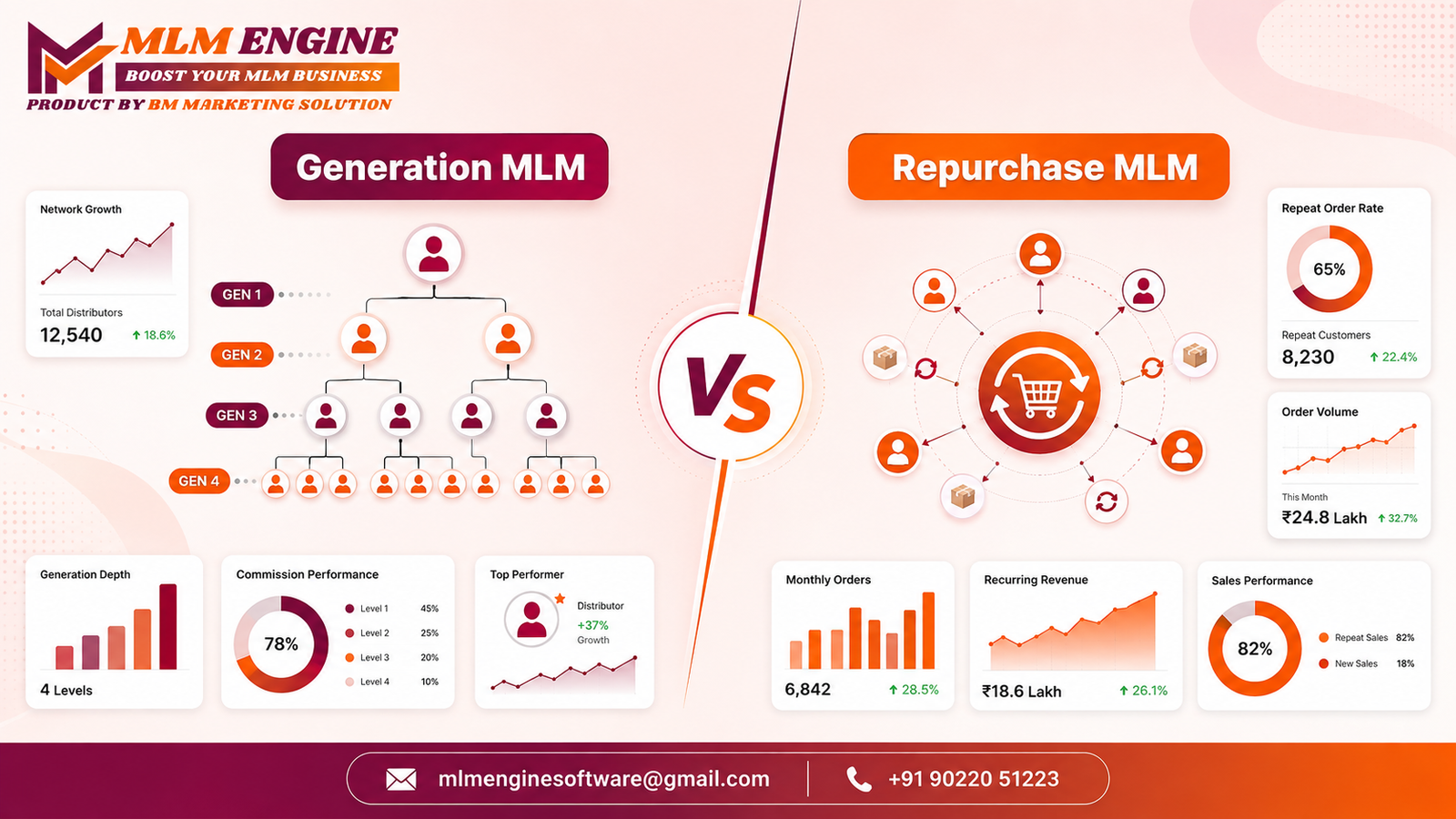
Choosing a compensation plan is one of those decisions that quietly shapes the entire future of an MLM company. Get it right and distributors stay motivated, income feels fair, and the business grows in a predictable direction. Get it wrong and you end up rebuilding your commission structure eighteen months in a painful, expensive exercise that most founders would rather avoid.
Two models that come up constantly in these conversations are Generation MLM and Repurchase MLM. Both are proven, both are widely used, and both solve very different business problems. If you’re weighing Generation vs Repurchase MLM for your own venture, the honest answer is that neither one is “better” in isolation the right fit depends on what you’re selling and how your customers behave after the first sale. This is exactly the kind of decision MLM Engine helps businesses work through, since the software backing your compensation plan needs to match the logic of the plan itself, not the other way around.
Let’s break both models down properly.
Generation MLM is a compensation structure built around depth. Instead of paying distributors purely on the people they personally recruit, it groups the downline into “generations” essentially horizontal layers that begin fresh every time a qualified leader appears in the tree.
Here’s the core idea: a generation doesn’t simply mean “level 3” or “level 4” the way it does in a basic unilevel plan. A new generation starts wherever a distributor reaches a defined rank or sales qualification. So one distributor’s “first generation” might technically sit ten levels deep in the tree, because that’s where the next qualified leader happens to be.
A simplified example:
This means senior distributors are rewarded for developing leaders, not just for adding raw headcount.
Businesses selling higher-value products with longer sales cycles wellness equipment, high-ticket courses, financial or investment-linked products tend to gravitate toward Generation MLM, because the plan rewards sustained leadership rather than frequent reordering. This is often the first thing that comes up when a business starts comparing Generation vs Repurchase MLM for a high-ticket catalog.
Managing this manually in a spreadsheet is close to impossible once a network crosses a few hundred members. This is where MLM Engine becomes genuinely useful automatically tracking rank qualifications, recalculating generation boundaries as the tree evolves, and generating accurate payouts without manual recompilation every commission cycle.
Repurchase MLM, sometimes called Re-Purchase MLM, flips the emphasis entirely. Instead of rewarding network depth, it rewards consistent buying behavior both from the distributor and their downline.
In this model, commissions are tied to repeat product purchases rather than one-time recruitment. A distributor earns not just when they bring someone new into the network, but every time that person (and their downline) places a repeat order. Business Volume (BV) or Point Value (PV) typically accumulates with every purchase cycle, and payouts are calculated against that recurring volume.
This naturally suits consumable products nutrition, skincare, wellness supplements, household goods anything a customer would realistically buy again next month.
Repurchase MLM essentially treats the distributor network as a recurring customer base as much as a sales force. The healthier the reorder rate, the stronger the commission pool, which keeps incentives aligned between the company (steady revenue) and the distributor (steady income).
Companies selling FMCG-style, wellness, nutrition, or personal-care products anything with a natural reorder cycle usually find Repurchase MLM a more honest fit than generation-based plans, simply because the product itself supports recurring purchases. It’s one of the clearest signals when weighing Generation vs Repurchase MLM for a consumable product line.
Tracking repurchase volume accurately, across thousands of orders and distributors, is where most manual systems fall apart. MLM Engine is built to handle exactly this kind of ongoing calculation monitoring repeat orders, updating BV/PV in real time, and keeping repurchase-linked commissions accurate without added manual work.
Laying Generation vs Repurchase MLM out side by side makes the trade-offs much easier to see:
| Factor | Generation MLM | Repurchase MLM |
|---|---|---|
| Compensation Basis | Rank-based generational depth | Recurring product purchases |
| Main Revenue Driver | Leadership development and team depth | Repeat customer orders |
| Network Structure | Generations formed by qualified leaders | Flat or leveled network tied to purchase volume |
| Repeat Purchases | Secondary factor, not the core driver | Central to the entire compensation model |
| Distributor Incentives | Building and mentoring strong leaders | Encouraging consistent reordering |
| Best Suited For | High-ticket, one-time or infrequent purchase products | Consumables, wellness, FMCG, subscription-style products |
| Software Requirements | Dynamic rank and generation tracking | Real-time order and BV/PV tracking |
| Growth Potential | Strong when leadership pipeline is healthy | Strong when reorder rates stay consistent |
There’s no universal winner here, and any article claiming otherwise is oversimplifying a genuinely nuanced decision. The right answer depends on a handful of business-specific factors:
A practical way to think about it: a company selling a premium water purifier (bought once, rarely repeated) is a natural fit for Generation MLM, since the compensation needs to reward the leaders who build and sustain the sales network over time. A company selling daily nutrition supplements, on the other hand, fits Repurchase MLM far better, because the entire business model depends on customers coming back month after month.
Some businesses even combine elements of both using repurchase volume as a qualifying criterion for generation advancement. This kind of hybrid structure is increasingly common, but it needs careful planning (and reliable software) to avoid confusing distributors about how they actually get paid.
Whichever way you lean on Generation vs Repurchase MLM, the compensation logic only works if the underlying software can calculate it correctly, every single cycle, without errors. This is where a dedicated platform earns its place in the business.
A capable MLM software solution typically supports:
MLM Engine is designed around this exact need supporting businesses running Generation MLM, Repurchase MLM, or hybrid structures, with the commission engine configured to match the specific plan rules a business defines, rather than forcing the business into a rigid template.
Manual commission tracking might work for a handful of distributors, but it breaks down fast as networks scale. A dedicated platform changes that equation in a few concrete ways:
For growing MLM businesses, this isn’t a luxury it’s the operational backbone that keeps trust intact between the company and its distributors. MLM Engine exists specifically to give businesses that backbone, whether they’re running a straightforward repurchase plan or a more complex, rank-driven generation structure.
Before locking in either side of Generation vs Repurchase MLM, it’s worth working through these points deliberately:
At the end of the day, Generation vs Repurchase MLM isn’t a competition with a single right answer it’s a question of matching your compensation structure to your product, your customers, and your long-term goals. Generation MLM rewards the leaders who build and sustain deep, capable teams, making it a natural fit for high-ticket or infrequently purchased products. Repurchase MLM rewards consistent buying behavior, making it the stronger choice for consumables and products with a natural reorder cycle.
Whichever direction fits your business, the compensation plan is only as strong as the software running it. MLM Engine is built to support both models and hybrid structures too with accurate commission calculations, real-time tracking, and the reporting businesses need to scale with confidence.
If you’re planning your MLM compensation structure and want software that can actually keep up with it, reach out to explore what MLM Engine can do for your business.
Email: mlmenginesoftware@gmail.com
Phone: +91 90220 51223
Website: https://mlmengine.com/
WhatsApp Channel: https://whatsapp.com/channel/0029Vaj8FP577qVKIi7ooC1d
MLM Software for Pimpri-Chinchwad Businesses: Features That Matter Pimpri-Chinchwad has grown into one of Maharashtra’s most active business and industrial hubs, and that growth is
Online Dating Portal Development & MLM Software Solution Guide Online dating has moved a long way from static profile listings and slow-loading chat rooms. Today’s
Online Dating Portal Development & MLM Software Solution Guide Online dating has moved a long way from static profile listings and slow-loading chat rooms. Today’s
Online Dating Portal Development & MLM Software Solution Guide Online dating has moved a long way from static profile listings and slow-loading chat rooms. Today’s
Online Dating Portal Development & MLM Software Solution Guide Online dating has moved a long way from static profile listings and slow-loading chat rooms. Today’s
Online Dating Portal Development & MLM Software Solution Guide Online dating has moved a long way from static profile listings and slow-loading chat rooms. Today’s
Online Dating Portal Development & MLM Software Solution Guide Online dating has moved a long way from static profile listings and slow-loading chat rooms. Today’s