Get a Free Demo of MLM Engine’s Software Today
Online Dating Portal Development & MLM Software Solution Guide Online dating has moved a long way from static profile listings and slow-loading chat rooms. Today’s

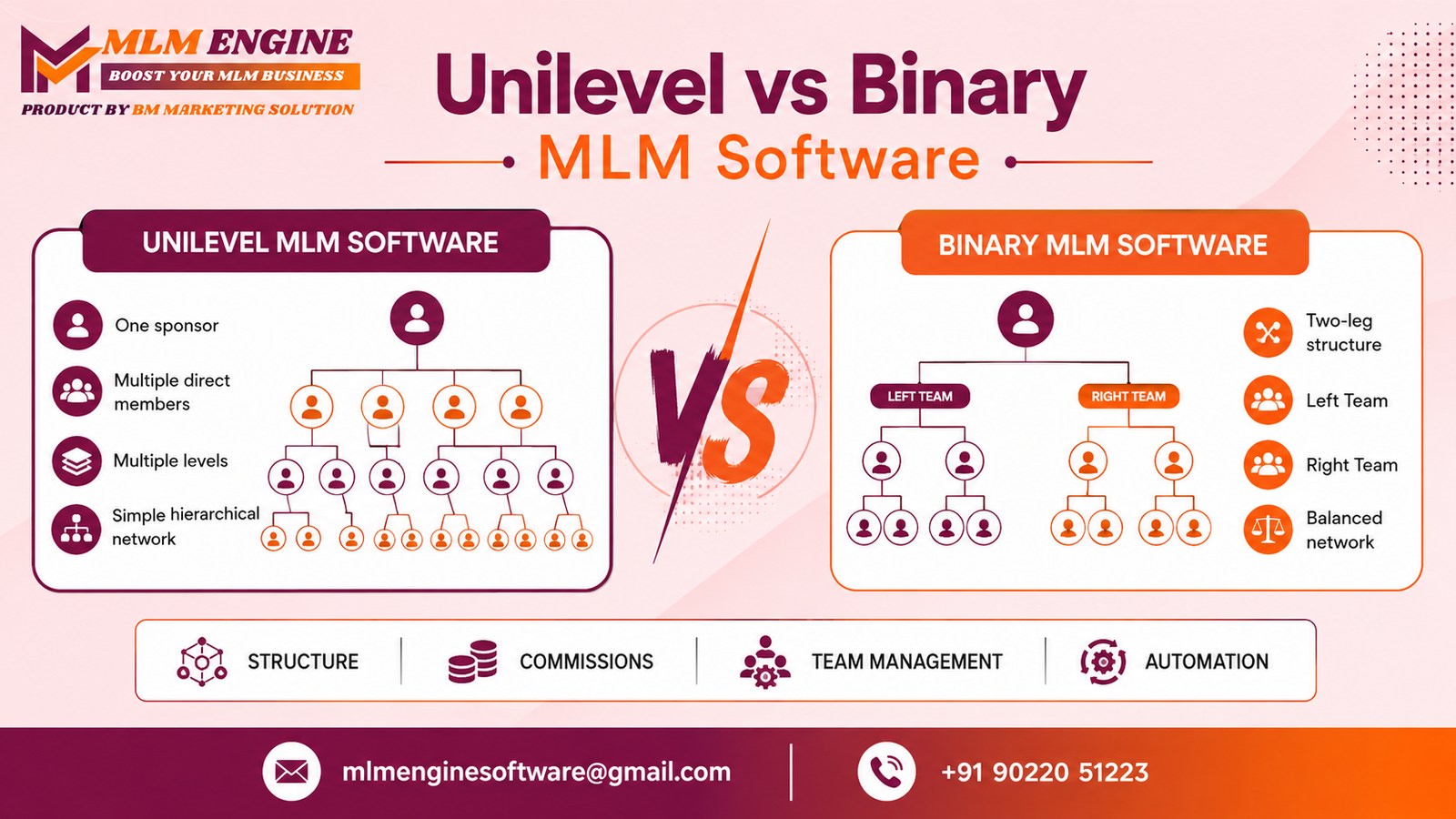
Choosing a compensation structure is one of the most important decisions any network marketing company makes and it directly shapes how distributors are rewarded, how teams grow and how sustainable the business becomes over time. The Unilevel vs Binary MLM Software debate comes up constantly among founders and operations teams because both models work well, just in different ways. Modern MLM software like MLM Engine can automate the heavy lifting behind either plan, handling distributor management, genealogy tracking, commission calculations, sales monitoring, reporting and payouts, so the real question isn’t which software to use but which compensation structure fits your business goals.
This guide breaks down both models in plain terms, compares them side by side, and helps you figure out which one makes sense for where your company is headed.
Unilevel MLM software supports one of the simplest and most widely used compensation structures in the industry. Every distributor can sponsor an unlimited number of people directly under them, forming one wide front line rather than being restricted to a fixed number of positions.
Here’s how it typically works:
The advantage of Unilevel is its simplicity. New distributors find it easy to understand because there’s no complicated placement strategy involved, just direct recruiting and team building. It also rewards distributors who are strong recruiters, since there’s no limit on how many people they can bring in directly.
The tradeoff is that depth-based earnings can sometimes concentrate income at the top levels unless the compensation plan is designed carefully with level caps or compression rules. Businesses that sell consumable or repeat-purchase products or that want a straightforward plan for a large, geographically spread-out distributor base, tend to do well with Unilevel structures.
Binary MLM software is built around a very different idea instead of unlimited width, each distributor can only have two direct positions, commonly called the left team and the right team.
The mechanics work like this:
For example, if a distributor’s left team generates 10,000 in business volume and the right team generates 6,000, commission is usually calculated on the matched 6,000, with the remaining 4,000 either carried forward or forfeited based on the plan’s rules.
Binary plans are attractive because they encourage teamwork and support between upline and downline, since spillover can help newer distributors get a head start. The tradeoff is added complexity, since balancing two legs takes more strategic thought than simply recruiting as many people as possible. Businesses with products suited to pair-based promotions or that want to encourage strong upline mentorship and team collaboration, often lean toward Binary structures.
Unilevel vs Binary MLM Software: Key Differences
The two models differ in several practical ways that affect both distributors and administrators.
Neither structure is inherently better than the other. Each has tradeoffs that matter more or less depending on the type of product, target market, and the culture a company wants to build among its distributors.
In a Unilevel plan, commissions generally flow based on how much sales volume is generated at each level below a distributor. A company might pay a percentage on level one, a smaller percentage on level two, and so on, often up to a defined number of levels. The logic is straightforward: more levels and more active distributors mean more commission potential.
In a Binary plan, commissions are calculated by comparing volume on the left and right legs. If both legs are reasonably balanced, the distributor earns based on the matched volume. If one leg is much stronger than the other, only the matched portion typically counts, which is why distributors are encouraged to keep both legs growing evenly.
For either model, MLM software plays a major role in removing manual errors from this process. Automated commission calculations, sales volume tracking, referral tracking, team performance monitoring, payout processing, commission reports, and individual distributor earnings statements all need to work together accurately and in real time, especially as networks grow into the thousands of members. Manually tracking any of this at scale is close to impossible without dedicated software support.
Regardless of which compensation model a business chooses, certain software features matter across the board:
MLM Engine is built to support these operational needs, offering the automation and structure businesses need whether they’re running a Unilevel plan, a Binary plan, or even a hybrid structure that combines elements of both.
There isn’t a universal answer, and any software vendor claiming one model is always superior isn’t being fully honest with you. The right choice depends on several factors specific to your business.
A Unilevel plan may suit companies that want a simple structure that’s easy to explain during recruitment, that expect distributors to build wide independent networks, or that sell products where individual selling effort matters more than team collaboration.
A Binary plan may suit companies that want to encourage mentorship and support between uplines and downlines, that are comfortable managing the added complexity of leg balancing, or that want spillover dynamics to help motivate and retain newer distributors.
Other factors worth weighing include your target market’s familiarity with MLM structures, how your product pricing and repurchase cycles work, the operational complexity your admin team can realistically manage, and your long-term growth objectives. Neither structure guarantees business success on its own; the compensation plan needs to align with a genuinely valuable product and a sound overall business strategy.
Once you’ve settled on a compensation structure, or if you’re still deciding, evaluate potential software providers against these criteria:
MLM Engine offers these capabilities as part of its software platform, giving businesses a foundation to manage either compensation model without being locked into a rigid, one-size-fits-all system.
Whether a company runs Unilevel, Binary or another compensation structure entirely, the operational demands of running a network marketing business are similar. Automated commission calculations reduce human error and payout disputes. Streamlined distributor onboarding gets new members active faster. Genealogy management keeps the team structure organized and easy to audit. Order tracking and sales monitoring give real-time visibility into business performance. Team performance reports help identify top performers and areas needing support. Payout management ensures distributors are paid accurately and on time. Business analytics support better strategic decisions, and centralized administrative control keeps the whole operation manageable as it scales.
MLM Engine is designed around these operational needs, giving businesses the tools to run their chosen compensation plan smoothly rather than managing it through spreadsheets and manual processes.
The Unilevel vs Binary MLM Software comparison ultimately comes down to how your business wants to grow and how you want your distributors to work together. Unilevel offers simplicity and unrestricted direct recruiting, while Binary encourages team collaboration through its two-leg structure and spillover dynamics. Neither is a shortcut to success on its own, but choosing the structure that fits your product, market, and growth strategy gives your compensation plan a much better chance of working the way it’s meant to.
Unilevel MLM software supports a wide, level-based structure built around direct recruiting, while Binary MLM software organizes teams into two balanced legs with volume-matching commissions. The Unilevel vs Binary MLM Software decision depends on factors like your product type, target distributors, and how much operational complexity your team can manage. Some businesses will find Unilevel’s simplicity a better fit, while others will benefit from the collaborative dynamics Binary encourages. Whichever structure you choose, having flexible, reliable MLM software behind it makes the difference between a compensation plan that runs smoothly and one that becomes an administrative burden. MLM Engine is built to support both models with the automation and reporting tools growing MLM businesses need.
Contact MLM Engine
Email: mlmenginesoftware@gmail.com
Phone: +91 90220 51223
Website: https://mlmengine.com/
WhatsApp Channel: https://whatsapp.com/channel/0029Vaj8FP577qVKIi7ooC1d
Online Dating Portal Development & MLM Software Solution Guide Online dating has moved a long way from static profile listings and slow-loading chat rooms. Today’s
Online Dating Portal Development & MLM Software Solution Guide Online dating has moved a long way from static profile listings and slow-loading chat rooms. Today’s
Online Dating Portal Development & MLM Software Solution Guide Online dating has moved a long way from static profile listings and slow-loading chat rooms. Today’s
How Learning Management System Software Is Reshaping Digital Training for Every Organization Digital learning has quietly become the backbone of how schools, companies and training
How Learning Management System Software Is Reshaping Digital Training for Every Organization Digital learning has quietly become the backbone of how schools, companies and training
How Learning Management System Software Is Reshaping Digital Training for Every Organization Digital learning has quietly become the backbone of how schools, companies and training
Unilevel MLM Software Explained: A Practical Guide for Direct Sellers INTRODUCTION Direct selling and MLM businesses grow fast and once a distributor network crosses a