The standards for measuring operational excellence have changed significantly over the past decade. In this evolving landscape, Single Vendor LMS SaaS solutions have become essential. They help deliver structured, measurable and scalable learning experiences. Earlier, periodic training sessions and basic employee records were enough. Today’s business environment demands a far more strategic approach. Learning and development is no longer a support function. It is now a core business driver.
Despite this shift, many organizations still rely on disconnected tools and informal processes. These systems were never designed to work together. As a result, businesses face inconsistent training outcomes and poor data visibility. Administrative costs continue to rise. The learner experience also suffers and fails to reflect the organization’s professionalism.
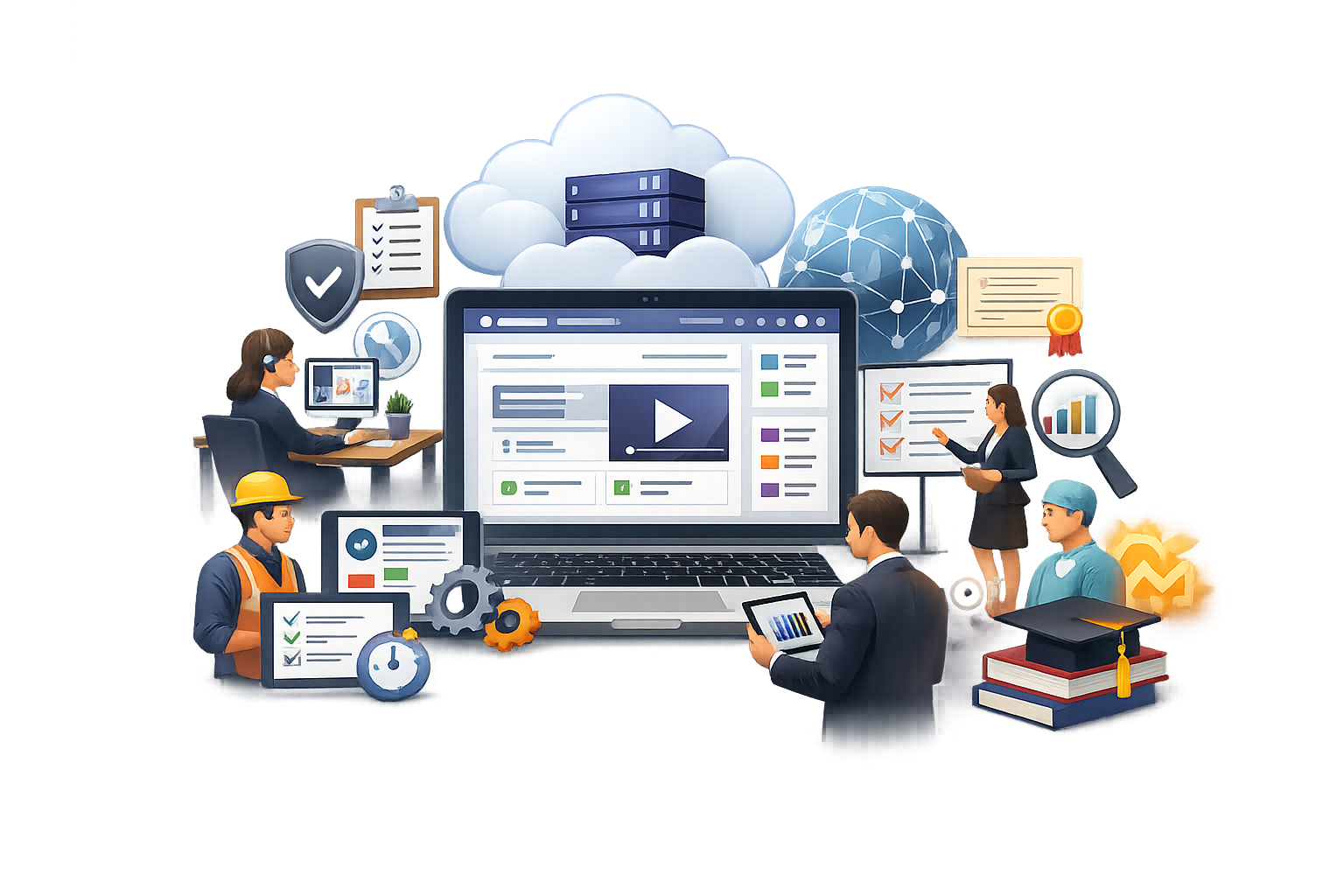
A SaaS-based single vendor Learning Management System solves these challenges effectively. It is not a temporary workaround but a purpose-built solution. It unifies content delivery, learner management, compliance tracking, reporting and certification. All of this is managed within one cloud-based platform by a single provider.
This article explores the single vendor LMS model in detail. It explains its operational and strategic benefits. It also highlights why it is the most logical investment for organizations aiming to build a scalable learning function.
A Learning Management System is a software platform designed to create, deliver, manage and track educational and training content. When deployed as a SaaS (Software as a Service) solution, the platform is hosted entirely in the cloud, eliminating the need for on-premise infrastructure, internal IT management or manual software updates.
The single vendor component refers to the consolidation of all LMS-related functions course authoring, learner management, assessment tools, reporting and certification within one unified platform provided by a single technology partner. This stands in direct contrast to multi-vendor approaches, where organizations patch together separate tools from different providers, each requiring its own integration, support relationship and licensing agreement.
Together, these two attributes create a learning infrastructure that is not only operationally simpler but strategically more powerful.
Before understanding the value a single vendor LMS delivers, it is important to acknowledge the operational burden that fragmented systems impose.
Organizations managing learning across multiple platforms routinely encounter duplicated administrative work, inconsistent learner experiences, unreliable data integration and inflated total costs of ownership. When a compliance deadline approaches or a large-scale onboarding initiative begins, the cracks in a multi-tool setup become immediately visible.
Beyond the visible inefficiencies, there is a subtler problem: leadership cannot make informed decisions about training investments when learning data is scattered across disconnected systems. A single vendor LMS resolves this at the foundational level.
Rapid Deployment and Minimal IT Dependency
Unlike traditional on-premise solutions that require extensive setup and infrastructure investment, a SaaS-based LMS can be deployed within days. Organizations can launch fully functional learning environments quickly, with no hardware procurement, no server configuration and no prolonged implementation timelines. This speed to value is particularly significant for businesses operating in fast-moving industries.
Consolidated Administration and Reduced Overhead
Managing a single platform is inherently more efficient than managing several. Administrators benefit from one dashboard, one login, one support contact and one unified workflow for enrollments, notifications, reporting and content management. The reduction in administrative overhead translates directly into time and cost savings that accumulate substantially over time.
Unified Learning Data and Actionable Reporting
When all learning activity flows through a single platform, organizations gain access to a complete and reliable data picture. Completion rates, assessment outcomes, engagement metrics and certification statuses are all visible in one place. This enables leadership to identify skill gaps proactively, measure training effectiveness accurately and allocate learning budgets with confidence rather than assumption.
Consistent and Scalable Learner Experience
A professional learning experience depends on consistency. When learners are required to navigate multiple platforms to complete a single training path, engagement drops and retention suffers. A single vendor LMS presents all content regardless of format or subject matter through one coherent, intuitive interface. As the organization scales, the platform accommodates growth without requiring architectural changes or additional integrations.
Predictable Costs and Transparent Pricing
SaaS-based platforms operate on subscription models that scale with usage, providing finance teams with predictable monthly or annual costs. There are no surprise infrastructure expenses, no costly version upgrades and no hidden integration fees. This financial transparency makes budget planning straightforward and eliminates the cost volatility associated with on-premise solutions and multi-vendor environments.
Continuous Updates Without Operational Disruption
SaaS platforms are maintained and updated by the vendor on a continuous basis. Security patches, feature enhancements and compliance-related updates are applied automatically, ensuring that organizations are always operating on a current, secure version of the software without scheduling downtime or engaging internal IT resources.
While a SaaS-based single vendor LMS serves a broad range of organizations, certain business profiles experience particularly significant impact.
Enterprises managing large, distributed workforces benefit from the platform’s ability to deliver consistent training experiences across locations and time zones. Organizations in regulated industries including healthcare, financial services and manufacturing rely on the centralized tracking and automated compliance workflows that a unified LMS provides.
Businesses focused on customer education find that a single platform simplifies the delivery of product training, reduces support demand and accelerates customer onboarding. Similarly, companies experiencing rapid growth appreciate the ability to scale their learning operations without rebuilding their infrastructure each time headcount increases.
Selecting a SaaS-based single vendor LMS requires careful evaluation across several dimensions. The platform should natively support the complete learning lifecycle, from content authoring and course delivery to assessment, certification and reporting. Mobile responsiveness, learner segmentation capabilities and the quality of vendor support are equally important considerations.
Organizations should also assess whether the platform’s pricing structure aligns with their growth trajectory and whether the vendor has demonstrated experience supporting businesses in their specific industry or use case.
A SaaS-based single vendor LMS is not simply a technology upgrade it is a strategic decision that shapes how an organization builds knowledge, maintains compliance and develops its people at scale. By moving away from fragmented, multi-tool approaches and investing in a unified, cloud-based learning platform, businesses gain the operational clarity and infrastructure they need to grow with purpose.
For organizations ready to consolidate their learning operations onto a platform built for performance, scalability and long-term value, the right solution is closer than you may think.
Explore what a purpose-built SaaS LMS can do for your business at mlmengine.com and take the first step toward a smarter, more unified approach to organizational learning.