The growth of a direct-selling business brings new opportunities, but it also introduces operational challenges. As a distributor network expands, companies must manage distributor registrations, customer orders, product information, commission calculations, sales performance, and payment records. Handling these activities through spreadsheets or disconnected applications can make daily operations increasingly complicated.
For businesses operating in California, having a well-organized digital infrastructure can make a significant difference. MLM Software Development California is an important consideration for companies looking to streamline distributor management, automate business processes, and build technology that supports their operational requirements.
However, developing an MLM platform requires more than selecting a few software features. Businesses must carefully plan their compensation structures, functional requirements, integrations, security measures, development budgets, and future expansion strategies.
A properly planned software project can bring multiple business operations into one centralized platform. It can also help administrators maintain accurate records, monitor sales activities, manage distributor relationships, and access meaningful business reports.
In this article, we will explore how California businesses can plan a complete MLM software development project, identify essential platform features, evaluate technology requirements, and select an appropriate development partner.
MLM Software Development for California Businesses
MLM software development involves creating a digital platform that helps direct-selling companies manage distributor networks, compensation structures, product sales, commissions, and administrative activities.
Unlike conventional business applications, MLM platforms must handle complex distributor relationships and compensation calculations. For example, companies operating a binary compensation structure need software that can manage two business legs, monitor eligible sales volume, and calculate commissions according to predefined rules. Similarly, businesses using unilevel or matrix structures require different organizational and calculation mechanisms.
Custom MLM Software Development allows companies to build a platform around their specific business requirements instead of depending entirely on predefined software functionality.
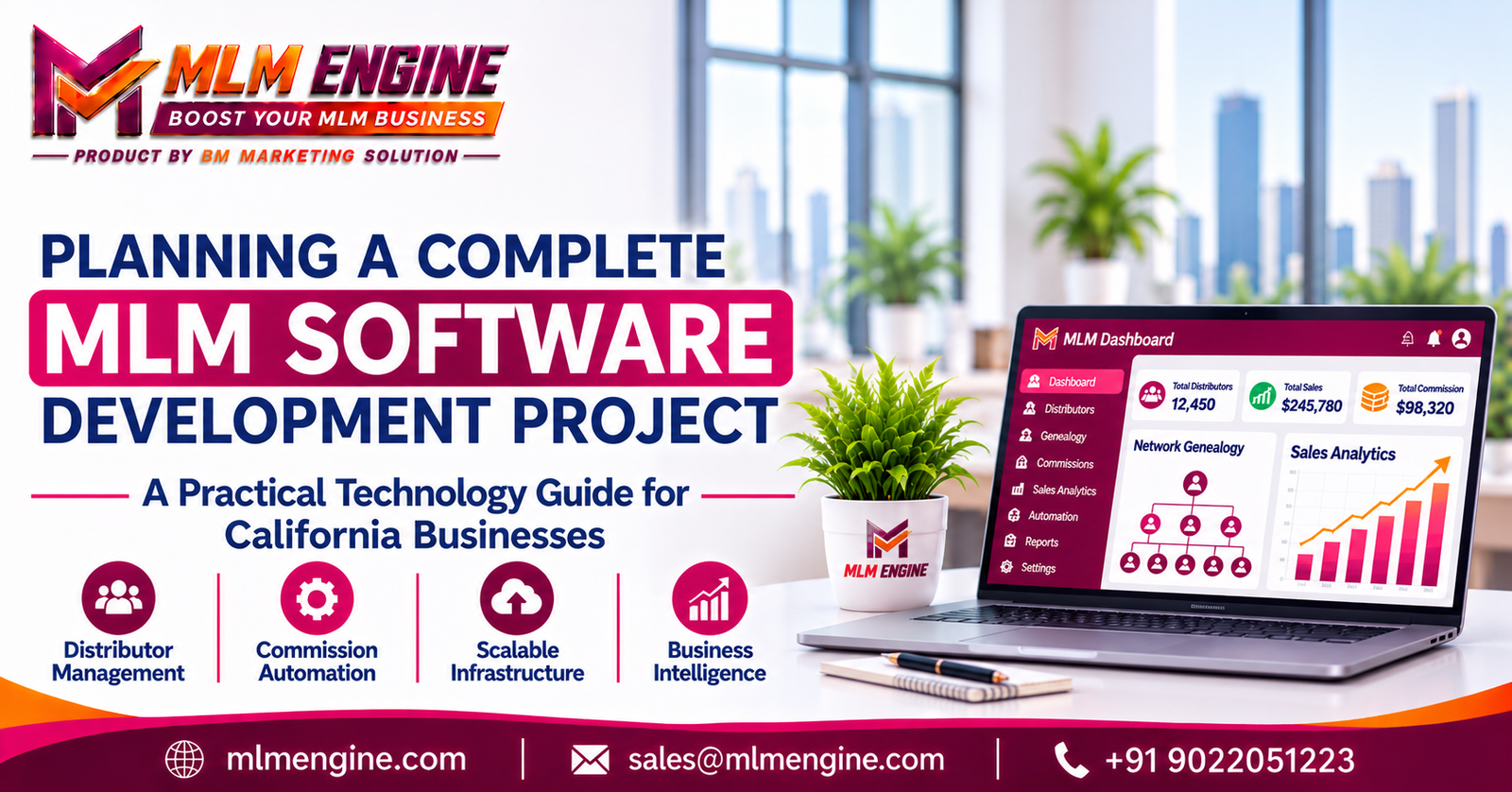
A comprehensive MLM platform may include distributor registration, genealogy tree management, commission calculations, e-wallet management, order processing, sales tracking, reporting, and administrative dashboards.
For companies exploring MLM Software Solutions California, the primary objective should be to establish a centralized technology system that simplifies operations and supports future business requirements.
How to Plan an MLM Software Development California Project
Planning is one of the most important stages of any software development project. Before beginning development, businesses should understand their operational processes and identify the functionality required to manage their distributor networks effectively.
The following steps can help establish a structured development approach.
1. Define Business Goals and Project Objectives
Start by identifying why your company needs an MLM software platform. Some businesses want to replace manual commission calculations, while others need a centralized system to manage distributors, customer orders, and sales activities.
Clearly defined objectives help developers understand the expected outcomes of the project.
For example, a company may want to organize distributor information, improve commission calculation workflows, simplify order management, or generate more accurate sales reports.
Businesses should prioritize objectives according to their operational importance. Separating immediate requirements from future enhancements can also help maintain a manageable development scope.
2. Identify Business Requirements
Once the objectives are established, document the processes that the software must support.
Consider how distributors register, how accounts are approved, how products are purchased, how commissions are calculated, and how administrators monitor network performance.
Different users may require different access permissions. Administrators may need complete operational controls, whereas distributors may only need access to their personal profiles, sales information, genealogy structures, and commission statements.
Clearly documenting these requirements helps prevent confusion during development and reduces the possibility of expensive changes later.
3. Select the Right Compensation Plan
The compensation structure directly influences how an MLM platform operates.
Before development begins, businesses should decide whether they require a binary, matrix, unilevel, generation, or hybrid compensation model.
Each structure follows different organizational and calculation rules. These rules may determine distributor placement, qualifying sales volume, commission eligibility, bonuses, and payout conditions.
A clearly documented compensation structure helps developers implement accurate calculation logic and appropriate reporting functionality.
Businesses should also validate their compensation models with qualified business and compliance professionals before implementation.
4. Determine Essential MLM Software Features
Every direct-selling company has different operational requirements. A startup may initially need distributor registration, commission management, and basic reporting, while an established business may require advanced analytics, e-commerce functionality, and multiple third-party integrations.
Prepare a feature list and organize it into essential launch features, important enhancements, and future development requirements.
This approach helps businesses prioritize their investment while ensuring that the initial platform addresses their most important operational challenges.
5. Choose the Appropriate Technology Stack
Technology selection influences application performance, maintainability, security, and scalability.
Businesses should evaluate frontend development technologies, backend frameworks, database architecture, cloud infrastructure, authentication systems, and monitoring tools.
The selected architecture should support the platform’s current functionality while allowing developers to introduce additional features when business requirements change.
Instead of choosing technologies simply because they are popular, companies should ask development teams to explain why their proposed architecture is appropriate for the project.
6. Plan Third-Party Integrations
An MLM platform may need to communicate with several external business applications.
Common integration requirements include payment gateways, CRM platforms, ERP systems, accounting applications, e-commerce solutions, email services, and notification providers.
For example, payment integration can help manage transaction records, while CRM integration may support customer and distributor information management.
Businesses should identify which applications need to communicate with the MLM platform and determine how information will be transferred between them.
A properly planned MLM Software Integration strategy helps reduce duplicate records, improve information consistency, and simplify business workflows.
7. Define Development Timelines and Budget
The development timeline and project budget depend on the complexity of the required platform.
A basic MLM application may require fewer development components than an enterprise platform with customized compensation logic, multiple integrations, advanced reporting, and extensive security requirements.
Businesses should consider the cost and effort associated with business analysis, UI/UX design, frontend development, backend development, testing, deployment, and ongoing maintenance.
Requesting a detailed proposal with development milestones, deliverables, dependencies, and scope information can make project planning more transparent.
8. Conduct Testing and Quality Assurance
Testing helps verify that the developed platform follows the documented business requirements.
Important testing areas include distributor registration, genealogy management, commission calculations, order processing, payment workflows, reporting, integrations, and mobile responsiveness.
Special attention should be given to compensation calculations because incorrect results can affect financial records and distributor statements.
Businesses should prepare sample scenarios with expected results and validate the software before moving it into production.
9. Plan Deployment, Training, and Ongoing Maintenance
Software implementation involves more than making an application available online.
Businesses should prepare deployment procedures, administrator training, distributor onboarding instructions, technical documentation, and post-launch support arrangements.
Regular maintenance is also necessary to address software updates, technical issues, infrastructure changes, and evolving business requirements.
Establishing a maintenance plan before launch helps ensure that the platform remains manageable after development is completed.
Essential Features to Include in MLM Software
The functionality of an MLM platform should reflect the company’s business model and operational requirements. However, several features are commonly important for direct-selling organizations.
Distributor registration and management helps administrators create accounts, manage distributor profiles, maintain records, and control account permissions.
Genealogy tree management provides a visual representation of distributor relationships and organizational structures. It helps administrators and distributors understand network placement and team development.
Commission calculation automates compensation calculations according to the selected compensation plan and its qualification rules.
E-wallet and payout management helps maintain distributor wallet records, eligible balances, transaction histories, and payout workflows.
Replicated websites can provide distributors with personalized web pages where the business model requires individual online storefronts or referral pages.
E-commerce and order management supports product catalogs, customer orders, order histories, and related business activities.
Sales and performance tracking helps companies monitor individual and network-level sales activities.
Reports and analytics provide information about distributor activity, orders, commissions, and business performance.
Admin and distributor dashboards give different users access to relevant information according to their responsibilities.
Mobile responsiveness allows users to access important platform functionality across smartphones, tablets, and desktop devices.
Notification and communication systems help communicate registration updates, order confirmations, account notifications, and other important information.
Together, these MLM Software Features can support better operational organization and reduce dependence on disconnected applications.
Choosing the Right MLM Compensation Plan
A compensation plan determines how eligible business activities translate into distributor commissions and bonuses. Selecting the appropriate structure is therefore an important part of Network Marketing Software Development.
A binary plan organizes distributors into two primary legs. The software must maintain placement records, monitor qualifying sales volume, and apply the configured commission rules.
A matrix plan follows predefined width and depth limits. The platform must enforce placement requirements and calculate compensation according to the selected matrix structure.
A unilevel plan allows distributors to build multiple direct relationships on the same level. Its software functionality must support organizational reporting and applicable commission calculations.
A generation plan calculates certain compensation according to defined organizational generations and qualification requirements.
A hybrid plan combines different compensation structures or bonus mechanisms. It generally requires more detailed configuration because multiple calculation rules must work together.
Before development begins, businesses should finalize their compensation rules, including eligibility requirements, sales qualifications, commission conditions, and payout procedures.
A well-designed MLM Compensation Plan Software component should maintain transparent calculation rules and accurate transaction records.
Companies should also ensure that their compensation structures and marketing practices comply with applicable consumer-protection requirements. Software should not be used to support misleading income representations or recruitment-focused promises.
Technology Stack and Integration Considerations
Technology decisions influence how an MLM platform performs and how easily it can be maintained as business requirements change.
Frontend development determines how administrators, distributors, and customers interact with the application. A simple interface, understandable dashboards, and responsive layouts can improve the overall User Experience.
Backend development handles distributor relationships, commission calculations, account management, order processing, and business workflows. A properly organized backend architecture makes it easier to test and maintain application functionality.
Database architecture is equally important because MLM applications manage distributor records, genealogy relationships, transactions, product information, and commission histories. The database should support accurate relationships and reliable transaction processing.
Cloud-Based Infrastructure can provide flexible hosting, monitoring, backup, and resource management. The appropriate configuration depends on the application’s expected activity, security requirements, and operating budget.
Businesses should also consider API development and third-party integrations. Payment gateways, CRM applications, ERP systems, e-commerce platforms, and analytics tools may all need to exchange information with the MLM platform.
A carefully planned technology environment can support maintainability, performance, and future expansion without introducing unnecessary complexity.
MLM Software Development Timeline and Budget Considerations
The timeline and budget of an MLM software project depend on the functionality, customization, and technical requirements involved.
A platform with basic distributor management and reporting requirements will involve a different development effort from a customized enterprise system with multiple compensation structures, payment integrations, and advanced analytics.
Several factors influence project planning:
Project complexity: More complicated workflows require additional analysis and development.
Number of features: A larger functional scope generally requires more development effort.
Custom compensation logic: Specialized calculations require detailed implementation and validation.
Integration requirements: External applications introduce additional development and testing dependencies.
UI/UX design: User interface requirements influence design and frontend development.
Quality assurance: Comprehensive testing is essential for operational reliability.
Deployment: Infrastructure configuration, data migration, and production preparation affect implementation.
Ongoing maintenance: Updates, monitoring, troubleshooting, and technical support create continuing responsibilities.
Businesses should request a detailed project estimate that separates development, integration, testing, deployment, and maintenance activities.
Choosing a development partner based only on the lowest initial estimate may create problems later if important requirements have been overlooked.
Common MLM Software Development Planning Mistakes
Several planning mistakes can affect the quality and long-term usefulness of an MLM platform.
One common problem is starting development without clearly documented requirements. When business workflows and user responsibilities are unclear, developers may implement functionality that does not match actual operational needs. Preparing a detailed requirements document can help prevent this issue.
Another mistake is choosing an unsuitable compensation plan. Since compensation rules influence the calculation engine and distributor relationships, businesses should validate their selected structure before development begins.
Ignoring scalability can also create difficulties as distributor accounts, transactions, and reporting requirements increase. Companies should consider future infrastructure and database requirements during architecture planning.
Underestimating integrations is another challenge. Payment gateways, CRM platforms, accounting applications, and e-commerce systems may require additional development and testing. Identifying these dependencies early helps avoid unexpected complications.
Neglecting security, skipping system testing, and overlooking user experience can also affect software reliability and usability.
Finally, some businesses focus entirely on development and forget about maintenance. Establishing a support and update plan before deployment helps maintain the platform over time.
How to Choose an MLM Software Development Company
Selecting the right MLM Software Development Company requires evaluating more than its technical capabilities.
A suitable development partner should understand the operational requirements of direct-selling businesses and have the ability to translate those requirements into practical software functionality.
Before selecting a company, consider its experience with distributor management systems, compensation calculations, custom development, database architecture, security practices, and third-party integrations.
Ask how the company tests different compensation scenarios, manages software changes, handles deployment, and provides post-launch support.
Communication and project transparency are equally important. A development partner should provide clear project milestones, documented deliverables, regular progress updates, and an understandable process for handling changes.
MLM Engine is a potential technology partner for businesses exploring customized MLM software development and distributor management solutions. Its platform offers capabilities related to distributor management, compensation calculations, wallet management, reporting, and business operations.
Companies evaluating MLM Software Solutions California can explore the MLM Engine website to learn more about its platform and discuss their software requirements.
Before choosing a solution, businesses should request a demonstration and evaluate its available functionality, customization capabilities, integration options, security practices, and support arrangements.
Frequently Asked Questions About MLM Software Development
What is MLM software development?
MLM software development is the process of creating a digital platform that manages distributor networks, compensation calculations, product sales, commissions, reporting, and administrative activities for direct-selling businesses.
How do I start an MLM software development project in California?
Start by defining business objectives, documenting operational requirements, selecting a compensation structure, identifying essential software features, and establishing integration and security requirements. Then evaluate suitable development companies.
What features should an MLM software platform include?
An MLM platform may include distributor registration, genealogy management, commission calculations, e-wallet management, order processing, sales tracking, reporting, administrative dashboards, and notification systems.
How long does custom MLM software development take?
The timeline depends on project complexity, feature requirements, compensation logic, integrations, testing, and deployment. A detailed schedule should be prepared after analyzing the business requirements.
Which compensation plans can MLM software support?
MLM software can support binary, matrix, unilevel, generation, and hybrid compensation structures. The platform must implement the specific qualification and commission rules associated with the selected plan.
How much does custom MLM software development cost?
The cost depends on customization, development complexity, integrations, infrastructure, security requirements, and ongoing support. Businesses should request a project-specific estimate based on documented requirements.
How can I choose the right MLM software development company?
Evaluate development experience, compensation plan expertise, customization capabilities, technology knowledge, security practices, integration capabilities, testing procedures, and post-launch support.
Conclusion
Planning a complete MLM software development project requires a clear understanding of business objectives, distributor management processes, compensation structures, and technical requirements.
For California businesses, developing a suitable platform involves more than automating commission calculations. Companies must also consider integrations, data security, privacy requirements, reporting, scalability, and ongoing maintenance.
A structured approach to MLM Software Development California can help businesses establish a centralized technology environment that supports their operational activities and future requirements.
Choosing an experienced development partner is equally important. MLM Engine provides MLM software development capabilities for businesses looking to organize distributor networks, manage compensation workflows, and explore customized technology solutions.
If your business is planning a new MLM platform or considering an upgrade to an existing system, connect with MLM Engine to discuss your requirements.
Book a Free MLM Software Demo
Company: MLM Engine
Website: https://mlmengine.com/
Email: sales@mlmengine.com
Phone: +91 9022051223
WhatsApp Channel: https://whatsapp.com/channel/0029Vaj8FP577qVKIi7ooC1d