Managing people is one of the most complex responsibilities any business takes on. It is not just about hiring and firing. It is about creating an environment where employees feel valued, processes run smoothly, compliance stays intact and leadership can make informed decisions without drowning in paperwork.
Yet, thousands of businesses across India and globally are still running their HR operations on spreadsheets, WhatsApp groups and manual registers. The result is predictable payroll errors, compliance penalties, employee dissatisfaction and an HR team that spends most of its time firefighting instead of building a stronger workforce.
An HRM Management System changes all of that. Not by adding more technology for the sake of it, but by solving real, daily problems that cost businesses time, money and talent.
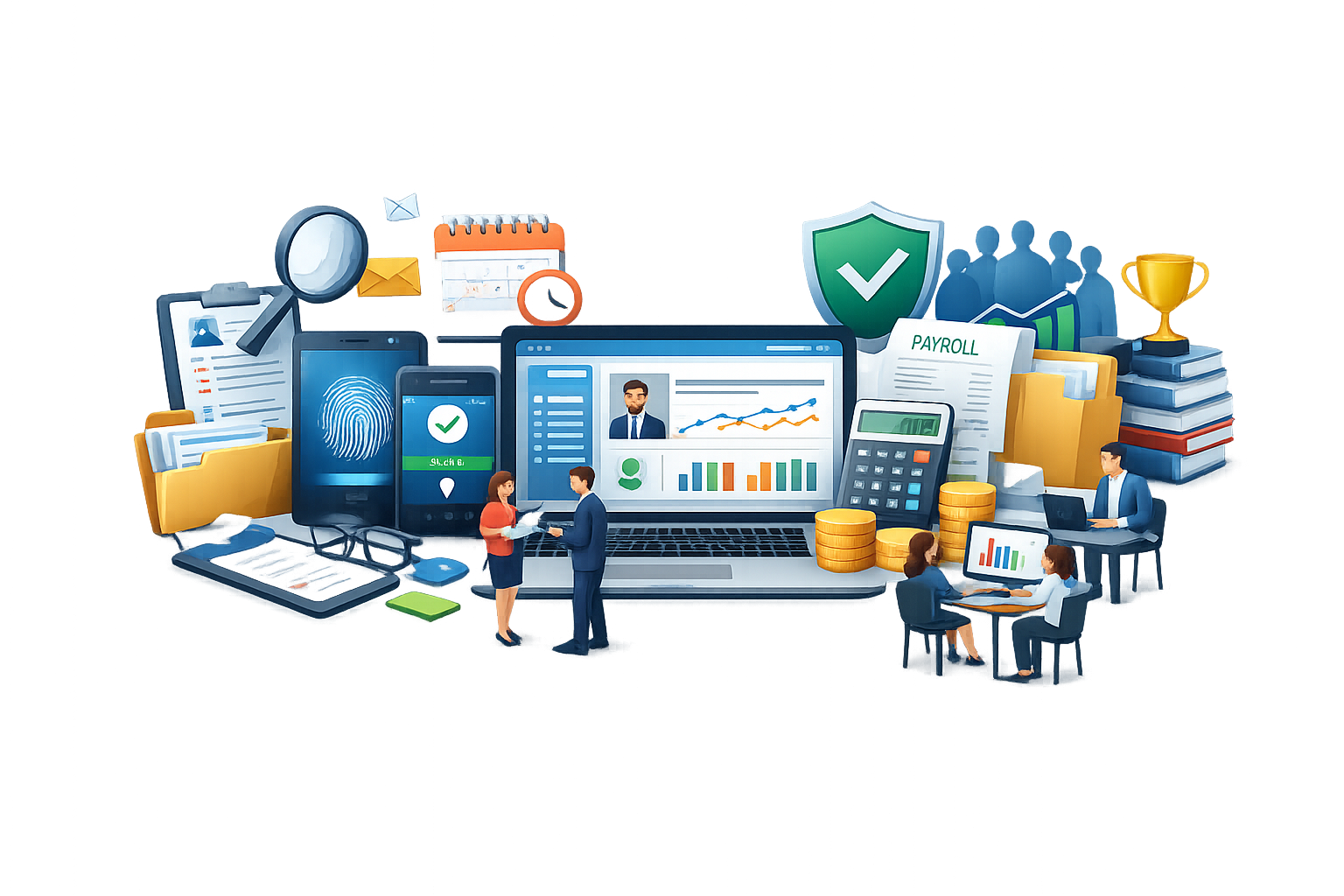
At its core, an HRM (Human Resource Management) System is a centralized software platform that manages the complete employee lifecycle. From the moment a candidate applies for a position to the day an employee exits the organization, every process, document and interaction is captured, managed and tracked within the system.
This means HR teams no longer need to maintain separate tools for recruitment, attendance, payroll, performance and compliance. Everything lives in one place, accessible to the right people at the right time.
But a good HRM system is not just a digital filing cabinet. It is a decision-making tool. It gives business leaders real-time visibility into workforce data who is performing, where attrition is rising, which departments are overstaffed and where productivity is slipping.
Before understanding the value of an HRM system, it helps to look honestly at what happens without one.
Payroll mistakes become routine. When salaries are calculated manually, errors creep in. Wrong deductions, missed overtime, incorrect tax calculations these are not rare occurrences. They are weekly headaches that erode employee trust and invite regulatory scrutiny.
Compliance becomes a gamble. Labour laws are not static. They evolve constantly. Businesses that rely on manual tracking struggle to keep up with provident fund rules, ESI regulations, gratuity calculations and state-level professional tax requirements. One missed update can result in penalties that far exceed the cost of any HR software.
Attendance and leave tracking turns chaotic. Without automation, HR teams spend hours every month reconciling attendance sheets, verifying leave applications and calculating paid days. Errors in this process directly affect payroll and employee morale.
Onboarding becomes inconsistent. When a new employee joins, the first few weeks define their long-term engagement with the company. Without a structured onboarding process backed by a system, new hires are often left confused, under-equipped and disconnected from the organization’s culture.
Data is scattered and inaccessible. Employee files in different folders, appraisal records in email threads, training certificates in desk drawers when data is not centralized, decision-making suffers. Leadership cannot see a clear picture of the workforce and HR cannot respond quickly when it matters most.
Every employee’s professional and personal information qualifications, employment history, bank details, documents, emergency contacts stored in one secure, searchable location. No more digging through folders or asking employees to resubmit the same documents every year.
The employee self-service portal, which is a standard feature in quality HRM systems, takes this further. Employees can update their own information, download payslips, check leave balances and raise HR requests on their own. This dramatically reduces the volume of routine queries that HR teams handle daily.
Modern HRM systems support multiple attendance input methods biometric integration, mobile app check-ins, geo-tagged attendance for field staff and web-based logins for remote employees. Shift scheduling, overtime tracking and holiday calendar management are all handled within the same platform.
Leave management is equally streamlined. Employees apply online, managers approve or reject with one click and the system automatically updates attendance records and payroll inputs. There is no room for miscommunication or manual error.
Payroll is where most HR errors surface and where the consequences are most severe. A strong HRM system automates the entire payroll process salary calculations, allowances, deductions for PF, ESI, TDS and professional tax and payslip generation all done accurately and on schedule.
More importantly, the system stays updated with statutory compliance requirements so businesses are never caught off-guard during audits or inspections.
From posting job openings and tracking applicants to scheduling interviews and generating offer letters, an HRM system brings order to the recruitment process. Once a candidate is selected, the onboarding workflow kicks in automatically document collection, IT access requests, policy acknowledgments and induction scheduling are all managed within the platform.
A structured onboarding experience is not just convenient. Research consistently shows that employees who go through a formal onboarding process are significantly more likely to stay with the organization beyond the first year.
Annual appraisals are slowly being replaced by continuous feedback systems. Modern HRM platforms support goal setting, quarterly reviews, 360-degree feedback and performance-linked increment calculations. Managers have visibility into team performance without waiting for year-end reports and employees understand exactly how their work is being evaluated.
Businesses that invest in employee development retain talent better. An HRM system tracks training programs, certifications, skill gaps and learning progress. It also helps HR teams plan future training needs based on performance data and role requirements.
Perhaps the most underrated feature of a good HRM system is its reporting capability. Workforce analytics give leadership insights into headcount trends, attrition patterns, department-wise productivity, payroll cost analysis and compliance status all presented in dashboards that make it easy to act on the data rather than just look at it.
An HRM system does not just benefit the HR department. Its impact extends across the entire organization.
For HR Teams — Less time spent on administrative tasks means more time focused on strategic initiatives like talent development, culture building, and workforce planning. HR professionals can do the work they were trained for instead of managing paperwork.
For Employees — Transparency in leave balances, payslips and performance expectations creates a sense of fairness and clarity. Employees who understand how decisions are made and can access their own information feel more respected and engaged.
For Managers — Real-time visibility into team attendance, performance and workload helps managers allocate resources better, identify problems early, and support their teams more effectively.
For Business Owners and Leadership — Accurate workforce data means better decisions. Whether it is planning a new hiring round, evaluating department costs or assessing the return on a training investment, leadership can act with confidence rather than assumption.
There is a common misconception that HRM systems are only for large corporations with hundreds of employees. This is simply not true.
In fact, small and mid-sized businesses often stand to gain the most from HR automation. When a company has a lean HR team managing a growing workforce, every hour saved through automation has a multiplied impact. A startup with fifty employees cannot afford payroll errors or compliance lapses any more than an enterprise with five thousand.
The cost of implementing an HRM system is consistently lower than the cost of the problems it prevents payroll corrections, compliance fines, rehiring costs due to poor employee experience and the productivity lost when HR teams are buried in manual work.
Not every HRM system is the right fit for every business. Before making a decision, consider the following:
Scalability — Can the system grow with your business? A platform that works for fifty employees should also work when you reach five hundred.
Ease of Use — A system that your HR team and employees find difficult to navigate will not be adopted effectively. Look for an intuitive interface that requires minimal training.
Integration Capability — Your HRM system should work seamlessly with your existing tools accounting software, project management platforms and communication tools.
Customer Support — Implementation is just the beginning. Ongoing support, training resources and responsive customer service are critical for long-term success.
Customization — Every business has unique processes. Choose a system that can be configured to match your workflows rather than forcing you to change how you operate.
Data Security — Employee data is sensitive. Ensure the platform you choose follows strong data security protocols, including encryption, role-based access and regular backups.
Businesses that treat human resource management as a strategic function rather than just an administrative one consistently outperform those that do not. They hire better, retain longer, develop faster and adapt more effectively to change.
An HRM Management System is the infrastructure that makes this possible. It does not replace the human judgment and empathy that great HR professionals bring. It removes the manual burden so those professionals can focus on the work that actually requires their expertise.
When your HR team is no longer buried in attendance sheets and payroll calculations, they have the bandwidth to build programs that genuinely improve employee wellbeing, strengthen workplace culture, and support business growth.
That is the real value of an HRM system. Not just efficiency transformation.
The way businesses manage their people has a direct and measurable impact on growth, culture, and profitability. Outdated, manual HR processes are not just inconvenient they are a genuine risk to business health.
An HRM Management System gives businesses the tools to manage their workforce with accuracy, transparency and strategic intention. From payroll automation and compliance management to performance tracking and workforce analytics, the right system turns HR from a cost center into a growth engine.
If your business is ready to move beyond spreadsheets and manual processes, the first step is finding an HRM solution that fits your needs, your team and your ambitions.
To explore a powerful, flexible, and business-ready HRM Management System, visit https://mlmengine.com/ and discover how the right technology can redefine the way you manage your most important asset your people.
Are you ready to streamline your HR operations and build a more productive, compliant, and engaged workforce?
Contact us now and let our team help you find the right HRM solution for your business.
Email: mlmenginesoftware@gmail.com
Phone/WhatsApp: +91 90220 51223
Do not wait for a payroll error or a compliance notice to push you into action. Take the smarter step today reach out, get a demo and see the difference a professional HRM Management System can make for your business.