INTRODUCTION
Ask any MLM business owner what eats up the most time in a typical week, and manual admin work is usually near the top of the list checking distributor records, recalculating commissions by hand, chasing down sales figures scattered across different files. It works fine when the network is small. It stops working the moment the business starts growing. That’s the problem an MLM Software Solution is meant to solve: pulling distributor records, commissions, sales, and reporting into one system instead of a dozen separate ones. MLM Engine is one example of a platform built around solving this exact problem for network marketing companies.
This piece covers what an MLM Software Solution does in practice, the operational pain points it removes, the features that actually matter, and how to think about picking one.
WHAT DOES AN MLM SOFTWARE SOLUTION ACTUALLY DO?
Strip away the marketing language, and an MLM Software Solution is really just infrastructure. It keeps distributor records, network structures, commission math, sales data, and reporting synchronized in one place, so nobody has to manually reconcile five different spreadsheets to answer a simple question like “how much does this distributor’s downline owe them this month.”
Distributors get their own dashboard their network, their earnings, their orders. Admins get a full operational view without having to assemble it themselves. The bigger shift here isn’t really about saving time, though that matters. It’s about accuracy. Commission mistakes and delayed payouts are one of the fastest ways to lose distributor trust, and that’s precisely the kind of error automated systems are built to prevent.
THE OPERATIONAL PROBLEMS THAT PUSH BUSINESSES TOWARD SOFTWARE
Most MLM companies hit the same wall eventually:
- Commission calculations done by hand, taking hours and prone to mistakes
- Distributor information spread across spreadsheets, email threads, and chat apps
- Network structures that get genuinely hard to visualize once they grow past a certain size
- Payment tracking with no single source of truth
- Sales data that’s always a step behind what’s actually happening
- Reports that take days to compile because the underlying data isn’t centralized
- Errors that compound as transaction volume increases
- Growth that requires adding staff just to keep up with admin work
None of these are dealbreakers at a small scale. They become serious operational drag once a business is managing hundreds or thousands of distributors.
THE FEATURES THAT ACTUALLY MATTER
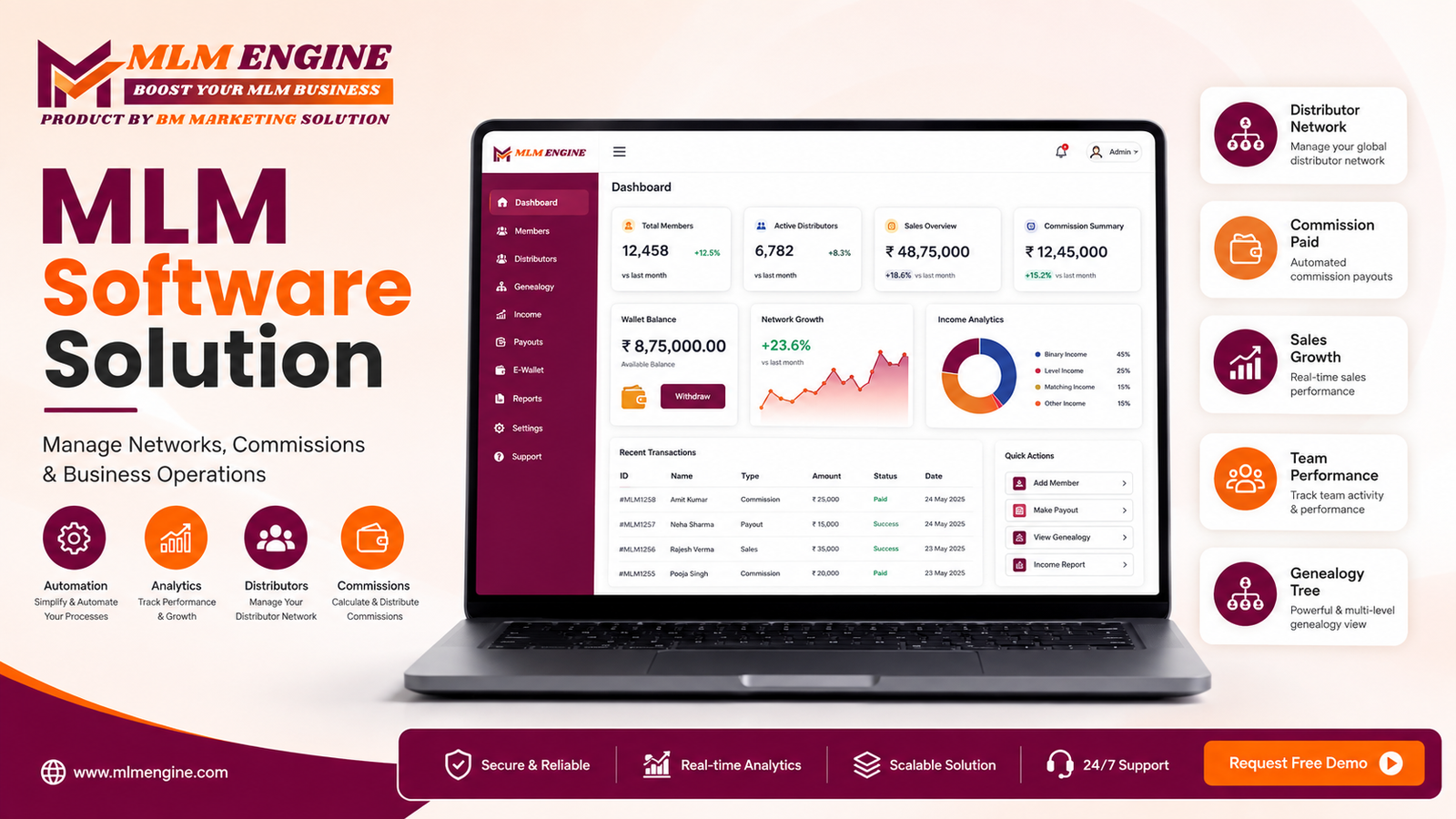
- Distributor Management: Registration, profile data, status tracking (active, inactive, suspended), and a clear view of each distributor’s activity. This is the foundation everything else sits on top of.
- Genealogy and Network Visualization: Once a downline gets past a certain size, trying to track it manually becomes impractical. Genealogy tools give admins and distributors a visual map of the network and how it’s structured.
- Commission Engine: Arguably the most important piece. A good commission engine calculates payouts automatically according to the business’s own rules, removing manual math and the errors that come with it.
- Compensation Plan Configuration: Binary, matrix, unilevel, generation every MLM business runs its plan a little differently. The software should be flexible enough to match the business, not the other way around.
- Sales and Order Tracking: A real-time view of what’s being sold, to whom, and when instead of piecing it together after the fact.
- Wallet and Payout Handling: Distributors need to see their own balances and request withdrawals without waiting on an admin. On the business side, payout management keeps disbursements organized.
- Admin Dashboard: One screen that shows what’s happening across the business new signups, sales trends, commission totals instead of pulling separate reports for each.
- Reporting and Analytics: Detailed breakdowns by sales, distributor, commission, and transaction. This is what turns raw activity into something a business can actually act on.
- Notifications: Automated alerts new registrations, commission payouts, order updates keep both admins and distributors in the loop without manual follow-up.
- Security and Role-Based Access: Given that the platform handles financial and personal data for potentially thousands of people, permissions, authentication, and data protection aren’t optional extras.
WHAT CHANGES WHEN A BUSINESS ADOPTS ONE
- Admin workload drops noticeably
- Commission accuracy improves
- Payouts happen faster
- Distributors get a more transparent, self-service experience
- Data lives in one place instead of several
- Sales and network activity are visible in real time
- Reporting becomes something you can actually rely on
- Scaling the network doesn’t require scaling the admin team at the same rate
- Decisions get made with better information
Worth being upfront about: software improves how a business operates. It doesn’t guarantee income or growth on its own that still comes down to strategy and execution.
HOW IT SUPPORTS GROWTH SPECIFICALLY
As a network expands, so does the operational load more registrations, more transactions, more support requests, more commission runs. Software is what lets that load grow without a matching increase in manual effort.
Practically, that looks like:
- Absorbing higher transaction volume without extra manual work
- Automating the repetitive stuff so the team can focus on strategy
- Giving leadership actual visibility into what’s working
- Speeding up routine operations across the board
- Keeping distributors engaged through self-service tools
- Providing the data needed to make informed calls on where to invest
Again infrastructure, not a guarantee. It builds the foundation; the business still has to execute on top of it.
WHERE MLM ENGINE FITS IN
MLM Engine is built to bring these pieces distributors, network structure, commissions, sales, wallets, reporting, admin operations into one connected system rather than a set of disconnected tools. For a business that’s outgrowing spreadsheets, that means less time reconciling data and more time on distributor support and actual strategy.
Because MLM Engine is built around configurable compensation rules, it’s designed to adapt to a business’s existing plan rather than forcing the plan to fit the software. The underlying goal is simple: give MLM businesses a dependable operational backbone so the admin side doesn’t become the bottleneck to growth.
HOW TO ACTUALLY EVALUATE ONE
A few things worth checking before committing to a platform:
- Which compensation plans it supports out of the box
- How much you can customize business rules without needing developer support
- Whether it’s actually built to scale or just handles small volumes well
- The strength of its security and data protection
- How usable the dashboard is for both admins and distributors
- How flexible the commission engine is when your plan changes
- The depth of its reporting
- What payment methods it integrates with
- Whether it works well on mobile, since most distributors will check it from their phones
- API access for connecting other tools you already use
- The responsiveness of technical support
- Pricing structure and what’s actually included
- Whether there’s a clear path to upgrade as your needs change
MANUAL MANAGEMENT VERSUS SOFTWARE, HONESTLY
Here’s the practical difference once you compare the two directly:
- Distributor records: manually updated versus automatically centralized
- Commissions: hand-calculated versus system-generated
- Network visibility: hard to track past a certain size versus mapped automatically
- Reporting: slow and manually compiled versus fast and automated
- Data: scattered versus centralized
- Scaling: limited by how much manual work the team can absorb versus built to scale
- Errors: higher risk with manual entry versus significantly reduced with automation
Manual management can genuinely work for a very small, early-stage business. It tends to stop working well before most owners expect it to.
WHERE THIS IS HEADED
The general direction across MLM businesses is toward cloud-based platforms, mobile-first dashboards, and real-time analytics as the default rather than the exception. Digital payment integrations are becoming standard, and API connections are making it easier to link MLM software with the other tools a business already relies on.
There’s also a growing emphasis on data-driven decision-making, with AI-assisted features starting to show up in reporting and distributor insights. The overall trend is toward systems that are more connected and more transparent which tends to benefit both the business and the distributors on it.
CONCLUSION
Manual processes can carry a small MLM business for a while, but that only lasts so long. An MLM Software Solution brings distributor management, commissions, sales tracking, and reporting into one connected system, cutting down on manual work and giving the business a much clearer view of what’s actually happening day to day. MLM Engine is built around exactly this helping MLM businesses run more efficiently without requiring them to change how their compensation plan already works. Software supports operations; it doesn’t guarantee income or success on its own. But for a network that’s actually growing, it can make a real difference in how smoothly things run.
To talk through your MLM software requirements:
Email: mlmenginesoftware@gmail.com
Phone: +91 90220 51223
Website: mlmengine.com
WhatsApp Channel: https://whatsapp.com/channel/0029Vaj8FP577qVKIi7ooC1